Newcastle-under-Lyme Workhouse

George Gilbert Scott (1811-1878) was an English architect. He began his career designing workhouses. Between 1835 and 1845, George and his partner, William Moffatt, designed over 40 workhouses including the one at Newcastle-under-Lyme.

One of Victorian England’s leading architects, George Gilbert Scott, designed Newcastle-under-Lyme’s workhouse.

Born at Gawcott in Buckinghamshire on July 13th, 1811, George was the third son of the Rev. Thomas Scott and his wife, Euphemia.

Educated at home by his father, George became an architect. He went into partnership with William Bonython Moffatt. The firm specialised in building workhouses, and George designed Newcastle-under-Lyme workhouse. which accommodated 300 inmates.

The workhouse opened in 1840. An Elizabethan-style building in Keele Road, it cost £6,000. The workhouse was enlarged a few years later when an infirmary, workshops and a laundry were erected. Casual wards for vagrants were constructed in 1878.

During the 1880s, a hospital was built on land behind the workhouse.
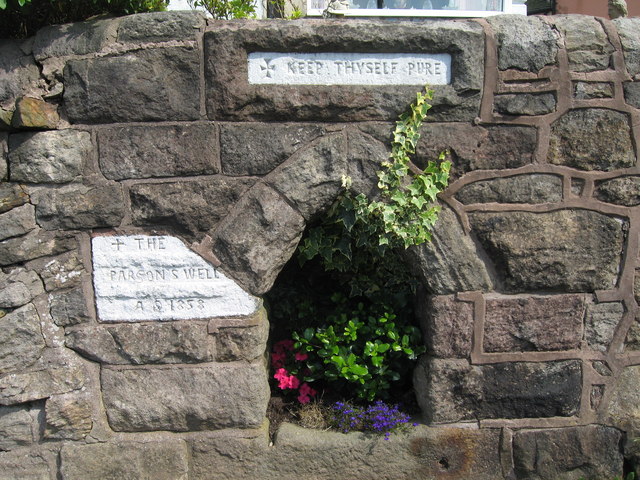
The Parson’s Well

A spring at Mow Cop

The Parson’s Well, near the Methodist Church at Mow Cop, was one of the springs on Mow Hill that were given a stone surround in the 19th century. After erecting stone surrounds around the springs, local people started calling them wells. The two inscriptions on The Parson’s Well read, “The Parson’s Well A S 1858” and “Keep Thyself Pure”.

Photograph: © Copyright Sue Adair and licensed for reuse under creativecommons.org/licenses/by-sa/2.0

New life for an old building

Ambitious plans for the Queen’s Theatre

Ambitious plans have been made to save “Burslem’s new town hall”, a listed heritage building that houses the Queen’s Theatre and the Prince’s Hall.

The proposals made in a report prepared for Stoke-on-Trent City Council by architectural consultants Affinity Design and Management would cost over 12 million pounds to implement.

The theatre and the hall were abandoned many years ago, and it will cost about £320,000 to make the building safe.

If the council accepts them, the proposals could make the theatre a conference centre, an exhibition hall or a venue for Asian weddings and the foyer could become a bar or restaurant.

The Prince’s Hall would be turned into retail shops or become one or two-bedroom flats with a shared roof garden.

Mow Cop Castle

Do You Know Who Painted This Picture?

While researching Mow Cop’s heritage, we came across this old print of Mow Cop Castle, indicating there may be more truth than we realise in the many legends surrounding its building history.

We think the print is one of a series of local views painted by an artist whose nom de plume was Jotter. North Staffordshire Heritage is trying to trace the publisher, Picturesque Staffordshire. Please get in touch if you can tell us more about the castle or help identify Jotter.

Our email address is northstaffordshireheritage@outlook.com

Since our post was written, we have been told that the view of Mow Cop, which is on a postcard, was painted by Walter William Young (1868-1920). Can anyone give us more information about him?

Can You Help Sandra?

How Did Pickle Onion Entry Get Its Name?

Sandra, who grew up in Tunstall during the 1970s, remembers Pickle Onion Entry. The entry ran on the north side of a pottery factory in Scotia Road to Wardle Street, a cul-de-sac leading to The Boulevard.

Sandra can’t remember the factory’s name. She recalls that Barbers Palace backed onto the north side of the entry which was long and straight with high walls on either side. If you can remember the entry or know how it got its name, please get in touch and share your memories.

Our email address is northstaffordshireheritage@outlook.com

The name Pickle Onion Entry must be unique.

Like Sandra, we should like to know how the entry got its name and look forward to receiving your emails.

Note: Sandra contacted us a year ago. Although people can remember the entry no one has been able to tell us how it got its name. Can you solve the mystery?