David’s School Days in Tunstall

The two people from different backgrounds who had the greatest influence on my life were Miss Wood, the headmistress, and Mr Williams, the caretaker.
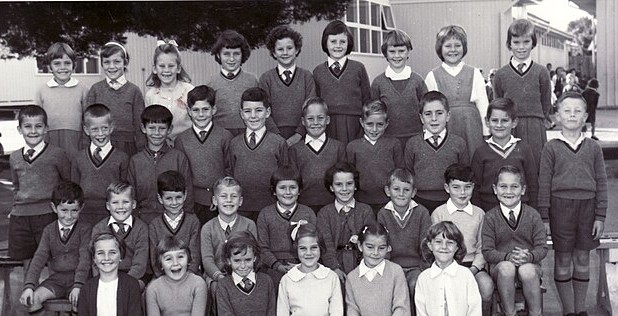
David Martin, North Staffordshire Heritage’s chief executive, remembers his school days in Tunstall, Stoke-on-Trent.

During the 1950s, I went to Central County Mixed School in Tunstall.

Mr Williams was the caretaker, and Miss Wood was the headteacher.

The school’s cellars, where Mr Williams had a table and chair, fascinated me. They were dark and dismal, with cobwebs hanging from the ceilings. I visited the cellars most dinner times. While I was sitting on a pile of coke drinking Tizer and eating potato crisps, Mr Williams told me about Medieval Tunstall and its courthouse in the market square. He vividly described the markets and fairs held there when the court was sitting.

Mr Williams showed me two large rooms, each housing a small Robin Hood boiler. He said these rooms had been the condemned cells beneath the courthouse, where men and women were held before being hanged in the square on market days. I sat enthralled as he told me about the cases heard by the court, and I decided to become a barrister.

My visits to the cellar ended when Miss Wood saw me walking across the playground covered in soot.

Despite giving the impression that she was a strict disciplinarian, Miss Wood was a person who loved and cared for children.

To keep me out of mischief, Miss Wood persuaded me to help her in the library after dinner. She shared her passion for history and classical literature with me. One afternoon, she took me to a second-hand book stall in Tunstall Market. I liked the stall and visited it on Saturday mornings to buy two or three books. The stall’s owner always gave me a discount, and I quickly acquired a collection of children’s classics and history books.

Miss Wood was an inspiring teacher whose passion for literature fired my imagination. Under her watchful eye, historical figures and characters from novels jumped off the pages and came to life in my mind’s eye. Her passion was infectious. I began to share her love of Shakespeare, Milton, Dickens and Hardy. My visits to the cellars were soon forgotten. I was now walking with Heathcliff on the moors surrounding Wuthering Heights, jousting with King Arthur and the knights of the Round Table, travelling around the world with Phileas Fogg and sailing to Treasure Island with Jim Hawkins and Long John Silver.

Most of my free time at home was spent reading. I lost interest in sports and rarely watched television. Looking back, it seems strange that two people from different backgrounds, whom I met at school, had such a significant influence on my life.
Heritage NewsDesk: Get Involved and Hold Your Own Heritage Open Day

The 2026 Heritage Open Days will take place from 11 to 20 September. Heritage Open Days is England’s largest community-led festival of history and culture, involving thousands of local volunteers and organisations. Every year in September it brings people together to celebrate their heritage, community, and history. Stories are told, traditions explored, and histories brought to life. All the events are free.

269 industrial heritage sites in England took part in Heritage Open Days (HoD) 2025, offering guided walks, talks, and exhibitions as well as hands on experiences. If you would like to take part then the HoD website has full details on how to list a site, event, and/or acitvity.

For further details on how to take part as an event and/or site organiser follow this link: Get involved

Our Easter Holiday

North Staffordshire Heritage’s Easter Holiday begins today. Our office will be closed until Monday, 20 April. We hope you all have a relaxing and enjoyable Easter. Take care. We look forward to seeing you again on the 20th.

Lee Wanger’s Favourite Teacher

Miss Featherstone Was Lee’s Favourite Teacher

From London to Tunstall

My sister, Sylvia, and I moved to Tunstall when my parents left London in the mid-1950s. We moved from Bow, in the East End, where my father’s family lived. Shortly after the war, there was a housing shortage in London, and my parents were forced to live in a terraced house with my grandparents. My mother, who came from Tunstall, heard of a house for sale on Rathbone Street. My parents bought the property, and we moved to Tunstall.

St Mary’s Infants’ School

I was about five years old. My sister, Sylvia was three. We attended St Mary’s Infants’ School on Lascelles Street, which is the first school I can clearly remember. On our first day at St Mary’s, we stood in the playground holding each other’s hands. Sylvia and I were overwhelmed by what seemed to us to be a vast, unfamiliar building. Our strong Cockney accents made us stand out from the other children. They kept staring at us, and we became frightened.

Miss Featherstone

Our fears were quickly allayed by Miss Featherstone, the headmistress. Her warm, reassuring manner quickly put us at ease. Despite her stern appearance and black dress, Miss Featherstone was a remarkably kind and dedicated teacher. She seemed to run the school single-handed and always showed genuine care for every child there. I don’t think she married and had children, but she treated all her pupils as if they were her own children

Many years later, I passed Miss Featherstone on the High Street. She greeted me simply by name as she walked by. I was surprised that she remembered me. It was just a moment in time. A moment that made a lasting impression on me and spoke volumes about her remarkable memory.

An Afternoon Nap

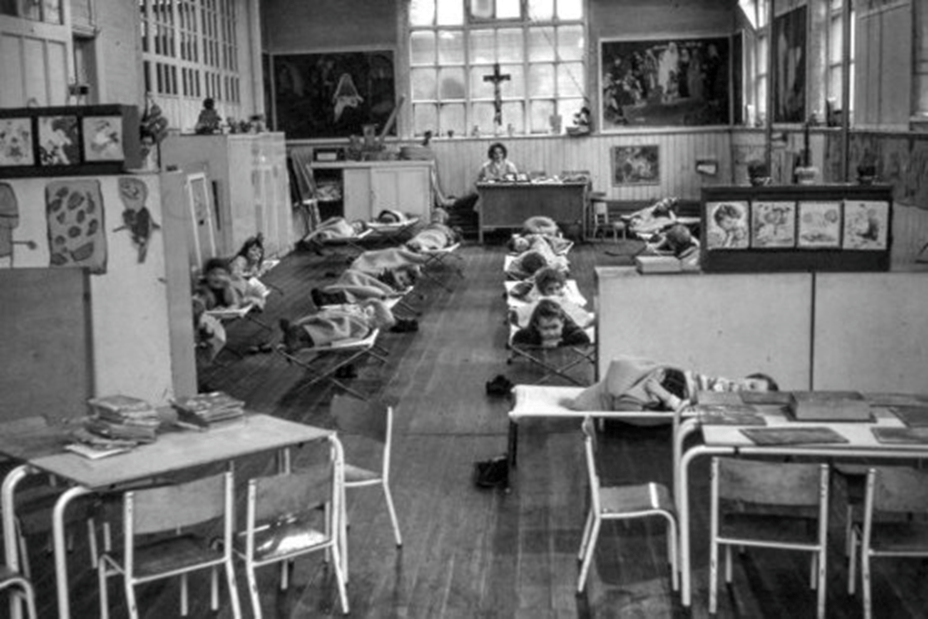
Another vivid memory of my first day at St Mary’s is that in the afternoon, the school hall was filled with small beds where we were expected to take an afternoon nap when play time ended. I found the idea of going to bed puzzling and unnecessary. I often wonder whether this was common practice in infant schools at the time.

Tell Us About Your School Days

We all remember that one teacher who made a lasting difference – the one who inspired us, encouraged us or simply made school a little brighter. Maybe they sparked your love of a subject, believed in you when you doubted yourself, or had a way of making lessons fun. We would love to hear your stories. Your memories can help celebrate the teachers who shaped our lives and remind us of the influence great teachers have on their students.

If, like us, you enjoyed reading Lee’s account of his first day at St Mary’s Infants’ School and his memories of Miss Featherstone, please visit https://northstaffordshireheritage.co.uk/2026/02/03/share-your-story-who-was-your-favourite-teacher/ and tell us about your favourite teacher.

Can You Help Us Trace Images of St John’s, Goldenhill?

Researching the History of St John’s Church, Goldenhill

North Staffordshire Heritage is researching the history of St John the Evangelist on High Street, Goldenhill, for a book about the life of Sir Smith Child.

North door to St Johns a disused church at Goldenhill, near Tunstall, Stoke-on-Trent

The north entrance to St John’s Church, High Street, Goldenhill, near Tunstall, Stoke-on-Trent.

Smith Child’s Philanthropy and the Founding of the Church

During the nineteenth century, Smith was North Staffordshire’s most generous philanthropist. In 1840, he became chairman of the Fundraising Committee set up to build a church at Goldenhill. He gave £200 towards the building’s cost and established a £1,000 endowment to pay the resident minister’s salary. The committee’s efforts were remarkably successful. It raised the money to build the church in just four months.

The church’s foundation stone was laid by Smith’s wife, Sarah, on 3 August 1840. One year later, the church was consecrated by the Bishop of Lichfield.

The Church of England closed St John’s over a decade ago.

An Appeal for Photographs and Memories

North Staffordshire Heritage is seeking photographs of the church, both interior and exterior, before its closure.

If you have any photographs of the church and are willing to allow them to be copied, or if you wish to share your memories of worshipping at St John’s, please get in touch with northstaffordshireheritage@outlook.com

Wiscasset the town where Sir Smith Child’s mother was born

Wiscasset, in Maine, is the town where Sir Smith Child’s mother, Elizabeth Parsons, was born in 1780. Her parents were Timothy Parsons and his wife, Elizabeth (nee Sylvester). She married John George Child, the son of Admiral Smith Child, in Wiscasset, on 15th May 1806. The couple moved to England and made their home at Newfield Hall, Tunstall. Their only son, Smith, who became Sir Smith Child, was born there in 1808.

Sir Smith Child: A False Trail

Research in North Staffordshire led us to believe that Smith’s parents, John George Child and Elizabeth Child (nee Parsons), were married in 1806 at St. Margaret’s Church, Wolstanton.

Recent research into Elizabeth’s life shows that the couple were married in the United States of America.

Elizabeth was born in Wiscasset, Lincoln County, Maine, in 1780.

American records* show that John and Elizabeth were married in Wiscasset, where John was living at the time, by the Rev Hezekiah Packard on 15 May 1806.

*Wiscasset Town Records

Heritage NewsDesk: Listed Status for Threatened Museum

In announcing the listing, Historic England noted that “We recommended listing the buildings at Grade II due to their historic and architectural interest. Leather working is strongly associated with Walsall, and the town is still a major centre for the industry. The workshops on Wisemore are among a very small group of such buildings of this date surviving in Walsall, and so are of particular significance for the town as they embody the industry that played a major part in the lives of many local people.”

In response to the listing, Walsall Council’s leader Mike Bird was quoted in the local press as saying: ‘It might be heritage to them but at the end of the day it’s an old factory, simple as that.’

DO YOU AGREE WITH COUNCILLOR BIRD?

We don’t. A town that destroys its heritage is a town without a future. Think again, Mr Bird. Your response is pathetic.

Heritage NewsDesk: Tell SPAB About Your Historic Windmill or Water Mill

Sir Smith Child: Calver House Tunstall’s First Workingmen’s Club

In 1876, Calver House and its grounds in Roundwell Street, Tunstall, were converted into a non-political and inter-denominational workingmen’s club.

The idea of using the house and its grounds to give Tunstall a workingmen’s club came from Sir Smith Child, who gave £100 towards the cost of conversion.

Inside the clubhouse, there were rooms for conversation, smoking, and playing games, including bagatelle, draughts, and chess. It contained reading rooms where members could read books and newspapers, a lecture theatre and a bar that sold alcoholic drinks.

The management committee intended to open a lending library, enabling members to borrow books and planned to create a recreation ground and build a gymnasium.

Membership of the club costs 2d per week, 6d a month or 1s 3d a quarter.

Smith opened the club on 14 July 1876. The opening ceremony was preceded by a parade led by the Tunstall Volunteer Band from the town hall along High Street to Calver House. During the ceremony, Smith said he was always happy to support any project that benefited Tunstall and its citizens. He believed the club could become the second home for many young working men who had only a bedroom in the house they lived in, that they could call their own.