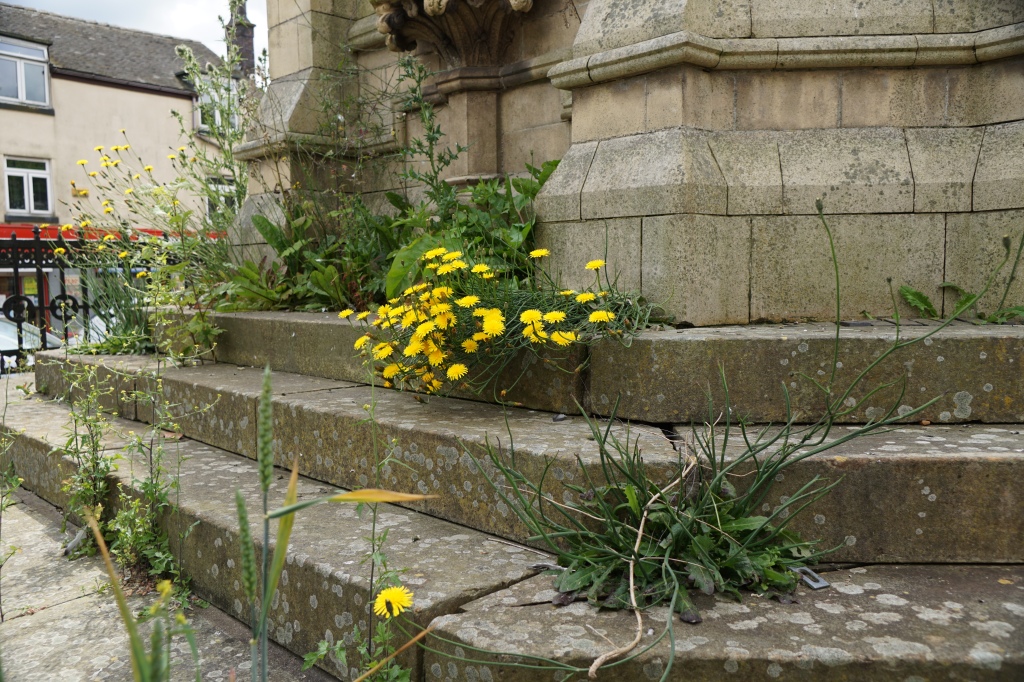
Weeds at the base of the Smith Child Clock Tower in Tower Square.
Our photograph shows weeds growing at the base of the Smith Child Clock Tower in Tower Square. The tower was erected in 1893 to honour Sir Smith Child, the town’s most generous 19th-century philanthropist.
Tell us about neglected buildings in Tunstall which need regenerating and help save them from demolition.
Our new series Tunstall’s Neglected Heritage looks at heritage buildings in Tunstall that face an uncertain future.
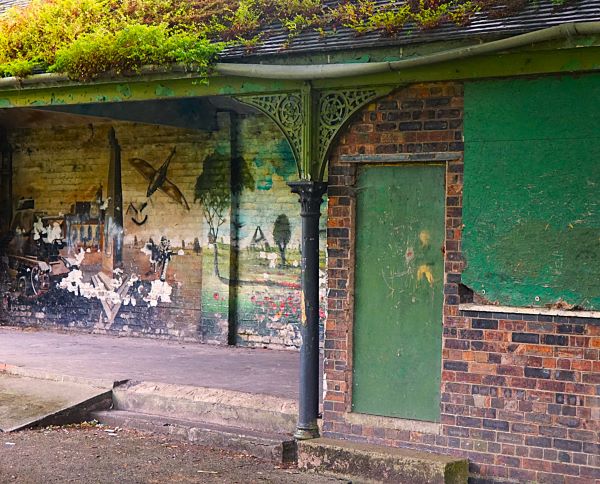
This photograph of the shelter in Tunstall’s War Memorial Gardens shows weeds growing on the roof, a gutter needing repair, a vandalised mural and a room whose door and window are boarded-up.
Tell us about other buildings in Tunstall that have been neglected by their owners and need regeneration or a facelift to save them from demolition.
After the First World War, former soldiers and sailors set up small bus companies and ran bus services from towns and villages on the North Staffordshire Coalfield to Tunstall.
A forty-horsepower Daimler Bus
In 1914, the Potteries Electric Traction Company started running bus services from Biddulph and Mow Cop to Tunstall, using forty-horsepower Daimler Buses.
During the First World War (1914-1918), the government requisitioned the buses and services were suspended. The buses were sent to France, where they were used to take troops to the front line. When the war ended, the buses were returned to the company, and the services resumed.
After the First World War, former soldiers and sailors formed bus companies. The companies ran services to Tunstall that competed with those run by the Potteries Motor Traction Company.
Rowbotham’s was a bus company with a garage in Sands Road, Harriseahead. The firm ran a service from The Bank, a hamlet in South Cheshire, to Tunstall. Its buses ran through Mount Pleasant, Dales Green, The Rookery, Whitehill, Newchapel Packmoor, Chell and Pitts Hill.
The Potteries Electric Traction Company operated another service from The Bank to Tunstall. Its route ran through Mount Pleasant, Dales Green, The Rookery, Whitehill, Kidsgrove, Goldenhill and Sandyford.
Stanier’s was a bus company based in Newchapel. It ran a service from Mow Cop to Tunstall via Harriseahead, Newchapel, Packmoor, Chell and Pitts Hill.
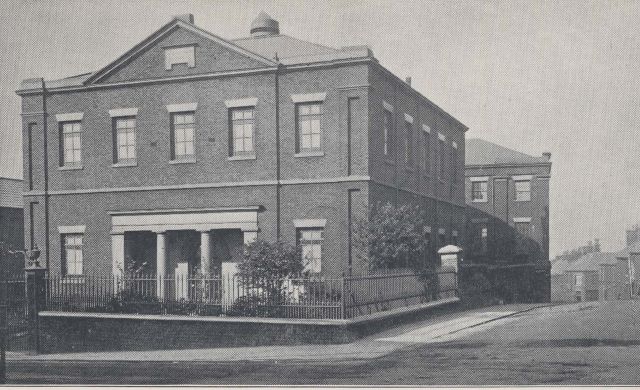
Tunstall’s Wesleyan Methodist Chapel in Wesley Place (now Wesley Street)
The Wesleyan Methodist Chapel in Wesley Place (now Wesley Street), Tunstall, replaced a chapel built near America Street in the 18th century.
Opened in 1835. the Chapel in Wesley Place was a large brick building with a portico supported by four stone pillars. It could accommodate over 1,000 worshipers and was lit by gas lamps.
In 1838 a Sunday School was erected on land behind the chapel. Five or six years later, a Wesleyan Day School opened in the building. The day school became a Board School in 189o. It closed four years later when Wolstanton School Board opened High Steet Schools.
Tunstall’s windmill stood in a field that became known as Millfield. The field overlooked Roundwell Street and America Street. A track that is now Pierce Street led from America Street to the mill.
The only houses near the mill were three one-storey working men’s cottages.
At one time, a man and his wife lived at the mill. There was a disused mine shaft full of water nearby. One evening the couple had an argument. The wife walked out and did not return. The next morning, her body was found in the mine shaft. She had committed suicide.
When the mill closed, Tunstall’s Drum and Fife band used it as a practice room.
Tunstall’s first Methodist Chapel was built in 1788 by the Wesleyan Methodists.
It cost £650 and was erected on sloping ground adjacent to ‘the old lane’ that later became America Street. Charles Lawton, a Newcastle builder, and his brother Samson, who came from Tunstall, built the chapel which was forty-five feet long by forty feet wide.
In a pamphlet, called ‘Introduction and Progress of Wesleyan Methodism in Tunstall’ published in 1842, Thomas Leese and Thomas Mores describe John Wesley’s visit to the town’s first Wesleyan Chapel in America Street.
“On March 29th, 1790, Mr Wesley preached in the new chapel at Tunstall, at nine o’clock in the morning, for the first and last time. He was then in his 87th year and died 11 months later, aged 88 years.
“His text on that occasion was ‘Let us go on to perfection.’ There was something very remarkable in his appearance that was calculated to impress the beholder with awe and veneration. Wesley seemed like a messenger from heaven. His pale heavenly countenance and penetrating eye, made him appear as if he was about to be ushered into the company of ‘angels, and the spirits of just men made perfect.’
“Wesley’s voice was weak and feeble, but his expression was clear and distinct. His hearing was remarkable, for although he knew, in general, all the hymns, there were times when he was at a loss for a starting word or two. On these occasions, Mr Joseph Bradford, who travelled with him, whispered the required word to him, which he would immediately catch, and proceed without it being observed by the generality of the congregation.
“He did not use glasses, and it would have been easy for him to have gone through the whole service without either a bible or hymn book.”



 North Staffordshire Heritage