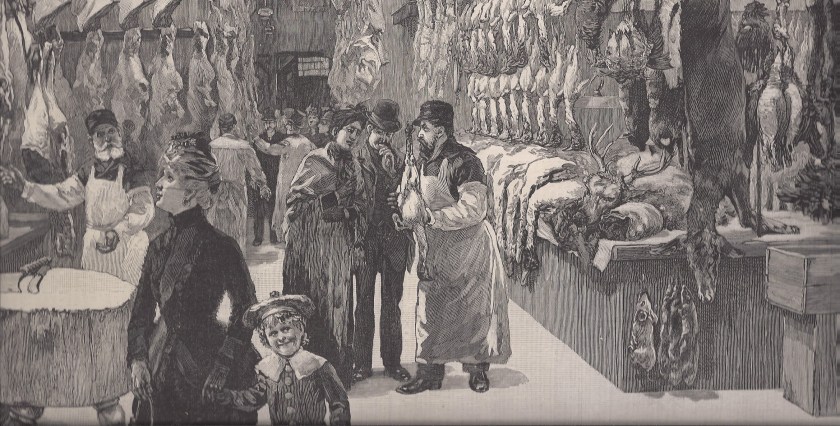
In his book, Old Times in the Potteries, published in 1906, William Scarratt describes the scene in Tunstall‘s Market Square. These scenes occur on Saturday nights during the 1850s.
Pottery workers worked a six-day week and were paid their wages at five o’clock on Saturday afternoon.
Saturday night was the busiest time in the market.
A score or two of butchers had stalls in the market square. Their tent-like stalls were lit by naphtha lamps. They were chopping up meat and haggling over prices with customers. These fat and smiling butchers seemed content. I do not think they liked covered markets. They were used to trading in the open air.
In the lower part of the square, in front of the town hall, were the hucksters and the poultry dealers. Stalls sold green groceries, fruit, and vegetables. A higgler from Cheshire was nicknamed ‘Cabbage’. His cry ‘Cabbage and cou’d (cold) lard’ was so loud that it was heard by customers at other stalls.
Between the higglers and the High Street were the fishmongers.
On Saturdays and Mondays, a quack doctor had a stall outside the Sneyd Arms. He sold patent medicines and displayed extracted teeth, charts and physic bottles on his stall. A real doctor who frequented the Sneyd Arms enjoyed teasing the quack. He sent notes to him asking difficult medical questions. These questions puzzled the quack, who couldn’t answer them.
Edited by The History Factory (2025)
 North Staffordshire Heritage