Regeneration experts in the Potteries are delighted that the Heritage at Risk Fund has given £1.5 million to help save Burslem’s Indoor Heritage Market and historic Bethesda Church in the City Centre.
The money will be used to repair the buildings.
If these buildings can be saved, they will make a significant contribution to the growth of North Staffordshire’s heritage tourist economy.
The Lancashire Mining Museum has been given over £360,000 to save its ‘unique’ winding house.
The Lancashire Mining Museum at Astley, Wigan, has been given about £200,000 by the National Lottery Heritage Fund.
The money will be used to safeguard the ‘unique’ winding house, which is a prominent feature in the area.
More money to save the building has been given by the Association for Industrial Archaeology, the Arts Council, Awards for All, the Pilgrim Trust and Wigan Council, making a total of over £360,000.
Opened in 1908, the colliery closed in 1970. A large number of written and photographic records have survived. The site includes a winding headgear, winding engine, colliery cottages and a miner’s canteen.
In the 1820s, married men living in Hanley who spent their time drinking in ale houses feared Molly Albin.
Molly, who lived in Tontine Street, was Hanley’s town crier. She used her job to publicly shame men who went drinking during working hours or neglected their families.
Men who frequented ale houses were terrified when they heard Molly ringing her bell and calling out their names. Large crowds gathered to listen to what she had to say about them.
She told the crowd everything she knew about a man she had named.
Molly pulled no punches when she described a man’s character. She listed all his defects. She told the crowd how much he earned each week and how much he spent on drinks. It heard how much money he gave his wife to buy food and clothing for herself and the children. All aspects of his life were made public. If a man had borrowed money that he hadn’t repaid, she gave details of the amount he owed.
Sometimes, a man whose lifestyle she was describing threatened her with violence. Molly was not afraid. It was unlikely that he would assault her. She was physically fit and capable of defending herself.
She knew that a man who attacked her would be arrested and brought before the Petty Sessions (Magistrates’ Court). The court sat in a room at the Swan Inn. It had the power to fine him, put him in the stocks or send him to prison. Men who attacked women were usually sentenced to two or three weeks’ imprisonment with hard labour.
Chatterley Whitfield is a former colliery facing an uncertain future. We believe it merits World Heritage Site Status. Can this historic site be saved? Using the Comments section below, tell us what you think should happen to Chatterley Whitfield.
During the week, we began learning how to use our new portable photocopier. This will allow us to visit people at home to copy their treasured photographs from bygone days.
A new series of posts tracing Tunstall’s history and architectural heritage will start in the autumn. The series is based on images in the film strip The Township of Tunstall, made by Highgate School in 1960. Posts in the series will trace the history of Tunstall from Anglo-Saxon times to the 21st century. These posts will introduce you to Tunstall’s heritage buildings. They will tell you about its unique Victorian Civic Centre, which includes the former Town Hall, Tower Square, Market Hall, the Jubilee Buildings, Tunstall Pool, the Drill Hall and the Memorial Gardens.
Have a relaxing and enjoyable weekend. Take care, and we’ll see you again on Monday.
How many buildings and places featured in this video can you remember? If you lived in Kidsgrove, please share your memories with us in the Comments section below. Let us know about your family and friends, the schools you went to, the games you played and your hobbies. Tell us about your first job and your working life.
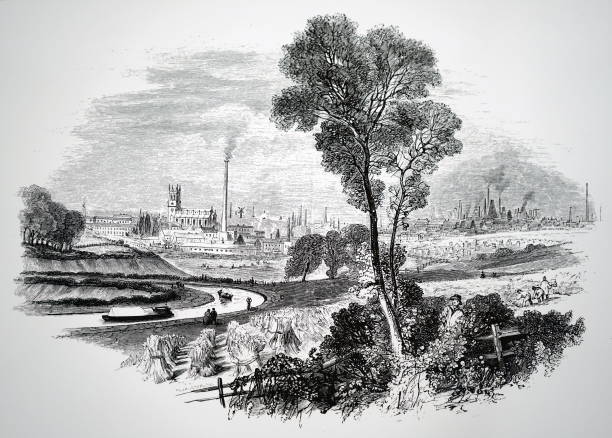
This engraving of the Fowlea Brook Valley looking towards Burslem was made in the 1860s. Note the sheaves of corn and the Trent & Mersey Canal in the foreground. In the background, you can see Burslem and St. Paul’s Church, Dalehall, where John Ward, who published The Borough of Stoke-upon-Trent in 1843, was churchwarden.
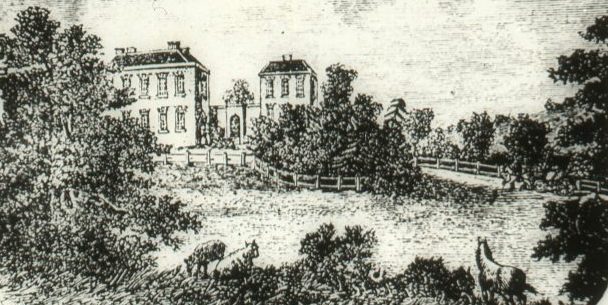
Smithfield Hall, which is shown above, was built in 1791 by Burslem pottery manufacturer, Theophilus Smith. In 1793, he built an industrial hamlet called Smithfield near the hall. Theophilus was declared bankrupt in 1800. He attempted to murder John Wainwright and was remanded to Stafford prison to await trial. When his wife and daughter visited him there, he murdered them and committed suicide. In 1801, the hall was bought by Jesse Breeze, who renamed it Greenfield Hall.
A Description of the Country From Thirty to Forty Miles Round Manchester, is a book published in 1795, compiled by Dr John Aikin. It describes Newcastle-under-Lyme and North Staffordshire’s pottery towns and villages as they were in the 1790s.
This edited extract from the book tells us what Newfield and Smithfield, two hamlets in the Township of Tunstall, were like in the 1790s.Newfield
Newfield is well situated for manufacturing purposes because there is plenty of coal nearby.
The hamlet belongs to Admiral Smith Child. He has a handsome estate there and lives at Newfield Hall. Smith Child owns Newfield Pottery. He is unlikely to allow more factories to be built in the hamlet in the foreseeable future.
Smithfield is the best place in the Potteries to manufacture earthenware. There are several strata of coal and clay, which are needed to make pottery. Smithfield belongs to Theophilus Smith. He owns a pottery and coal mines there. It is unlikely that there will be further industrial development in the hamlet.
The Poor Law Acts were passed in 1597 and 1601 towards the end of the reign of Elizabeth I. These laws required every parish to care for its own poor. Poor relief for each parish was the responsibility of the Overseers of the Poor. They who were elected every year and were answerable to the Justices of the Peace at Quarter Sessions. The Overseers of the Poor were unpaid officers who were often local farmers and craftsmen. The overseers had the right to raise money from local rates or ‘assessments’, to relieve the poor. They had to balance the requests from the poor with pressure from the ratepayers to keep costs down.


 North Staffordshire Heritage