The government’s refusal to list historic buildings that Historic England has recommended for listing worries the Victorian Society.
Ignoring Historic England’s advice can erode trust in the listing process and put heritage buildings at risk.
Historic England recommended listing the part of Medlock Mill in Manchester, which was built in the 1790s or early 1800s. The government refused to list them.
There have been other instances where the government has decided to reject Historic England’s recommendations.
The Victorian Society and similar groups want to see greater public accountability in the way the government makes its decisions.
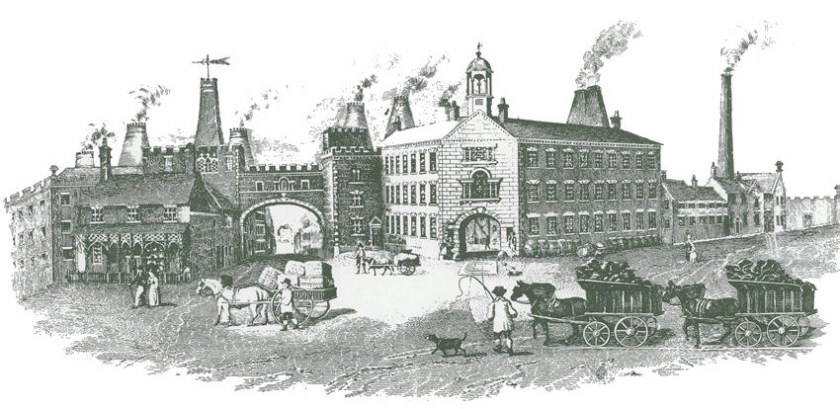
This image shows Wood & Caldwell’s Fountain Place Works in Burslem. In the 1790s the company made Staffordshire figures, earthenware and stoneware. Enoch Wood and James Caldwell were partners in the firm.The firm owned Bycars Colliery, where it mined coal to fire the factory’s bottle ovens and kilns.
A Description of the Country From Thirty to Forty Miles Round Manchester, a book published in 1795, was compiled by Dr John Aikin. The book tells us about Newcastle-under-Lyme and North Staffordshire’s pottery towns and villages in the 179os
This edited extract from the book describes Burslem and Cobridge as they were in the 1790s.
Burslem
Burslemis the home of North Staffordshire’s pottery industry. Earthenware has been made there for many centuries. Dr Plot, in his History of Staffordshire, written in 1686, said that the factories making pottery in Burslem were the largest in the district…
The town has two weekly markets. A large market is held on Monday, and a smaller one is held on Saturday. Four or five years ago, cattle markets were established. These markets are well attended by cattle dealers and butchers.
Burslem is a parish in its own right. The parish church, St John’s, has a good organ. The church has recently been enlarged and regenerated.
There are a large number of [Wesleyan] Methodists in the district. The Methodists have built a large chapel in Burslem and erected chapels in several pottery towns and villages. There are many other religious sects in the Potteries. Few areas have such a great diversity of sincerely held religious opinions.
Cobridge
Cobridgeis an industrial village where earthenware is made. It is partly in Burslem Parish and partly in Stoke Parish.
Not far from Leek, the Cheddleton Asylum, later called St Edward’s Hospital, was the third County Asylum to be built in Staffordshire. This vast institution, initially designed to accommodate 618 patients in 16 wards, was intended to relieve chronic overcrowding at the Stafford and Burntwood Asylums. The site at Bank Farm, Cheddleton, near Leek, was decided upon in preference to the original proposal of land at Bramshall Park Farm, Uttoxeter, because it was on elevated land; a criteria considered essential to provide a healthy environment for the patients.
Come to the Potteries Museum and Art Gallery on Saturday, 4 October to celebrate Black History Month.
The event is a creative cultural day that celebrates the art, music and food of people of African or Caribbean descent.
This year, Black History Month’s theme is ‘Standing Firm in Power and Pride’, a tribute to the resilience, strength, and unwavering commitment to progress that define the Black community.
During the day, there will be a wide range of events including craft workshops, dancing, music and singing, Ghanaian acrobatics, stalls and many more things to enjoy.
The celebration starts at 11 am and ends at 5 pm. Admission is free.
My journey spans the transformative years between 1980 and 2007, documenting the vibrant nightlife, iconic local landmarks, businesses and the palpable atmosphere that once defined my hometown. A town full of so much hope for a future that never came.
In the 80s and 90s, Hanley’s nightlife was the heartbeat of the towns night-time economy. Iconic clubs like The Place, Chicos, Satchmos and Golden at the Academy, the latter attracting busloads from the West-Midlands and Manchester, hosted world famous DJs, featured on MTV and in numerous sub-culture magazines of the day.
Moorcroft Pottery in Cobridge, which closed in April, has reopened. Will Moorcroft, who bought the firm and saved it from liquidation, has restarted production. Will, whose grandfather William Moorcroft founded the company, said he was “quite emotional” when the factory started making ware again.
This video takes you on a nostalgic journey down Memory Lane to Longton in the 1960s. You will be taken back to a time of tight-knit communities, bustling high streets and industrial activity in a pottery town in Stoke-on-Trent.
During your trip down Memory Lane you will see a stunning collection of rare photographs that bring Longton’s past to life.
When you have seen the video, please use our Comments Section below to share your memories of Longton with us. Tell us about the schools you attended and your first job. Let us know what you did in your spare time and tell us about your interests and hobbies.
The Ironbridge Gorge showcases the advancements made in iron production during the Industrial Revolution. It is a testament to technological innovation and reflects the social changes that began in the 18th century. In the gorge, there are industrial archaeological features. including mines, foundries, and workshops. They tell the story of an industrial valley.
Having viewed this video, North Staffordshire Heritage is asking why North Staffordshire’s Industrial Landscape is not a World Heritage Site.
There is a free open day at Stoke-on-Trent Museum Archaeological Society’s dig on Hall Lane, Hilderstone. The whole excavated area will be uncovered and many interesting finds will be on display. The site was originally believed to be the location of a multi-phase house dating from the 17th century. During deeper excavations this year, Roman and Medieval finds have been made. What could have been a ring ditch has been discovered, and it is possible that the site is prehistoric.
The site is open on Sunday, 28 September, from 11 am to 3 pm. Entry is free. Parking is available at Hilderstone Garage, Hall Lane.
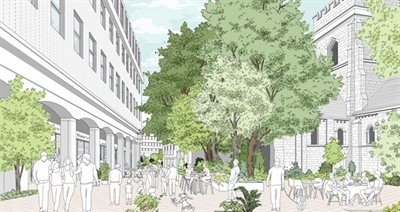
Major regeneration projects will transform Stafford town centre.
Staffordshire County Council and Stafford Borough Council are working on schemes to ensure that Stafford will be a place where people want to live and work.
Their projects complement each other and will encourage investment and support the tourist industry.
Stafford’s Market Square and the approach to the Railway Station have already been refurbished.
The borough council is working on major high street regeneration projects including the Guildhall shopping centre.
Staffordshire County Council has started work on its Eastgate regeneration scheme to create leisure facilities and homes in former council buildings.
Both councils are working in partnership to deliver the Stafford Station Gateway scheme which will redevelop land near the railway station.

 North Staffordshire Heritage