Burslem-based Titanic Brewery is brewing a special ale in honour of the City of Stoke-on-Trent’s centenary.
Called the Centenary Anniversary Ale, the traditional amber ale will be on sale in public houses throughout the Potteries. The Lord Mayor, Councillor Lyn Sharp, visited the brewery recently.
During her visit, she said Stoke-on-Trent’s brewing heritage had played a proud role in the city’s first 100 years.
A spokesperson for JD Wetherspoons confirmed that all its public houses in Staffordshire would stock the ale.
“When I started working at Buxton Museum and Art Gallery, I was given a tour of the stores and instantly spotted watercolours by the same artist, the Rev. John Louis Petit.”
The British Ceramics Biennial returns to the former Spode Works in Stoke in September. The event lasts for six weeks, from 6 September to 19 October.
Free exhibitions and talks will spotlight international contemporary ceramic artists and introduce new talent by drawing on Stoke-on-Trent’s industrial heritage.
The Biennial’s Artistic Director and Chief Executive, Clare Wood, says, “It is wonderful to be back at Spode.”
Since 2009, the British Ceramics Biennial has been helping to transform and regenerate Stoke-on-Trent. It uses artists’ commissions, learning, and community projects to achieve its vision of making change through clay.
North Staffordshire Heritage would like to celebrate the City of Stoke-on-Trent’s Centenary by showing a series of film strips.
The film strips were made by local schools in 1960. They celebrated the 50th anniversary of the amalgamation of the six towns, which created the County Borough of Stoke-on-Trent.
We have the film strip, The Township of Tunstall, made by Highgate Secondary School. The filmstrips about Burslem, Hanley, Stoke-upon-Trent, Fenton and Longton are missing.
Victory From Home, How We Helped Win The War is a new exhibition at Newcastle’s Brampton Museum. The exhibition in the Spotlight Gallery marks the 80th anniversary of the end of the Second World War in 1945. It explores the contributions local people made to the Allies’ victory over the Axis powers. The exhibition remains open until September 16th. Admission is free.
Do you know what happened when the Romans left Britain?
The centuries after the Romans left Britain were once called the Dark Ages by historians. These centuries are some of the most mysterious in English history. They are also the most fascinating.
We hope to show a series of film strips during 2025, Stoke-on-Trent’s Centenary Year. In 1960, schools in the six towns created these film strips. They were made to celebrate the 50th anniversary of the County Borough of Stoke-on-Trent’s creation.
North Staffordshire Heritage has the scripts for all these film strips. Unfortunately, we only have one film strip, the Township of Tunstall, which was made by Highgate Secondary School.
The film strips about Burslem, Hanley, Stoke-upon-Trent, Fenton and Longton have been lost. If you can help us find them, please email northstaffordshireheritage@outlook.com
This image was taken at Birchenwood near Kidsgrove in 1994. It shows a polluted stream. The stream ran next to the route followed by the North Staffordshire Railway Company’s ‘loop line’. The line closed in the 1960s. It ran from Etruria to Kidsgrove. There were stations at Hanley, Waterloo Road, Cobridge, Burslem, Tunstall, Pitts Hill and Goldenhill.
In his book, Old Times in the Potteries, published in 1906, William Scarratt describes the scene in Tunstall‘s Market Square. These scenes occur on Saturday nights during the 1850s.
Pottery workers worked a six-day week and were paid their wages at five o’clock on Saturday afternoon.
Saturday night was the busiest time in the market.
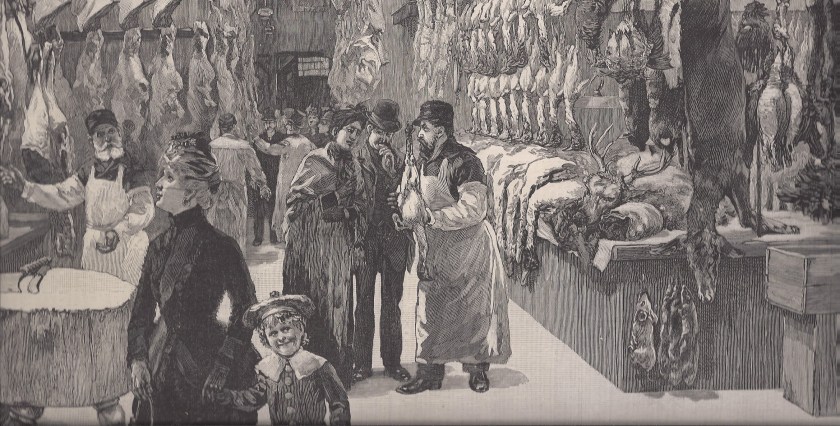
A score or two of butchers had stalls in the market square. Their tent-like stalls were lit by naphtha lamps. They were chopping up meat and haggling over prices with customers. These fat and smiling butchers seemed content. I do not think they liked covered markets. They were used to trading in the open air.
In the lower part of the square, in front of the town hall, were the hucksters and the poultry dealers. Stalls sold green groceries, fruit, and vegetables. A higgler from Cheshire was nicknamed ‘Cabbage’. His cry ‘Cabbage and cou’d (cold) lard’ was so loud that it was heard by customers at other stalls.
Between the higglers and the High Street were the fishmongers.
On Saturdays and Mondays, a quack doctor had a stall outside the Sneyd Arms. He sold patent medicines and displayed extracted teeth, charts and physic bottles on his stall. A real doctor who frequented the Sneyd Arms enjoyed teasing the quack. He sent notes to him asking difficult medical questions. These questions puzzled the quack, who couldn’t answer them.
William Scarratt’s book Old Times in the Potteries, published in 1906, describes the Chatterley Valley in the 1850s.
Ironworks sprang up rapidly in North Staffordshire during the 1850s. I recall a workingman who was a forgeman. He predicted that all the land in the valley would be covered by industrial buildings of one kind or another. I have often thought of that visionary’s foresight when I look at the industries there today.
It was a pretty valley. The Fowlea Brook, surrounded by meadows, ran through it. Willow trees called Osiers grew on its banks. Osiers were small willows with long, flexible shoots used to make baskets. They were grown commercially in damp, marshy fields near the brook.
A shepherd looked after a flock of sheep in a field by the railway line. People in the valley heard the leading sheep’s bell tinkling.
Men working on the night shift in local industries would leave work briefly to smoke their pipes. They would go into the valley to catch a breath of spring. Sometimes, they lingered there for a few minutes in the long twilight of a summer’s evening.

 North Staffordshire Heritage