We all remember that one teacher who made a lasting difference – the one who inspired us, encouraged us, or simply made school a little brighter. Maybe they sparked your love of a subject, believed in you when you doubted yourself, or had a way of making lessons fun.
We’d love to hear your stories. Tell us about your favourite teacher and what made them special. Was it their kindness, their humour, their passion for teaching, or something they did that you’ve never forgotten?
Your memories can help celebrate the people who shaped our lives and remind us of the power a great teacher can have.
If you went to school in North Staffordshire, you can share your story in Leave a Comment below. Alternatively, you can email it, with or without images, to northstaffordshireheritage@outlook.com
We are sure everyone will enjoy reading your memories of your favourite teacher.
In 1986, Joan Baggaley, who wrote The City of the Six Towns: Stoke-on-Trent and Seven Pillars of Wisdom, visited Tunstall. She had come to see The Coach and Horses, an inn on Oldcourt Street, which overlooked the Chatterley Valley.
On the opposite side of the street, there were houses, bungalows and a school. This side of the street had recently been developed. There were still traces of the terraced houses that had been demolished, along with the cobblestone back entries behind them.
The sun was shining, and Joan looked westward across the valley. In the distance, she saw Bradwell Wood and the hills behind Newcastle.
The inn was open, and Joan was welcomed by the landlady, who took her inside. They went into the lounge, which had been created when two small rooms had been enlarged.
Many years ago, the inn had been a coach house and a resting place for horses. On the north side of the inn, there was a large yard with stables and a hay loft. The stables and the hay loft had been converted into a room where dances and wedding receptions were held. On the east side of the inn was a former school building that was occupied by social services.
This review gives a comprehensive description of the Doubletree by Hilton Stoke-on-Trent. It also introduces its readers to Middleport Pottery, the Emma Bridgewater Factory, the Gladstone Pottery Museum and Biddulph Grange Gardens.
North Staffordshire Heritage supports the campaign to save Walsall Leather Museum. This fascinating and unique museum must be saved. It is a local and regional asset that can easily be transformed into a significant national and international heritage tourism attraction. North Staffordshire Heritage takes no pleasure in reminding the local council that a town or city that destroys its heritage is a town or city without a future. We ask everyone in the UK who cares about our country’s history and heritage to sign the Petition to keep the museum open. Remember that once it’s gone, it’s gone!
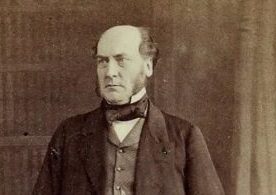
George Gilbert Scott (1811-1878) was one of England’s leading architects. Between 1835 and 1845, George and his partner, William Moffatt, designed over forty workhouses.
One of Victorian England’s leading architects, George Gilbert Scott, designed Newcastle-under-Lyme workhouse.
Born at Gawcott in Buckinghamshire on July 13th, 1811, George was the third son of the Rev. Thomas Scott and his wife, Euphemia.
Educated at home by his father, George became an architect. He went into partnership with William Bonython Moffatt. The firm specialised in building workhouses, and George designed the Newcastle workhouse to accommodate 300 inmates.
Newcastle-under-Lyme workhouse opened in 1840. An Elizabethan-style building in Keele Road, it cost £6,000. The workhouse was enlarged a few years later when an infirmary, workshops and a laundry were erected. Casual wards for vagrants were constructed in 1878.
During the 1880s, a hospital was built on land behind the workhouse.
Absalom Reade Wood was one of North Staffordshire’s leading Architects. He created Tunstall’s unique Victorian Civic Centre.
When Absalom Reade Wood died in 1922, North Staffordshire lost one of its leading architects. During his long life, Absalom had created numerous churches and chapels, houses and factories, schools and civic buildings throughout the district.
He was born at Burslem in 1851, and attended the town’s Wesleyan Day School. When he left school, Absalom was articled to Shelton architect Robert Scrivener.
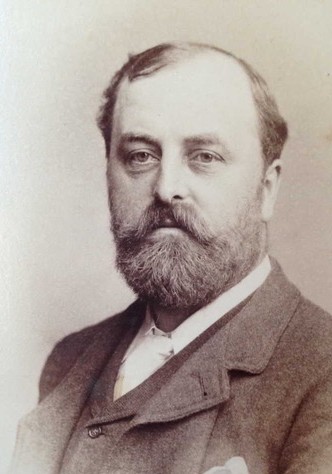
Absalom was a small man, with ‘a comfortable, neat figure and a short beard’ and a warm, friendly personality that gave him an optimistic outlook on life. He was a keen sportsman who enjoyed cycling, swimming, and playing cricket, tennis, and golf.
He became an architect during the early 1870s and established his own practice in Tunstall in 1874.
A year later, Absalom became the town’s part-time surveyor, a position he held until the creation of the County Borough of Stoke-on-Trent in 1910. Working closely with John Nash Peake and the town clerk, Arthur Llewellyn, he modernised Tunstall’s market hall. He created the town’s unique late Victorian Civic Centre containing his piece de resistance the town hall, which opened in 1875.
Other civic buildings Absalom designed included Kidsgrove’s town hall and Longton’s Sutherland Institute. Burslem School Board employed him to build Jackfield, Park Road and Longport Schools.
Absalom married Mary Holdcroft, the daughter of pottery manufacturer William Holdcroft. The couple had five children – two boys and three girls. The Wood family were Methodist. They worshipped at Hill Top Methodist Church in Burslem. In 1889, Absalom was employed to enlarge and modernise the church.
Absalom’s best-known building in Burslem is the Art School in Queen Street. Situated on land opposite the Wedgwood Institute, which was given by Thomas Hulme, the school cost £8,500. The school opened in 1907, and one of its most famous alumni was pottery designer Clarice Cliff.
Clarice was born in Meir Street, Tunstall, on 20 January 1899. Before going to Burslem Art School, she attended High Street School, Tunstall, Summerbank Road School, Tunstall and Tunstall Art School, which was housed in the Jubilee Buildings in Station Road (now The Boulevard). High Street and Summerbank Road Schools were designed by Absalom, as were the Jubilee Buildings.
Absalom died at his home Hillcrest, Woodland Avenue, Wolstanton on 21 December 1922.
Absalom Reade Wood (1851-1922) is one of a series of articles about North Staffordshire’s history written by Betty Martin before her death. Other articles from the series will be posted from time to time.
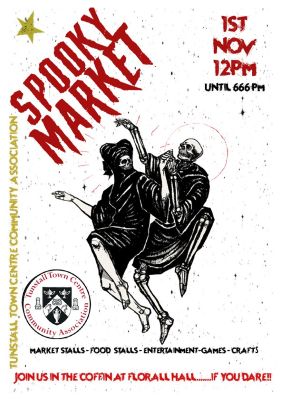
Tunstall Town Centre Community Association challenges you to come and shop at its Spooky Market. The market will be held in ‘the coffin’ at the Floral Hall in Tunstall Park on Saturday, 1st November.It opens at 12pm. As well as traditional market stalls, there will be fun and games, refreshments and live entertainment. You might meet a ghost. Who knows?
A Description of the Country From Thirty to Forty Miles Round Manchester, a book published in 1795, was compiled by Dr John Aikin. The book tells us about Newcastle-under-Lyme and North Staffordshire’s pottery towns and villages in the 1790s.
This edited extract from the book describes Longport in the 1790s.
Longport is situated in a valley between Burslem and Newcastle. There are some good buildings in it and several large pottery factories. Because it is in a valley, there are times when the smoke from bottle ovens and kilns hangs over Longport, making the air disagreeable, if not unwholesome.
The Trent & Mersey Canal passes through Longport, where there is a public canal wharf. Before the canal was constructed, Longport was called Longbridge Hays because there was a kind of bridge that ran parallel for a hundred yards with the Fowlea Brook. The bridge was dismantled when the canal was cut.
The number of buildings increased rapidly when the canal was completed, and the village’s name was changed from Longbridge Hays to Longport.
 North Staffordshire Heritage