During the 19th century, there were numerous springs, called wells, on the slopes of Mow Cop from which local people obtained their water supply.
In his book “Mow Cop and its Slopes” published in 1907, W. J. Harper describes the Corda Well – a spring that never ran dry.
Not far from Mow Cop is a little well, about 2ft in diameter, which was never known to be dry. The water always bubbles up in summer or winter, seedtime or harvest.
About 30 years ago, there was a drought. The cows were moaning in the fields, and the sheep were bleating in the mountain meadows for want of water. This little well, all the while, supplied the inhabitants with water for many miles around. At three o’clock in the morning, people came for water bringing buckets, tubs and various utensils to carry the precious liquid. Although a small well, its water supply was never exhausted but flowed on and continues to flow.
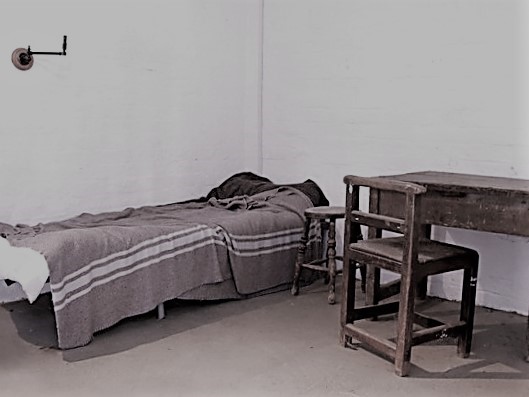
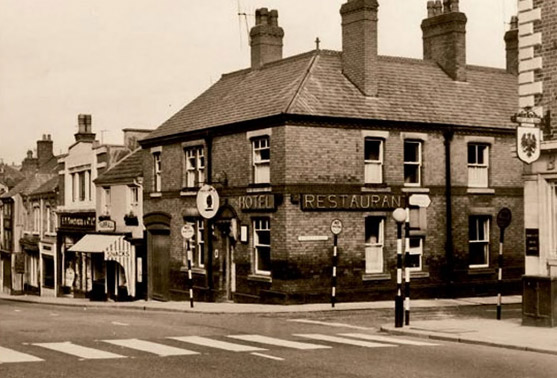
William Frederick Horry, born in 1843, was a charismatic yet ruthless killer who owned Burslem’s George Hotel. After a tumultuous marriage, he shot his estranged wife, Jane. Convicted of murder, he was sentenced to death and hanged on April 1, 1872, at Lincoln Castle Prison.
The condemned cell at Lincoln Castle Prison where William Horry spent his last days.
Despite his superficial charismatic charm, William Frederick Horry, the landlord of Burslem’s George Hotel, was a cold-blooded, ruthless killer.
Born on November 17th, 1843, in Boston, Lincolnshire, he was the son of William Horry, senior, a successful brewer.
When he left school, young William became a trainee manager at Parker’s Brewery in Zion Street, Burslem. He lived at the George Hotel in Nile Street, where he fell in love with Jane Wright, the hotel’s barmaid.
Jane left the George Hotel and went to work at the Sneyd Arms Hotel in Tunstall. William realised he could not live without her. He asked her to marry him. She consented, and William’s father gave them £800 to buy the George Hotel. The couple married in 1867 and had three children.
William who was a heavy drinker convinced himself that Jane was flirting with male customers. At night, he walked the streets looking for prostitutes or drinking with criminals in back street beer houses.
William’s father and Jane’s brother Thomas, a solicitors clerk, came to Burslem to find out why the marriage had failed. William told them Jane had committed adultery with three of the town’s leading citizens. When the two men investigated the allegation, they discovered that William had lied to them.
William and Jane separated in March 1871. She took the children and went to live with his father in Boston. William sold the George Hotel and went to Nottingham.
He visited Boston and asked Jane to take him back. She refused, and William started divorce proceedings, claiming she had committed adultery with five men.
While waiting for the case to be heard, William bought expensive clothes and often visited the Potteries. Early in January 1872, he stayed for a week visiting brothels in Hanley and drinking with friends in Burslem.
On Saturday, January 13, William returned to Nottingham, where he bought a revolver and a hundred cartridges.
William left Nottingham and went to Boston, where he visited his father’s home where Jane was living. She invited him into the house. He followed her along the passage leading to the breakfast room. As she entered the room, William pulled out the gun and shot her in the back. The bullet passed through her left rib and penetrated her lung. Jane died a few minutes later. William was detained by members of his family, who called the police. He was arrested and charged with murder.
William’s friends in Burslem launched a public appeal to pay for his defence.
He was tried at Lincoln Assizes on March 13 and pleaded “Not Guilty”. His trial lasted three hours. The jury took 15 minutes to convict him.
William stood in the dock and watched Mr Justice Quain don the Black Cap before sentencing him to death. He was taken to Lincoln Castle Prison and hanged on Easter Monday, April 1st, 1872.
In the 1950s and 60s, self-service stores replaced local shops in town centres throughout North Staffordshire and South Cheshire.
If your family used self-service stores, please share your memories of shopping there with our readers. Tell them how self-service stores differed from High Street and corner shops.
To read the full post, click on “How England’s First Self-Service Store Heralded the Birth of the Modern Supermarket” below the photograph.
There was no M.P. for the town until 1832. The whole of the Potteries was formed into a constituency. It sent two members to Parliament. This early recognition showed that the six municipalities shared common interests. It marked the beginning of nearly eighty years of debate over unifying local government in the district.
To read the whole post, click on “Staffordshire Archives and Heritage” below.
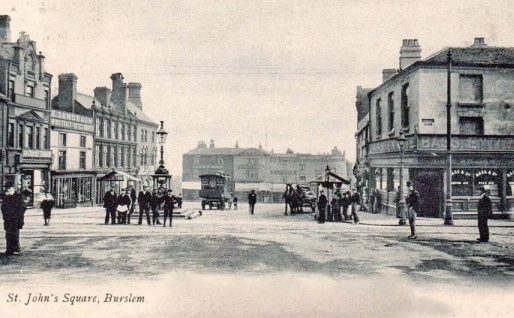
Burslem is situated in the north-west of the City of Stoke-on-Trent, one of the six towns which form the City.
When it was recorded in the Domesday Book in 1086, Burslem was called Barcardeslim (Burgweard’s Lyme). It was not a large village consisting of just four households and one plough team. The other resource mentioned is two acres of alder wood. Its value was 10 shillings.
Through the medieval period, Burslem was not a centre of any importance. It was part of the parish of Stoke on Trent and was subject to the Tunstall manor court. A survey in 1563 reported 30 households for the area served by the chapel of St John. The village was agricultural and did not have good communications. However the occupants of the poor farms had beneath their feet mineral resources, which over the next two centuries produced steady growth turning Burslem into…
Until they closed in 2009, Woolworth’s stores dominated the High Street in many towns and cities.
Affectionately known as “Woolies”, they sold a wide range of goods. These included children’s toys, ladies’ clothes, chocolate, tins of paint, and cutlery. Prices were reasonable and Woolworth’s attracted customers from all walks of life. Did you and your family shop at a Woolworth’s’ store in North Staffordshire or South Cheshire? Please share your memories of shopping there with us.
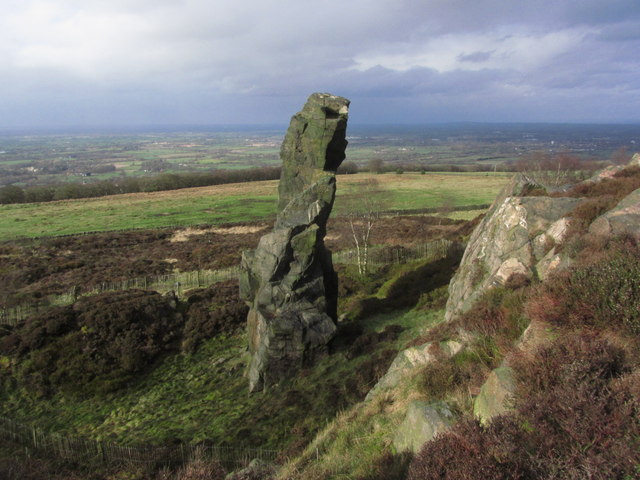
The Old Man of Mow is a local landmark whose origin is hidden by the sands of time.
In 1907, J. W. Harper wrote Mow Cop and Its Slopes, a local history book about Mow Cop and its surrounding villages. During the coming weeks, North Staffordshire Heritage is posting edited extracts from the book. It is out of print and difficult to obtain from second-hand bookshops.
In the first extract from Mow Cop and its Slopes, we post Harper’s description of The Old Man of Mow.
The Old Man of Mow is a great rock. It stands in a rocky dell. The quarrymen of a former age left it intact. Like many things connected with this hill, why it was left is a matter of conjecture. But there it is. It stands alone, looking down over the Cheshire Plain. It is sombre and black with the years of weather it has seen. It remains a curio unexplained for ages.
The Old Man’s rock’s circumference is 76 feet (ca. 23 m) 7 inches. It is 65 feet (ca. 20 m) 6 inches high. All the approaches to the rock are of the most rugged kind. The location appears to be an ideal rockery. It is pure and simple. There are no shrubs to relieve the monotony of stone.
Visitors to Mow Cop often try to access the rocky dell. Some climb to perilous heights on its steep sides. Few consider their visit to Mow Cop finished without a glimpse of the Old Man.
Women from North Staffordshire were “called up” for military service or war work during the Second World War. Some served in the armed forces. Others built Spitfires at Castle Bromwich or worked in munitions factories at Swynnerton and Radway Green.
To read about women’s contribution to the war effort, click “Women Work and War” below.
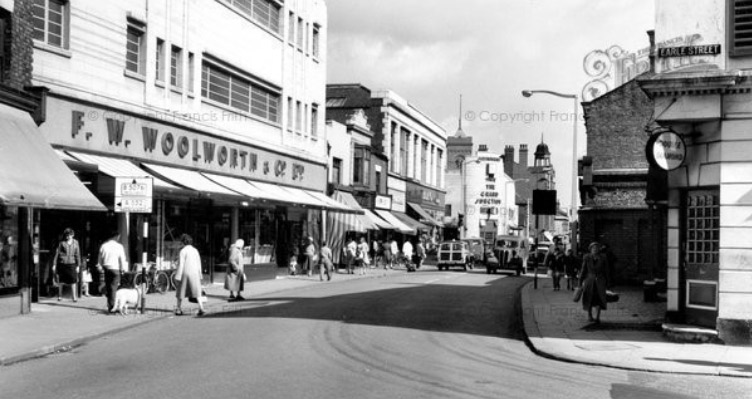
Woolworths opened their 199th store in October 1925 in the town of Crewe. The store they built had a grand Art Deco style, as you can see in the photo below. It spanned from numbers 59 to 67 of the High Street.
The store closed in 1984, another casualty of the Kingfisher closures. Today you’ll find Poundland here, and you’ll happy to see the Art Deco frontage is still there, but it seems to have lost the top floor (compare it to the 1960s photo to see!).
There was something for everyone at Woolworth stores. They were located on the High Street in major towns and cities throughout England and Wales.
Affectionately known as “Woolies”, these stores were like Aladdin’s Cave. They were stocked with a wide range of goods. These goods attracted customers of all ages from diverse backgrounds. Among the items Woolworths stocked were toys and games, as well as chocolate and sweets. They also sold pop records, portable radios and car accessories. Other stock included household paint, stationery, and stamps. All stores sold electric fires and fan heaters. The larger ones stocked garden furniture and plants. The list is endless…
Everyone who shopped at Woolworths will have memories of the store they bought from. They will remember its staff and the things they sold. If you and your family shopped at “Woolies”, please share your memories with us and tell us what you bought. Email, northstaffordshireheritage@outlook.com
To learn more about Congleton Woolworths, click “Woolies Buildings-Then and Now” at the top of the extract.
Woolworths opened in Congleton in 1927. It was a small store with a typical Woolworths look to the first floor – see below.
Congleton Woolworths 1956
Source: Congleton Through Time, Alcock J.
In 1968 Woolworths bought The Bears Head Hotel and Farrell’s Sweet Shop next door. They were demolished along with Banks Car Garage on Market Street to build a Woolworths superstore. At the time Mr. G. Lamb was the store manager, pictured below with his staff. These photos were in The New Bond (The House Journal of F. W. Woolworth and Co. Limited) June/July 1970 – kindly sent in by Richard Northover. He says “This was the forerunner of Woolworths/Woolies News, which was all about people and stores – not the political rag that was Woolies News!! It was named after the original head office in New Bond Street London…



 Crewe Woolworths 1960
  Crewe Former Woolworths – Poundland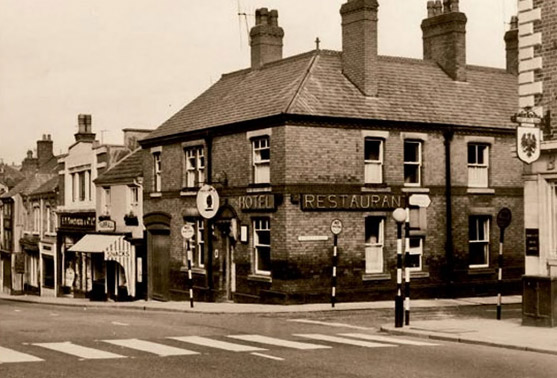
 Congleton Woolworths 1956
  North Staffordshire Heritage