How to apply for a grant of between £10,00 and £250,000 for your heritage project

Does your organization want to apply for a grant of between £10,000 and £250,000 from The National Lottery Heritage Fund? If you have an idea for a heritage project, this video tells you how to apply for Heritage Lottery Funding.

For more information, please visit The National Heritage Fund’s website at https://www.heritagefund.org.uk/fundi…

Ancestral Tourism 1: Churches and Churchyards

What might, for us, be termed ‘Ancestral Tourism’ could simply be an enjoyable day out for any family and friends accompanying us. The little stops and circuitous routes wouldn’t be too burdensome on companions, and might be thought to add dimension to a place.

I say this from a position of experience, since I’ve done quite a bit of visiting the ancestors over the years, often accompanied by my husband and dog. The trick is to intersperse the family history with other sightseeing and activities and, above all, to know where to draw the line.

Bottle Ovens of Staffordshire at the Brampton Museum

A special talk on the Bottle Ovens of Staffordshire will be given by Phil Rowley, a local historian and ceramics expert. The talk will take place at Newcastle-under-Lyme’s Brampton Museum on Sunday 7 September at 2.00 pm. Admission £5. For more details, please contact the Museum.

Two Film Shows at the Brampton Museum

Two Film Shows at the Brampton Museum in September, telling the story of North Staffordshire’s Pottery and Textile Industries.

There are two film shows at Newcastle-under-Lyme’s Brampton Museum in September.

The first film, The Pottery Industry – 20th Century to Today, will be shown on Sunday, 14 September at 2.00 pm. Admission Free.

The second film, Leek and the Story of Silk Twisting, will be shown on Thursday, 18 September at 2.30 pm. Admission £5. The film marks the start of an autumn programme called Textile Take Over at the Brampton Museum. The programme will include exhibitions, talks and events relating to North Staffordshire’s textile industry.

Biddulph Grange

One of the wonders of Victorian England, Biddulph Grange Garden is unique. The garden, created by James Bateman, is a major tourist attraction. It will help to make North Staffordshire’s Industrial Landscape a World Heritage Site.

Friday Newsdesk

A week with very little news.

Most of the time has been spent reorganising our filing system.

Research into the Anglo-Saxon legal system continues. We have been looking at the Christian Church’s role in the administration of justice.

Have a relaxing and enjoyable weekend. We’ll see you again next week.

Claybody Theatre to Stay at Spode Works

Stoke-on-Trent’s Claybody Theatre is going to stay at The Dipping House on the historic Spode Works site in Stoke-upon-Trent’s town centre.

The theatre has taken a 15-year lease on The Dipping House, which has been its home since 2023. Deborah McAndrew, the theatre’s co-artistic director, said:

We absolutely delighted to have secured the future of the Dipping House.

The Dipping House has proven to be a great space for us and we have already welcomed thousands of visitors who have come to watch our performances and participate in workshops and other events.

In going forward we will continue to collaborate with the City Council to develop the venue for theatre, arts and community events right in the heart of this incredible and historic site at Spode Works.

Researching Members of Your Family Who Served in the Armed Forces

The Staffordshire History Centre in Stafford has a collection of military records, personal letters, photographs and regimental histories. If your ancestor served in the armed forces, the centre could help you to trace them.

The Tragedy of Lidice – A talk at the Potteries Museum

In June 1942, the small Czech village of Lidice, 12 miles from Prague, was destroyed. Its inhabitants were murdered or deported, and the village was wiped off the map.

The atrocity was a reprisal for a top-secret operation code-named “Operation Anthropoid,” to kill Reinhard Heydrich, a high-level Nazi official who planned the Holocaust, which murdered at least 6 million people.

On 9th June, the day of Heydrich’s state funeral in Berlin, Hitler ordered retaliatory measures against the Czech population. That very evening, German police and SS officials surrounded Lidice. Their behaviour was caught on film. The atrocities they committed caused an international outcry that strengthened the resolve of Great Britain and the United States to destroy Nazi Germany.

On Friday, 5 September, Dr Kate Vigurs, a Second World War Historian, will give a talk at the Potteries Museum and Art Gallery telling the story of Lidice from Operation Anthropoid to 2025, revealing its special relationship with Stoke-on-Trent.

Her talk starts at 7.00 pm and ends at 9.00 pm. The bar opens at 6,00 pm. Tickets cost £12.

Telephone 01782 232323 or email museumevents@stoke.gov.uk to book your ticket.

Tunstall in the 1790s

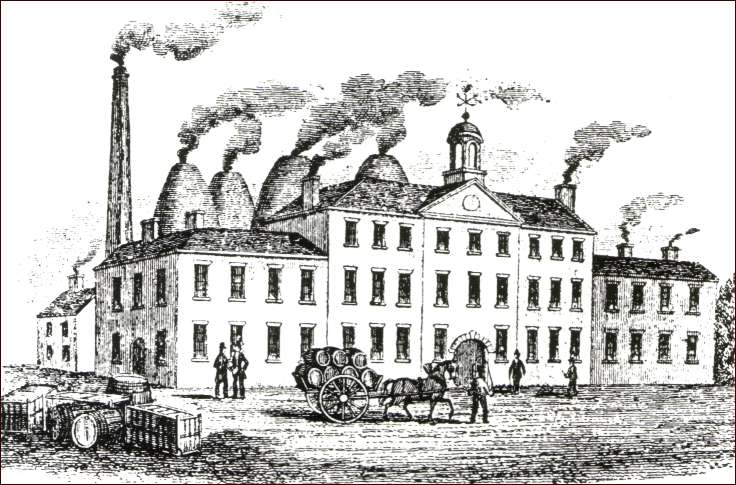
The sketch above shows William Adams’ Greengates Pottery in Tunstall. The factory built between 1779 and 1781 was one of the largest in the Potteries. It manufactured tableware, stoneware and jasper ornaments for the luxury market. William Chaffer, the author of ‘Marks and Monograms on Pottery and Porcelain’, said some of the jasper made at Greengates was ‘equal to, if not superior’ to that produced by Josiah Wedgwood at Etruria.

A Description of the Country From Thirty to Forty Miles Round Manchester, a book published in 1795, was compiled by Dr John Aikin. The book tells us about Newcastle-under-Lyme and North Staffordshire’s pottery towns and villages in the 1790s.

This edited extract from the book describes Tunstall as it was in the 1790s.

Tunstall is the pleasantest village in the Potteries. It stands on high ground, commanding extensive views of the surrounding countryside. Pottery manufacturers in the village produce good-quality ware and do considerable business. There was a church here, and human bones have been dug up. But such is the effect of time that no trace of either the church or the bones remains today. A small chapel has recently been built here. There is a considerable number of brick and tile works. They use local clay to make blue bricks, which look as well on the roofs of houses as moderate slate. Tunstall is four miles from Newcastle-under-Lyme and nine miles from Congleton. The turnpike road from Lawton to Newcastle-under-Lyme runs through Tunstall, where the turnpike road to Bosley in Cheshire begins [near the Wheatsheaf Inn].