Appetite has organised an open-air pop-up exhibition to celebrate the life of Arthur Berry.
Berry was a playwright, poet and painter. The exhibition explores his life and the impact he had on art and culture in the Potteries.
The exhibition opens in the City Centre on August 4th. It runs there until September 14th. Then it moves to Newcastle-under-Lyme. It reopens there on September 20th and runs until October 1st.
A Description of the Country From Thirty to Forty Miles Round Manchester, a book published in 1795, was compiled by Dr John Aikin. The book tells us about Newcastle-under-Lyme and North Staffordshire’s pottery towns and villages in the 1790s.
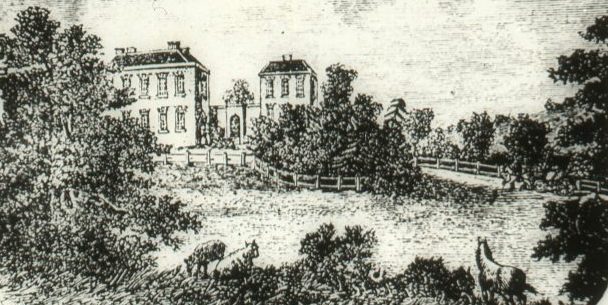
This edited extract from the book describes Goldenhill as it was in the 1790s.
One would imagine from its name that Goldenhill is a large, splendid place. But names can be deceptive. In fact, Goldenhill is the smallest village in the Potteries.
Nonetheless, the valuable coal mines, which gave the village its name, make ample amends for its deficiencies.
At the upper [North] end of the village is Green Lane, which commands an extensive view of the surrounding areas. On one side of the lane, the Cheshire Plain can be seen with the Welsh Hills in the distance. On the other side, there is the best view of the Potteries and the countryside beyond it.
The Second World War ended eighty years ago in 1945. Victory from Home: How we Helped Win the War is an exhibition at Newcastle-under-Lyme’s Brampton Museum.
The exhibition examines life on the home front. It highlights the vital role that those who stayed at home played in helping the Allies win the war. The exhibition closes on 16 September.
Admission to the museum and the exhibition is free.
A Description of the Country From Thirty to Forty Miles Round Manchester, a book published in 1795, was compiled by Dr John Aikin. The book tells us about Newcastle-under-Lyme and North Staffordshire’s pottery towns and villages in the 1790s.
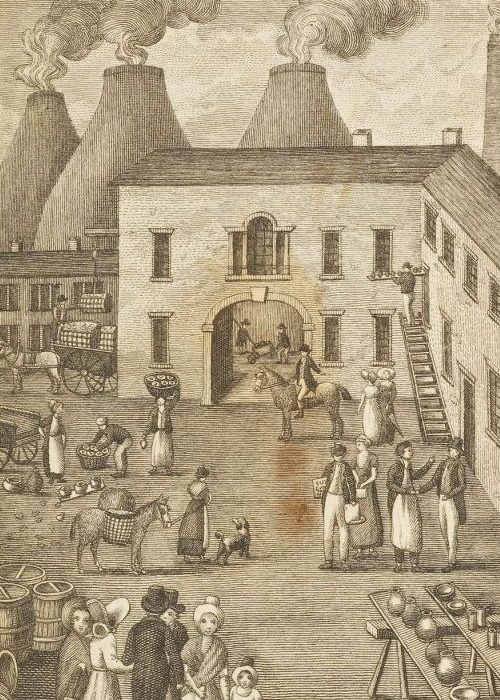
This edited extract from the book describes the Potteries in the 1790s.
The Staffordshire Potteries commence about a mile from the Cheshire border at a village called Goldenhill.
From there it extends to Lane End [Longton], a distance of more than seven miles. Many of the towns and villages that form the Potteries are linked by houses and factories. The traveller is left with the impression that he is journeying through one town with different names. Manufacturing pottery is the primary business of this extensive and populous area. It is believed that the number of inhabitants or houses has increased threefold over the last twenty years. The towns and villages that make up the Potteries arelikely to merge to create one town with one name. Many people who live nearby already call the area The Pottery.
Victory From Home, How We Helped Win The War is a new exhibition at Newcastle’s Brampton Museum. The exhibition in the Spotlight Gallery marks the 80th anniversary of the end of the Second World War in 1945. It explores the contributions local people made to the Allies’ victory over the Axis powers. The exhibition remains open until September 16th. Admission is free.
George Gilbert Scott (1811-1878) was an English architect. He began his career designing workhouses. Between 1835 and 1845, George and his partner, William Moffatt, designed over 40 workhouses including the one at Newcastle-under-Lyme.
One of Victorian England’s leading architects, George Gilbert Scott, designed Newcastle-under-Lyme’s workhouse.
Born at Gawcott in Buckinghamshire on July 13th, 1811, George was the third son of the Rev. Thomas Scott and his wife, Euphemia.
Educated at home by his father, George became an architect. He went into partnership with William Bonython Moffatt. The firm specialised in building workhouses, and George designed Newcastle-under-Lyme workhouse. which accommodated 300 inmates.
The workhouse opened in 1840. An Elizabethan-style building in Keele Road, it cost £6,000. The workhouse was enlarged a few years later when an infirmary, workshops and a laundry were erected. Casual wards for vagrants were constructed in 1878.
During the 1880s, a hospital was built on land behind the workhouse.