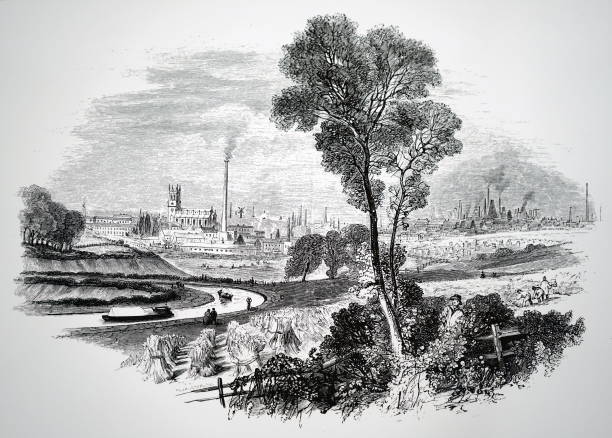
This engraving of the Fowlea Brook Valley looking towards Burslem was made in the 1860s. Note the sheaves of corn and the Trent & Mersey Canal in the foreground. In the background, you can see Burslem and St. Paul’s Church, Dalehall, where John Ward, who published The Borough of Stoke-upon-Trent in 1843, was churchwarden.
Arthur Berry, who has been called Stoke-on-Trent’s Poet Laureate and the Potteries’ Lowry, was an artist, author, playwright and poet. In this video, he shares his unique and sometimes controversial views about the people he painted and wrote about. Use our Comments section to share your memories of Arthur.
An appeal has been launched to find the relatives of Stoke-on-Trent’s Second World War hero, Lance Sergeant John Baskeyfield.
John, who came from Burslem, was killed during the Battle of Arnhem in September 1944. During the battle, he single-handedly manned two anti-tank guns and refused to leave his post. For his remarkable courage, he was posthumously awarded the Victoria Cross.
As part of Stoke-on-Trent’s Centenary Celebrations, the city council is planning to commemorate John’s bravery.
Councillor Lyn Sharpe, Lord Mayor of Stoke-on-Trent, said: “Our city is proud of Lance Sergeant John Baskeyfield. His bravery will never be forgotten in Stoke-on-Trent and beyond.
“We hope any relatives can be found so they can be part of the special events we are holding this year in his memory.”
The events in November are expected to include an expanded exhibition in the Spitfire Gallery at the Potteries Museum. Additionally, there will be an act of Remembrance at John’s memorial in Festival Park.
If you are one of John’s relatives or can help trace them, email sot100@stoke.gov.uk
Burslem-based Titanic Brewery is brewing a special ale in honour of the City of Stoke-on-Trent’s centenary.
Called the Centenary Anniversary Ale, the traditional amber ale will be on sale in public houses throughout the Potteries. The Lord Mayor, Councillor Lyn Sharp, visited the brewery recently.
During her visit, she said Stoke-on-Trent’s brewing heritage had played a proud role in the city’s first 100 years.
A spokesperson for JD Wetherspoons confirmed that all its public houses in Staffordshire would stock the ale.
North Staffordshire Heritage would like to celebrate the City of Stoke-on-Trent’s Centenary by showing a series of film strips.
The film strips were made by local schools in 1960. They celebrated the 50th anniversary of the amalgamation of the six towns, which created the County Borough of Stoke-on-Trent.
We have the film strip, The Township of Tunstall, made by Highgate Secondary School. The filmstrips about Burslem, Hanley, Stoke-upon-Trent, Fenton and Longton are missing.
We hope to show a series of film strips during Stoke-on-Trent’s Centenary Year. Schools in the six towns made these film strips in 1960 to celebrate the 50th anniversary of the County Borough of Stoke-on-Trent’s creation.
North Staffordshire Heritage has the scripts for all these film strips. But we only have one film strip, the Township of Tunstall, made by Highgate Secondary School.
The film strips about Burslem, Hanley, Stoke-upon-Trent, Fenton and Longton are missing. If you can help us trace them, please email northstaffordshireheritage@outlook.com
Do you think Fenton is Stoke-on-Trent’s forgotten town? We believe Fenton’s town hall and Christ Church will help make North Staffordshire’s Industrial Landscape a World Heritage Site.
Fenton is called Stoke-on-Trent’s Forgotten Town
Can You Help Us?
We hope to show a series of film strips during Stoke-on-Trent’s Centenary Year.
Schools in the six towns made these films in 1960. They were made to celebrate the 50th anniversary of the County Borough of Stoke-on-Trent’s creation.
North Staffordshire Heritage has the scripts for all these film strips. But, we only have one film strip, The Township of Tunstall, made by Highgate Secondary School.
The film strips about Burslem, Hanley, Stoke-upon-Trent, Fenton and Longton are missing. If you can help us trace them, please email northstaffordshireheritage@outlook.com
A city that forgets its past is a city without a future.
Reginald Mitchell’s Spitfire
Stoke-on-Trent is a city with a proud heritage.
Its history is a testament to people from the Potteries who have played significant roles on the world stage.
Stoke-on-Trent’s city council was one of the pioneers of comprehensive education. It defied Conservative and Labour governments to reform secondary education by creating comprehensive schools and a sixth-form college.
Local art schools, technical schools and colleges of further education were progressive centres of excellence. Reginald Mitchell, who designed the Spitfire, turned down a place at Birmingham University. He wanted to serve an apprenticeship with a firm in Fenton and study engineering at city technical schools.
By the early 1930s, the North Staffordshire Technical College was a university in everything but name. The college’s worldwide reputation in ceramic research and mining engineering attracted students from Europe, North America and the Commonwealth.
Some argue that the past is dead. They are mistaken. It lives in our collective memory and shapes our destiny. Our city’s proud heritage tells us who we are and why we are unique. A city that forgets its past is a city without a future.
Can You Help Trace These Film Strips?
North Staffordshire Heritage needs your help to find a series of historic 35 mm film strips. These films were made by local schools in 1960. They were produced to celebrate the 50th anniversary of the County Borough of Stoke-on-Trent’s creation.
We have the scripts for all these film strips. But we have only found one film strip, the Township of Tunstall that was made by Highgate Secondary School.
The film strips about Burslem, Hanley, Stoke-upon-Trent, Fenton and Longton are missing. If you can help us to trace them, please email northstaffordshireheritage@outlook.com
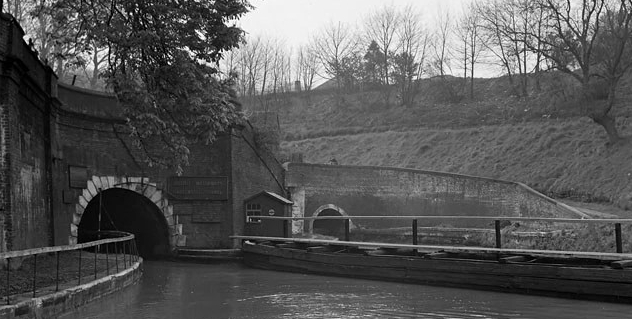
The Harecastle Tunnels on the Trent & Mersey Canal at Kidsgrove
There are no historical reasons to prevent North Staffordshire’s Industrial Landscape from becoming a World Heritage Site.
In the 18th century, North Staffordshire helped to make England “the workshop of the world.” Local entrepreneurs, like Wedgwood and Adams, transformed a group of small towns into an industrial area of international importance.
James Brindley’s Trent & Mersey Canal “kick-started” the Industrial Revolution, which made Britain “the Workshop of the World. The canal and railway tunnels between Kidsgrove and Chatterley are significant feats of civil engineering. They merit World Heritage Site status in their own right.
The Primitive Methodist Church was founded in North Staffordshire by Hugh Bourne and William Clowes. It gave the Potteries its unique culture and a way of life that Arnold Bennett vividly portrayed in his novels.
Burslem’s “old town hall” is one of the finest examples of Victorian civic architecture. The Wedgwood Institute’s terracotta facade is an inspiring tribute to the men, women and children who worked in local industries.
The former colliery at Chatterley Whitfield should have been made a World Heritage Site many years ago.
Making North Staffordshire’s Industrial Landscape a World Heritage Site would encourage economic regeneration and create new employment opportunities.


 North Staffordshire Heritage