Become a time traveller. Go to Longton Park’s Centenary Carnival on 10th August and turn the clock back to 1925.
You will see what the park was like when Stoke-on-Trent was granted city status. There will be fun for you and your family. You can listen to music from the roaring twenties or play hopscotch and other children’s games. Take your children to a funfair. Watch a Punch and Judy show and see a collection of vintage vehicles. It will be a great day out for all the family.
The event takes place from 11:00 a.m. to 4:00 p.m. Admission is free.
This aerial view of Longton showcases its distinctive industrial landscape and rich architectural heritage. How many buildings and places featured in this video do you recognize? If you live or work in Longton, please use the Comments section below to share your memories with us. Let us know about your family and friends, the schools you went to, the games you played and your hobbies. Tell us about your first job and your working life.
Longton’s Architectural Heritage will help to make North Staffordshire’s Industrial Landscape a World Heritage Site.
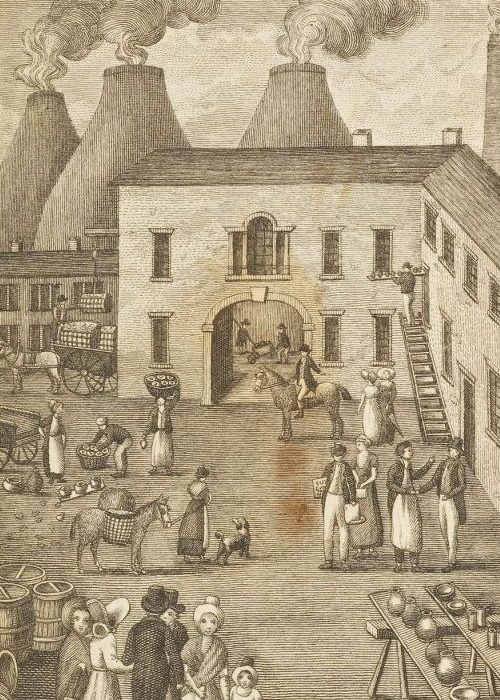
A Description of the Country From Thirty to Forty Miles Round Manchester, a book published in 1795, was compiled by Dr John Aikin. The book tells us about Newcastle-under-Lyme and North Staffordshire’s pottery towns and villages in the 1790s.
This edited extract from the book describes the Potteries in the 1790s.
The Staffordshire Potteries commence about a mile from the Cheshire border at a village called Goldenhill.
From there it extends to Lane End [Longton], a distance of more than seven miles. Many of the towns and villages that form the Potteries are linked by houses and factories. The traveller is left with the impression that he is journeying through one town with different names. Manufacturing pottery is the primary business of this extensive and populous area. It is believed that the number of inhabitants or houses has increased threefold over the last twenty years. The towns and villages that make up the Potteries arelikely to merge to create one town with one name. Many people who live nearby already call the area The Pottery.
We hope to show a series of film strips during Stoke-on-Trent’s Centenary Year. Schools in the six towns made these film strips in 1960 to celebrate the 50th anniversary of the County Borough of Stoke-on-Trent’s creation.
North Staffordshire Heritage has the scripts for all these film strips. But we only have one film strip, the Township of Tunstall, made by Highgate Secondary School.
The film strips about Burslem, Hanley, Stoke-upon-Trent, Fenton and Longton are missing. If you can help us trace them, please email northstaffordshireheritage@outlook.com
Do you think Fenton is Stoke-on-Trent’s forgotten town? We believe Fenton’s town hall and Christ Church will help make North Staffordshire’s Industrial Landscape a World Heritage Site.
Fenton is called Stoke-on-Trent’s Forgotten Town
Can You Help Us?
We hope to show a series of film strips during Stoke-on-Trent’s Centenary Year.
Schools in the six towns made these films in 1960. They were made to celebrate the 50th anniversary of the County Borough of Stoke-on-Trent’s creation.
North Staffordshire Heritage has the scripts for all these film strips. But, we only have one film strip, The Township of Tunstall, made by Highgate Secondary School.
The film strips about Burslem, Hanley, Stoke-upon-Trent, Fenton and Longton are missing. If you can help us trace them, please email northstaffordshireheritage@outlook.com
A city that forgets its past is a city without a future.
Reginald Mitchell’s Spitfire
Stoke-on-Trent is a city with a proud heritage.
Its history is a testament to people from the Potteries who have played significant roles on the world stage.
Stoke-on-Trent’s city council was one of the pioneers of comprehensive education. It defied Conservative and Labour governments to reform secondary education by creating comprehensive schools and a sixth-form college.
Local art schools, technical schools and colleges of further education were progressive centres of excellence. Reginald Mitchell, who designed the Spitfire, turned down a place at Birmingham University. He wanted to serve an apprenticeship with a firm in Fenton and study engineering at city technical schools.
By the early 1930s, the North Staffordshire Technical College was a university in everything but name. The college’s worldwide reputation in ceramic research and mining engineering attracted students from Europe, North America and the Commonwealth.
Some argue that the past is dead. They are mistaken. It lives in our collective memory and shapes our destiny. Our city’s proud heritage tells us who we are and why we are unique. A city that forgets its past is a city without a future.
Can You Help Trace These Film Strips?
North Staffordshire Heritage needs your help to find a series of historic 35 mm film strips. These films were made by local schools in 1960. They were produced to celebrate the 50th anniversary of the County Borough of Stoke-on-Trent’s creation.
We have the scripts for all these film strips. But we have only found one film strip, the Township of Tunstall that was made by Highgate Secondary School.
The film strips about Burslem, Hanley, Stoke-upon-Trent, Fenton and Longton are missing. If you can help us to trace them, please email northstaffordshireheritage@outlook.com
The Gladstone Pottery Museum is one of Stoke-on-Trent’s heritage assets. It will help make North Staffordshire’s Industrial Landscape a World Heritage Site.


 North Staffordshire Heritage