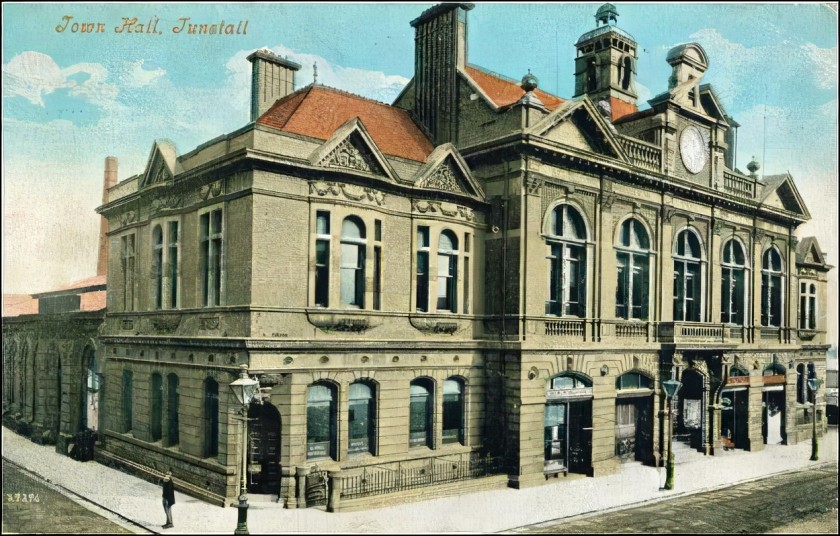
Did you go to the discos held in Tunstall town hall during the 1970s and 80s?
These discos were designed for young people; only light refreshments and soft drinks were sold. When they started in 1974, discos were held on Saturday nights. The discos were popular with teenagers. By 1977, they were being held on Monday and Friday nights.
David Martin and Lee Wanger are writing a book about Tunstall Town Hall and Market. They would like to know more about these discos. If you went to the discos, share your memories with David and Lee. You can email David at davidmartin227@outlook.com
A Halifax Bomber like the one that crashed on Grindon Moor.
The winter of 1946-47 was long and hard. There were heavy snowfalls and gale-force winds. Temperatures fell to below freezing, and icicles hung from the roofs of houses.
Mainline railway lines were kept open, but frozen points on branch lines prevented coal trains from leaving collieries. The National Coal Board did not thaw the points. They stockpiled coal at the pit head. This created a fuel shortage, and British industry was forced to introduce short-time working.
Between Sunday, February 2nd and Tuesday, February 4th, 1947 a blizzard lasting forty-eight hours swept across Staffordshire and Cheshire. More than ten inches of snow fell. Roads became impassable and motorists abandoned their vehicles.
Villages in the Staffordshire Moorlands were isolated by snowdrifts five or six feet deep. Over a hundred snowploughs and bulldozers fought to keep Staffordshire’s main roads open. German prisoners of war helped to clear the snow from roads leading into Burton-on-Trent. A working party from Stafford prison cleared snow blocking the road from Stafford to Stone.
In the Potteries, roads blocked by snowdrifts were reopened by Polish troops stationed at Keele. A bus fitted with a snowplough opened the road to Leek, but surrounding villages remained cut off.
Power stations producing electricity were running out of coal and output fell. Supplies of electricity were disrupted. Householders were asked not to use electricity between 9.00am and noon and between 2.00pm and 4.00pm. These savings were not enough to keep hospitals supplied with electricity. On February 7th, the government ordered companies to stop using electricity.
Industry throughout the country was hard hit. Factories were forced to close. At Stafford, English Electric dismissed its 5,000 employees. In the Potteries 44,000 men and women were made redundant.
At a meeting in Stoke, the National Political Union condemned the Labour government. It blamed the government for creating a fuel crisis. The crisis also caused widespread unemployment.
A few shopkeepers in Stafford continued to use electric spotlights to highlight displays in their shop windows. Lights and heating were turned off at the Guildhall where the Magistrates’ Court sat. It was so cold in the courtroom that Justices of the Peace wore their overcoats.
Many shops were lit by candlelight. Old gas mantles were used to light offices throughout the region. The Midland Bank at Crewe was lit by oil lamps and hurricane lamps were used to light Stoke town hall.
Blizzards prevented rescue teams from reaching Longnor, Butterton, Grindon and Ilam, isolated villages where 3,000 people were trapped.
The Royal Air Force was asked to help. At RAF Fairford in Gloucestershire, Halifax Bombers were loaded with food supplies for the villagers.
On February 12th, despite adverse weather conditions and low clouds, a bomber dropped thirteen canisters containing food near Longnor. Volunteers helped Police Sergeant Davenport carry the canisters to the village hall. They contained margarine, lard, sugar, cheese, bread and jam for the villagers and people living in neighbouring hamlets.
The next day, another Halifax, piloted by Squadron Leader McIntyre, took off from Fairford with food for Butterton. Weather conditions had deteriorated overnight. Visibility was poor. People on the ground, who were waiting for the food canisters to be dropped, heard the aircraft’s engines. They could not see the plane.
Squadron Leader McIntyre flew low hoping to find the dropping zone. The plane’s engines cut out. There was an explosion, and the Halifax crashed near Sheldon Farm on Grindon Moor. Eight men were on board. Only one survived the impact. He was unconscious when rescuers pulled him out of the cockpit and died shortly afterwards.
Among the dead was twenty-four-year-old Sergeant William Sherry from Clews Street, Burslem. Educated at Middleport School, he had been an army glider pilot before transferring to the Royal Air Force. William served with the 1st Airborne Division. He fought at Arnhem, where he was wounded and captured by the Germans.
Note: A Hard Winter (1946-1947) is one of a series of articles written by Betty Martin before her death. Other articles from the series will be posted from time to time.
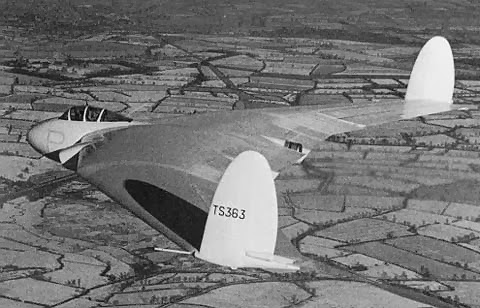
John Lloyd, whom Sir Morien Morgan, the Director of the Royal Aircraft Establishment at Farnborough, said was “one of the 20th century’s leading aeronautical engineers”, is Stoke-on-Trent’s forgotten aircraft designer.
His most important contribution to aviation history was research into laminar flow and the creation of experimental Flying Wings that helped to create the V Bomber force and Concord.
Born near Swansea in 1888 into a Welsh-speaking family, four-year-old John could not speak English when they moved to the Potteries. An intelligent child, he quickly mastered the English language and won a scholarship to Hanley High School. Leaving school at sixteen, he became an apprentice at Shelton Bar, an iron and steel works at Etruria and studied engineering at Stoke Technical School.
Fascinated by the Wright brother’s attempts to build a petrol-engine-powered glider, he designed and built model flying machines in his spare time.
Before the First World War (1914-1918) aeroplanes had wooden frames covered with canvas. Having studied aerodynamics, John believed that an all-metal aircraft could be built. When war broke out, he was employed by the Royal Aircraft Factory to design composite wood, metal and canvas fighter planes.
Coventry-based aircraft manufacturer Armstrong Whitworth made him its chief designer in the 1920s, and he designed the Siskin fighter bomber.
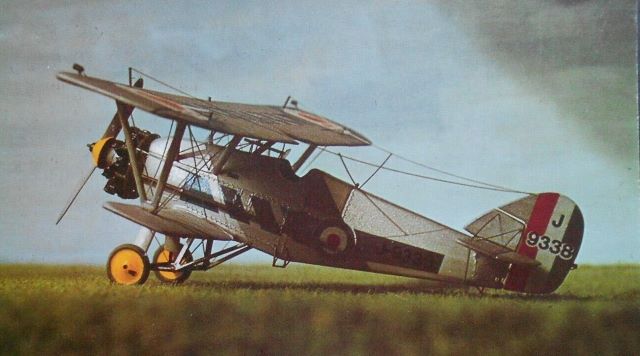
The Siskin
In 1923, a specially built two-seater Siskin 11 won the King’s Cup Air Race, reaching a speed of 149 miles per hour. Shortly afterwards, he modified the aircraft’s design and constructed the Siskin 111, the Royal Air Force’s first all-metal framed biplane.
Armed with two Vicker’s machine guns, the aircraft could carry four small bombs. It had an open cockpit and was powered by an Armstrong Siddely Jaguar radial piston engine.
This post is taken from a series of articles about John Lloyd written by Betty Martin when she was researching Aviation History. Copyright: North Staffordshire Heritage 2024.
Before she died in 2023, North Staffordshire Heritage’s historical geographer, Betty Martin, planned to publish her extensive original research into Stoke-on-Trent’s history and architectural heritage.
Betty went to Brownhills High School and Tunstall always had a special place in her heart. A not-for-profit foundation is being set up to publish a series of books based on her research. The first books are about Tunstall. They are being written by Betty’s husband, David, and Lee Wanger.
David and Lee are working on the first book, The History of Tunstall Town Hall and Market. Other books in the series include The History of the Jubilee Buildings and The Life of Sir Smith Child.
Senior citizens remember the town hall and market as they were before they closed for regeneration in the 1990s. They can recall social activities they went to in the town hall and going shopping in the market. Amateur photographers and students from Stoke-on-Trent College and Staffordshire University photographed the market and the town hall before they were regenerated.
David and Lee need your help to trace these photographs.
Simeon Ackroyd Shaw was born in Salford on April 17th, 1785. He became the Potteries’ leading intellectual in the first half of the 19th century.
Simeon came to North Staffordshire, where he worked as a printer and compositor for the Potteries Gazette and Newcastle-under-Lyme Advertiser.
Simeon Aykroyd Shaw
In 1985, Keele University’s Department of Adult Education published People of the Potteries. The book says that by 1818, Simeon was “running an academy for young gentlemen in Northwood, Hanley”. According to People of the Potteries, in 1822, Simeon owned a commercial academy in Piccadilly, Hanley. By 1834, he had a large academy in the town’s Market Place.
When he was writing By-gone Tunstall (Published in 1913), William J. Harper was given notes called Tunstall Reminiscences written by Simeon’s grandson, Mr W. S. Shaw. In these reminiscences, Mr Shaw says his grandfather lived in Piccadilly Street, Tunstall. He had one of North Staffordshire’s largest and most influential academies in the Market Place (Tower Square).
White’s Directory of Staffordshire, published in 1834, shows that Simeon owned an academy in Market Place, Tunstall. Official records prove that he lived in Piccadilly Street, which ran from Market Place to Sneyd Street (Ladywell Road).
Simeon was still living in Piccadilly Street in 1851. He died on April 8th, 1859 and was buried in Bethesda churchyard Hanley.
When they left the Sneyd Arms in Tunstall, stagecoaches going to London followed the Old Lane through the Potteries, stopping at coaching inns in Burslem, Hanley, Stoke, Fenton and Longton.
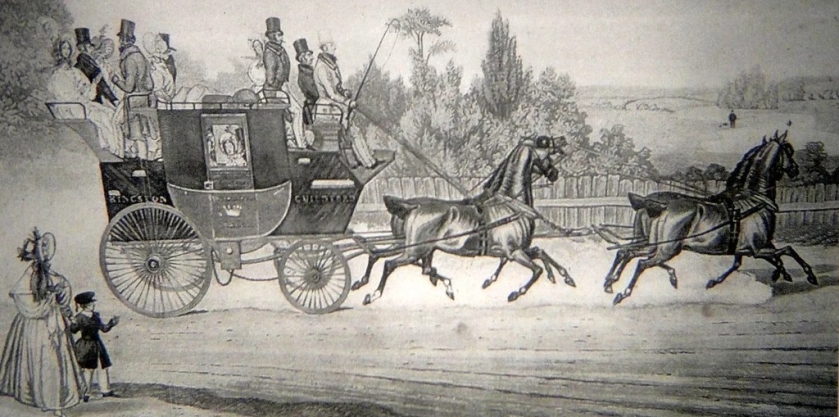
A Red Rover Stagecoach
During the 1830s, two firms, the Red Rover Company and the Royal Express Company, ran mainline stagecoaches between London and Liverpool.
Between Warrington and the Potteries, the coaches were driven along the Old Lane (the A50) that linked London and the East Midlands with Merseyside and the Northwest. These coaches stopped at the Sneyd Arms in Tunstall to pick up passengers. When they left the Sneyd Arms, the coaches followed the Old Lane through the Potteries, stopping at coaching inns in Burslem, Hanley, Stoke, Fenton and Longton.
On leaving Longton, coaches owned by the Royal Express Company left the Old Lane and went to London via Stone, Rugeley, Lichfield, Birmingham and Warwick. Coaches owned by the Red Rover Company followed the Old Lane to Hockcliffe in Bedfordshire, where it joined the London to Holyhead Road (the A5).
Two Stoke-on-Trent firms, the Hark Forward Company and the Independent Potter Company, ran day return stagecoach services that stopped to pick up passengers at the Sneyd Arms.
The Hark Forward Company’s coach went to Birmingham via Stone, Stafford and Wolverhampton. The Independent Potter Company’s coach ran to Manchester, Congleton, Macclesfield and Stockport. These two coaches left the Potteries early in the morning and returned late at night.
Stagecoaches were pulled by teams of four or six horses and could travel at a speed of eight to ten miles an hour. Travelling by stagecoach was expensive, and tickets had to be booked in advance. Coaches carried first and second class passengers. First class passengers travelled in the coach, and second class passengers sat on wooden seats on the roof.
The cost of the journey depended on its length. First-class passengers were charged threepence per mile, and second-class passengers were charged one and a half pence per mile.


 North Staffordshire Heritage