We all remember that one teacher who made a lasting difference – the one who inspired us, encouraged us, or simply made school a little brighter. Maybe they sparked your love of a subject, believed in you when you doubted yourself, or had a way of making lessons fun.
We’d love to hear your stories. Tell us about your favourite teacher and what made them special. Was it their kindness, their humour, their passion for teaching, or something they did that you’ve never forgotten?
Your memories can help celebrate the people who shaped our lives and remind us of the power a great teacher can have.
If you went to school in North Staffordshire, you can share your story in Leave a Comment below. Alternatively, you can email it, with or without images, to northstaffordshireheritage@outlook.com
We are sure everyone will enjoy reading your memories of your favourite teacher.
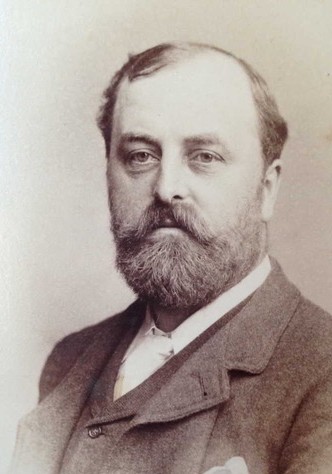
Absalom Reade Wood was one of North Staffordshire’s leading Architects. He created Tunstall’s unique Victorian Civic Centre.
When Absalom Reade Wood died in 1922, North Staffordshire lost one of its leading architects. During his long life, Absalom had created numerous churches and chapels, houses and factories, schools and civic buildings throughout the district.
He was born at Burslem in 1851, and attended the town’s Wesleyan Day School. When he left school, Absalom was articled to Shelton architect Robert Scrivener.
Absalom was a small man, with ‘a comfortable, neat figure and a short beard’ and a warm, friendly personality that gave him an optimistic outlook on life. He was a keen sportsman who enjoyed cycling, swimming, and playing cricket, tennis, and golf.
He became an architect during the early 1870s and established his own practice in Tunstall in 1874.
A year later, Absalom became the town’s part-time surveyor, a position he held until the creation of the County Borough of Stoke-on-Trent in 1910. Working closely with John Nash Peake and the town clerk, Arthur Llewellyn, he modernised Tunstall’s market hall. He created the town’s unique late Victorian Civic Centre containing his piece de resistance the town hall, which opened in 1875.
Other civic buildings Absalom designed included Kidsgrove’s town hall and Longton’s Sutherland Institute. Burslem School Board employed him to build Jackfield, Park Road and Longport Schools.
Absalom married Mary Holdcroft, the daughter of pottery manufacturer William Holdcroft. The couple had five children – two boys and three girls. The Wood family were Methodist. They worshipped at Hill Top Methodist Church in Burslem. In 1889, Absalom was employed to enlarge and modernise the church.
Absalom’s best-known building in Burslem is the Art School in Queen Street. Situated on land opposite the Wedgwood Institute, which was given by Thomas Hulme, the school cost £8,500. The school opened in 1907, and one of its most famous alumni was pottery designer Clarice Cliff.
Clarice was born in Meir Street, Tunstall, on 20 January 1899. Before going to Burslem Art School, she attended High Street School, Tunstall, Summerbank Road School, Tunstall and Tunstall Art School, which was housed in the Jubilee Buildings in Station Road (now The Boulevard). High Street and Summerbank Road Schools were designed by Absalom, as were the Jubilee Buildings.
Absalom died at his home Hillcrest, Woodland Avenue, Wolstanton on 21 December 1922.
Absalom Reade Wood (1851-1922) is one of a series of articles about North Staffordshire’s history written by Betty Martin before her death. Other articles from the series will be posted from time to time.
We hope to show a series of film strips during Stoke-on-Trent’s Centenary Year. Schools in the six towns made these film strips in 1960 to celebrate the 50th anniversary of the County Borough of Stoke-on-Trent’s creation.
North Staffordshire Heritage has the scripts for all these film strips. But we only have one film strip, the Township of Tunstall, made by Highgate Secondary School.
The film strips about Burslem, Hanley, Stoke-upon-Trent, Fenton and Longton are missing. If you can help us trace them, please email northstaffordshireheritage@outlook.com
During the 18th century, Hanley and Shelton became the most important towns in the Potteries.
Between 1762 and 1801, their populations increased from 2,000 to 7,940. Hanley’s first church, St. John’s, was erected in 1738 and enlarged in the 1760s. Stage coaches called at the Swan Inn. Horse-drawn wagons carried pottery to the Weaver Navigation at Winsford and returned carrying ball clay and household goods.
A covered market, designed by architect James Trubshaw, was built on Town Road in 1776.
The Trent and Mersey and the Caldon Canals stimulated economic expansion. Entrepreneurs opened factories, collieries and ironworks. Families from the surrounding countryside flocked to Hanley and Shelton looking for work. New houses were built to accommodate them.
In 1791, a trust was formed to manage the market and build a town hall. The trustees leased land in Market Square, where they erected a town hall. Markets were held on Wednesdays and Saturdays. A fortnightly cattle market was established at the beginning of the 19th century. In 1813, Parliament gave the trustees the power to regenerate Market Square. They demolished the town hall, replacing it with a poultry market. A lockup was also built where those arrested were held before being brought to court.


 North Staffordshire Heritage