We have had a busy week planning a series of talks and posts about Tunstall’s history. Our plans include talks about Tower Square, the Jubilee Buildings and the Memorial Gardens.
Have a good weekend. Relax and keep safe. We’ll see you again on Monday.
Arthur Berry, who has been called Stoke-on-Trent’s Poet Laureate and the Potteries’ Lowry, was an artist, author, playwright and poet. In this video, he shares his unique and sometimes controversial views about the people he painted and wrote about. Use our Comments section to share your memories of Arthur.
The filmstrip ‘The Township of Tunstall’, last seen in the 1990s, was shown again last Saturday in Tunstall Town Hall.
Made by Highgate School in 1960, the filmstrip depicts life in the town during the 19th century and features images of historic buildings that have been demolished. Members of the audience were introduced to Anglo-Saxon Tunstall and told about the lives of Sir Smith Child and John Nash Peake.
These shops in High Street, Tunstall, built in 1898, were designed by Absalom Reade Wood. Many local historians believe that Absalom was North Staffordshire’s leading architect.
In 1935, Arthur Cotton shared his memories of late Victorian Tunstall with a Sentinel reporter.
Arthur, who was born at Goldenhill in 1857, became an estate agent with an office in Market Square (Tower Square). He and his wife, Gavina, lived in Tunstall. They had six children – four boys and two girls. The family were Methodists. They worshiped at the Wesleyan Methodist Church in Wesley Place (Wesley Street).
Arthur took a keen interest in local politics and joined the Liberal Party. He became a Staffordshire County Councillor and an Urban District Councillor in Tunstall.
From 1905 to 1907, he was chairperson of the Urban District Council.
Arthur opposed the scheme to amalgamate the six towns and create the County Borough of Stoke-on-Trent. He believed it would undermine local democracy by transferring power from councillors to senior local government officials.
A man with a retentive memory, Arthur was a local historian. He told the Sentinel what Tunstall was like during the latter part of the 19th century, saying:
During the past 70 years or so, the district has changed beyond all recognition. The Tunstall of my boyhood days was an industrial town of small pottery factories. Many of them have long since disappeared, giving way to an industrial era that demands fewer factories, but bigger ones.
Many small collieries were scattered throughout the district. There were collieries at Goldenhill, Clanway, Newfield, Greenfield, Scotia and on the slopes leading up to High Lane… All these have ceased to exist because of flooding.
There were hardly any public buildings in the town. The old town hall stood in the centre of Market Square [Tower Square].
Much of the land now occupied by streets, houses, and factories was open country. The public library was built in Phoenix Park, which local people called Cope’s Running Ground. The Memorial Gardens were laid out in the park.
John Henry Clive, an astute entrepreneur, founded the company that created Tunstall‘s Market Place (Tower Square) and built the first Market Hall. He believed time was money and too precious to waste.
In 1830, John wrote The Linear System of Short Hand, a practical textbook for students. One of the exercises in the book is called a Letter Against Waste of Time, in which he gives his philosophy of life.
LETTER AGAINST WASTE OF TIME
Converse often with yourself, and neither lavish your time, nor suffer others to robyou of it. Many of our hours are stolen from us, and others pass insensibly away; but of both these losses, the most shameful is that which happens through our own neglect. If we take the trouble to observe, we shall find, that one considerable part of our life is spent in doing evil, and the other in doing nothing, or in doing what we should not do. We do not seem to know the value of time, nor how precious a day is; nor do we consider, that every moment brings us nearer our end. Reflect upon this, I entreat you, and keep a strict account of time. Procrastination is the mostdangerous thing in life. Nothing is properly ours but the instant we breathe in, and all the rest is nothing; it is the only good we possess, but then it is fleeting, and the first-comer robs us of it. Men are so weak, that they think they oblige by giving trifles, and yet reckon that time as nothing, for which the most grateful person in the world can never make amends.Let us, therefore, consider time as the most valuable of all things; and every moment spent without some improvement in virtue, or some advancement in goodness, as the greatest sublunary loss.
North Staffordshire Heritage would like to celebrate the City of Stoke-on-Trent’s Centenary by showing a series of film strips.
The film strips were made by local schools in 1960. They celebrated the 50th anniversary of the amalgamation of the six towns, which created the County Borough of Stoke-on-Trent.
We have the film strip, The Township of Tunstall, made by Highgate Secondary School. The filmstrips about Burslem, Hanley, Stoke-upon-Trent, Fenton and Longton are missing.
In his book, Old Times in the Potteries, published in 1906, William Scarratt describes the scene in Tunstall‘s Market Square. These scenes occur on Saturday nights during the 1850s.
Pottery workers worked a six-day week and were paid their wages at five o’clock on Saturday afternoon.
Saturday night was the busiest time in the market.
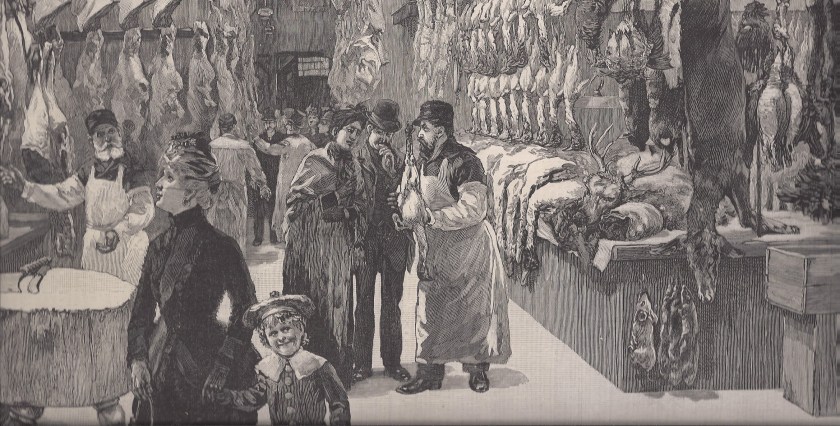
A score or two of butchers had stalls in the market square. Their tent-like stalls were lit by naphtha lamps. They were chopping up meat and haggling over prices with customers. These fat and smiling butchers seemed content. I do not think they liked covered markets. They were used to trading in the open air.
In the lower part of the square, in front of the town hall, were the hucksters and the poultry dealers. Stalls sold green groceries, fruit, and vegetables. A higgler from Cheshire was nicknamed ‘Cabbage’. His cry ‘Cabbage and cou’d (cold) lard’ was so loud that it was heard by customers at other stalls.
Between the higglers and the High Street were the fishmongers.
On Saturdays and Mondays, a quack doctor had a stall outside the Sneyd Arms. He sold patent medicines and displayed extracted teeth, charts and physic bottles on his stall. A real doctor who frequented the Sneyd Arms enjoyed teasing the quack. He sent notes to him asking difficult medical questions. These questions puzzled the quack, who couldn’t answer them.
William Scarratt’s book Old Times in the Potteries, published in 1906, describes the Chatterley Valley in the 1850s.
Ironworks sprang up rapidly in North Staffordshire during the 1850s. I recall a workingman who was a forgeman. He predicted that all the land in the valley would be covered by industrial buildings of one kind or another. I have often thought of that visionary’s foresight when I look at the industries there today.
It was a pretty valley. The Fowlea Brook, surrounded by meadows, ran through it. Willow trees called Osiers grew on its banks. Osiers were small willows with long, flexible shoots used to make baskets. They were grown commercially in damp, marshy fields near the brook.
A shepherd looked after a flock of sheep in a field by the railway line. People in the valley heard the leading sheep’s bell tinkling.
Men working on the night shift in local industries would leave work briefly to smoke their pipes. They would go into the valley to catch a breath of spring. Sometimes, they lingered there for a few minutes in the long twilight of a summer’s evening.
We hope to show a series of film strips during Stoke-on-Trent’s Centenary Year. Schools in the six towns made these film strips in 1960 to celebrate the 50th anniversary of the County Borough of Stoke-on-Trent’s creation.
North Staffordshire Heritage has the scripts for all these film strips. But we only have one film strip, the Township of Tunstall, made by Highgate Secondary School.
The film strips about Burslem, Hanley, Stoke-upon-Trent, Fenton and Longton are missing. If you can help us trace them, please email northstaffordshireheritage@outlook.com


 North Staffordshire Heritage