Tunstall Memorial Gardens

An Open Letter From Lee Wanger (10 November 2024)
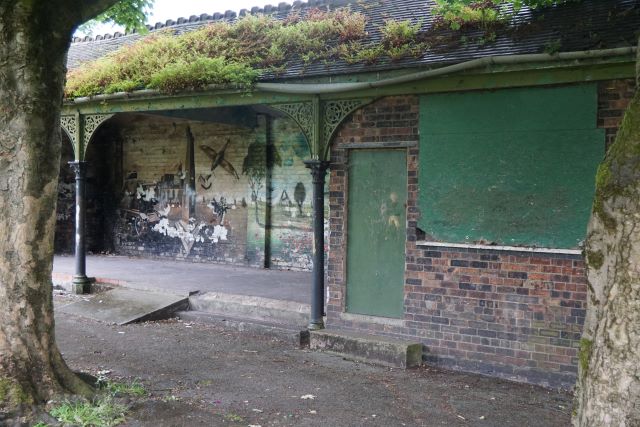
The Pavilion in the Memorial Gardens

I want to draw your attention to the plight of Tunstall’s Memorial Gardens in The Boulevard.

If you haven’t visited the gardens recently, please go and see for yourself how they have been neglected.

While nearly every town has a war memorial, Tunstall’s Memorial Gardens are unique. They are a heritage asset we should be proud of. The gardens are the focal point of a Conservation Area and home to our cenotaph.

My attempts to get Stoke-on-Trent City Council to look after the gardens failed. I consulted heritage lawyers and asked them if there was anything else I could do. They told me my only choice was to shame the council into action. Will you add your voice to mine? Can we work together and ask the council to restore our Memorial Gardens before it is too late?

The pavilion shown in the image has been left to rot. Fires and graffiti have damaged the murals, bricks have been knocked out of the walls and the guttering is collapsing.

The ornate entrance gates and fencing in The Boulevard are rotting away. Finials are missing from the tops of pillars, and the fencing is rusting and disintegrating.

For a long time, I have been asking the council to restore the gardens to their former glory. My requests have been ignored. Now, I need your help. Please write to the City Council, your local Councillor, and your Member of Parliament. Tell them about the plight of the Memorial Gardens. These gardens are of great historical significance. Ask them to stop the neglect and save the gardens.

Many thanks for reading my letter. Best wishes, Lee Wanger

A Tunstall Church Could Help Create a World Heritage Site

The Sacred Heart Catholic Church in Tunstall, designed by Father Patrick Ryan and built by unemployed men could help make North Staffordshire’s Industrial Heritage Landscape a World Heritage Site.

The Sacred Heart Catholic Church in Tunstall is one of Stoke-on-Trent’s hidden jewels.

Architectural historians believe it will help make North Staffordshire’s Industrial Landscape a World Heritage Site. The parish priest, Father Patrick Ryan, designed the church, which was built between 1922 and 1930 by unemployed men.

Anglo-Saxon Tunstall

An Anglo-Saxon Village

Tunstall is one of the oldest towns in the Potteries. Its Old English name suggests it dates from the late 5th or 6th century. 

The Anglo-Saxons called a town or village surrounded by a ditch and a stockade a “Tun”, and a “Stall” was a place inside the stockade where cattle were kept. 

Anglo-Saxon Tunstall was built at the crossroads where a road from the Staffordshire Moorlands to Chester crossed the main highway linking London and the East Midlands with the North West and Scotland. Part of the highway’s route through Tunstall can be traced by following Oldcourt Street, America Street, Hawes Street and Summerbank Road to its junction with High Street. 

The road from the Staffordshire Moorlands to Chester may have been a drove road.

Old drove roads are not easy to trace. In places, they were a quarter of a mile wide. We believe the road from the Staffordshire Moorlands entered Tunstall near the Wheatsheaf Inn and passed through the village on a track called Green Street, which is now Roundwell Street.  

All physical traces of Anglo-Saxon Tunstall have disappeared. Two old field names, God’s Croft and Church Field, tell us there was a church in the village. Another old field name, Cross Croft, suggests that a marketplace may have existed.       

(Revised July 2025)

Tunstall’s First Market

John Henry Clive founded an unincorporated company that gave Tunstall a market hall and a Market Place (Tower Square).

He was born at Bath on 29 March 1781. After his father’s death, John and his mother, Sarah, came to live in Longton.

On 28 May 1793, Sarah married earthenware manufacturer Charles Simpson at St. Giles’ Church, Newcastle-under-Lyme.  

John served an apprenticeship in the pottery industry. He married Lydia Cash on 30 September 1805 at St. Bartholomew’s Church, Norton-in-the Moors.

Shortly after John’s wedding, his stepfather, Charles Simpson, started making pottery at a factory in Sandyford.

Sarah and Charles left Longton and moved to Tunstall, where they lived at Newfield Hall. John and Lydia came to live with them. John managed the Newfield Estate for its owner, Admiral Smith Child, and went into partnership with him. They formed a company, Child & Clive. The firm mined coal and ironstone at Clanway Colliery and made earthenware at Newfield Pottery. 

John was an astute entrepreneur. He realised Tunstall was a growing industrial town. A town that needed shops, a market square and a civic building containing a covered market and a courtroom, where Justices of the Peace could hold Petty Sessions (Magistrates’ Courts) and try minor criminal cases.

John formed a company to finance the project and sold its shares to local businesspeople. The company leased a plot of land, on a field called Stony Croft, for 500 years at an annual rent of £5 from Walter Sneyd, the Lord of the Manor, who lived at Keele Hall. Shares in the company cost £25 each. John bought one share. Walter bought eight, and Ralph Hall, the company’s treasurer, bought two.  

Between 1816 and 1817, the company created Market Place, a market square surrounded by shops and erected a civic building. The building had two names until it became known as the Town Hall in the 1840s. The company called it the Courthouse, and the Sneyd family called it the Market Hall. In the late 1830s, Market Place’s name was changed to Market Square.

NSH-2o24(F) 

We Need Your Help

North Staffordshire Heritage is publishing a series of history books and booklets about Tunstall and is trying to find old photographs of the town. If you can help, please email David at davidmartin227@outlook.com

R.06.09.24

Weeds in Tower Square

Tunstall’s Neglected Heritage

The clock tower in Tower Square, Tunstall.
Weeds at the base of the Smith Child Clock Tower in Tower Square.

Our photograph shows weeds growing at the base of the Smith Child Clock Tower in Tower Square. The tower was erected in 1893 to honour Sir Smith Child, the town’s most generous 19th-century philanthropist.

Tell us about neglected buildings in Tunstall which need regenerating and help save them from demolition.

You can email us at northstaffordshireheritage@0utlook.com

The War Memorial Gardens

Tunstall’s Neglected Heritage

The old shelter in Tunstall's Memorial Gardens
The shelter in Tunstall’s War Memorial Gardens i

Our new series Tunstall’s Neglected Heritage looks at heritage buildings in Tunstall that face an uncertain future.

This photograph of the shelter in Tunstall’s War Memorial Gardens shows weeds growing on the roof, a gutter needing repair, a vandalised mural and a room whose door and window are boarded-up.

Tell us about other buildings in Tunstall that have been neglected by their owners and need regeneration or a facelift to save them from demolition.

Our email address is northstaffordshireheritage@outlook.com

Daimler buses ran from Mow Cop to Tunstall

After the First World War, former soldiers and sailors set up small bus companies and ran bus services from towns and villages on the North Staffordshire Coalfield to Tunstall.
A forty-horsepower Daimler Bus

In 1914, the Potteries Electric Traction Company started running bus services from Biddulph and Mow Cop to Tunstall, using forty-horsepower Daimler Buses.

During the First World War (1914-1918), the government requisitioned the buses and services were suspended. The buses were sent to France, where they were used to take troops to the front line. When the war ended, the buses were returned to the company, and the services resumed.

After the First World War, former soldiers and sailors formed bus companies. The companies ran services to Tunstall that competed with those run by the Potteries Motor Traction Company.

Rowbotham’s was a bus company with a garage in Sands Road, Harriseahead. The firm ran a service from The Bank, a hamlet in South Cheshire, to Tunstall. Its buses ran through Mount Pleasant, Dales Green, The Rookery, Whitehill, Newchapel Packmoor, Chell and Pitts Hill.

The Potteries Electric Traction Company operated another service from The Bank to Tunstall. Its route ran through Mount Pleasant, Dales Green, The Rookery, Whitehill, Kidsgrove, Goldenhill and Sandyford.

Stanier’s was a bus company based in Newchapel. It ran a service from Mow Cop to Tunstall via Harriseahead, Newchapel, Packmoor, Chell and Pitts Hill.

Tunstall’s Wesley Place Chapel

Tunstall’s Wesleyan Methodist Chapel in Wesley Place (now Wesley Street)

The Wesleyan Methodist Chapel in Wesley Place (now Wesley Street), Tunstall, replaced a chapel built near America Street in the 18th century.

Opened in 1835. the Chapel in Wesley Place was a large brick building with a portico supported by four stone pillars. It could accommodate over 1,000 worshipers and was lit by gas lamps.

In 1838 a Sunday School was erected on land behind the chapel. Five or six years later, a Wesleyan Day School opened in the building. The day school became a Board School in 189o. It closed four years later when Wolstanton School Board opened High Steet Schools.

Tunstall’s Windmill

Tunstall Windmill

Tunstall’s windmill stood in a field that became known as Millfield. The field overlooked Roundwell Street and America Street. A track that is now Pierce Street led from America Street to the mill.

The only houses near the mill were three one-storey working men’s cottages.

At one time, a man and his wife lived at the mill. There was a disused mine shaft full of water nearby. One evening the couple had an argument. The wife walked out and did not return. The next morning, her body was found in the mine shaft. She had committed suicide.

When the mill closed, Tunstall’s Drum and Fife band used it as a practice room.

The mill was demolished in the mid-1850s.