The British Ceramics Biennial calls for volunteers

British Ceramics Biennial needs volunteers to help with the 2025 Biennial programme. 

It is looking for creative individuals who love working with people and have a passion for clay and ceramics.

Becoming a volunteer will give you a unique insight into the world of ceramics. You will be part of a major international event that showcases the work of the world’s leading ceramic artists.

Helping local history societies to find good speakers

Many local history societies in Staffordshire and the Potteries have difficulty finding good speakers.

Staffordshire History Network can help to find them. The network has a list of all the speakers who have features in Speakers Corner, a section in its newsletter.

A copy of the list can be obtained from helen.johnson@staffordshire.gov.uk

Lost Film Strips

Can You Help Us Find Them?

We hope to show a series of film strips during 2025, Stoke-on-Trent’s Centenary Year. In 1960, schools in the six towns created these film strips. They were made to celebrate the 50th anniversary of the County Borough of Stoke-on-Trent’s creation.

North Staffordshire Heritage has the scripts for all these film strips. Unfortunately, we only have one film strip, the Township of Tunstall, which was made by Highgate Secondary School.

The film strips about Burslem, Hanley, Stoke-upon-Trent, Fenton and Longton have been lost. If you can help us find them, please email northstaffordshireheritage@outlook.com

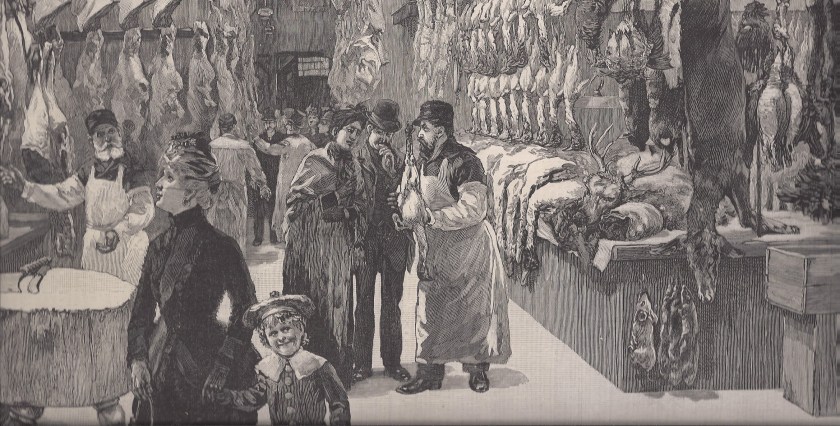
Tunstall Market in the 1850s

A 19th Century Meat Market

In his book, Old Times in the Potteries, published in 1906, William Scarratt describes the scene in Tunstall‘s Market Square. These scenes occur on Saturday nights during the 1850s.

Pottery workers worked a six-day week and were paid their wages at five o’clock on Saturday afternoon.

Saturday night was the busiest time in the market.

A score or two of butchers had stalls in the market square. Their tent-like stalls were lit by naphtha lamps. They were chopping up meat and haggling over prices with customers. These fat and smiling butchers seemed content. I do not think they liked covered markets. They were used to trading in the open air.

In the lower part of the square, in front of the town hall, were the hucksters and the poultry dealers. Stalls sold green groceries, fruit, and vegetables. A higgler from Cheshire was nicknamed ‘Cabbage’. His cry ‘Cabbage and cou’d (cold) lard’ was so loud that it was heard by customers at other stalls.

Between the higglers and the High Street were the fishmongers.

On Saturdays and Mondays, a quack doctor had a stall outside the Sneyd Arms. He sold patent medicines and displayed extracted teeth, charts and physic bottles on his stall. A real doctor who frequented the Sneyd Arms enjoyed teasing the quack. He sent notes to him asking difficult medical questions. These questions puzzled the quack, who couldn’t answer them.

Edited by The History Factory (2025)


Can You Help Trace These Film Strips

We hope to show a series of film strips during Stoke-on-Trent’s Centenary Year. Schools in the six towns made these film strips in 1960 to celebrate the 50th anniversary of the County Borough of Stoke-on-Trent’s creation.

North Staffordshire Heritage has the scripts for all these film strips. But we only have one film strip, the Township of Tunstall, made by Highgate Secondary School.

The film strips about Burslem, Hanley, Stoke-upon-Trent, Fenton and Longton are missing. If you can help us trace them, please email northstaffordshireheritage@outlook.com

Dog Fighting in Tunstall

Fighting dogs were aggressive. When they fought, there was no stopping them.

In his book Old Times in the Potteries, published in 1906, William Scarratt shares his memories of a dog fight.

Although dog fighting declined in the 1840s and 50s, there were still dog fights in Tunstall.

Bull terriers, or fighting dogs, had large yellow and white patches. They also had brindle and white patches on their bodies, over their eyes and on their ears. Their coats were course, and their tails were thick.

Fighting dogs were aggressive, although they were quiet and affectionate at home. They had to be forced to fight, and when they fought, there was no stopping them.

I saw a dog fight when I was a schoolboy. It was between two dogs and took place at dinnertime. One dog was a white bullterrier that weighed 24 lbs. The other was a cross-breed that weighed 28 lbs.

The struggle continued for several rounds until both dogs were exhausted. When the next round started, the dogs had to crawl to each other before starting to fight again.

At the end of each round, the dogs were picked up and taken out of the arena. The hairs caught in their mouths were removed before the next round.

The fight lasted a long time. The dogs continued to fight. To end the contest, their owners reached a compromise. They agreed that the dog entering the arena first would be the winner when the next round started.

The dogs fought for about an hour. When it ended, both dogs were too weak to walk. The men picked them up and carried them to the Grapes Inn. They took the dogs to an outhouse and weighed them.

Edited by North Staffordshire Heritage 2024
The town Bennett forgot

Do you think Fenton is Stoke-on-Trent’s forgotten town? We believe Fenton’s town hall and Christ Church will help make North Staffordshire’s Industrial Landscape a World Heritage Site.

Fenton is called Stoke-on-Trent’s Forgotten Town

Can You Help Us?

We hope to show a series of film strips during Stoke-on-Trent’s Centenary Year.

Schools in the six towns made these films in 1960. They were made to celebrate the 50th anniversary of the County Borough of Stoke-on-Trent’s creation.

North Staffordshire Heritage has the scripts for all these film strips. But, we only have one film strip, The Township of Tunstall, made by Highgate Secondary School.

The film strips about Burslem, Hanley, Stoke-upon-Trent, Fenton and Longton are missing. If you can help us trace them, please email northstaffordshireheritage@outlook.com

DM/LW /BC(2024)

Furlong Road in the 1850s

Scarratt’s Tunstall

Furlong Road ran from High Street, Tunstall, to Greenfield, an industrial village near Pitts Hill. The road was narrow and overhung with laburnum and other trees.

In his book Old Times in the Potteries (published in 1906), William Scarratt describes the road in the 1850s.

In 1854, Furlong Road was like a country lane. The oak and other trees surrounded Greengates House, which Mr William Adams built in the 18th century. These trees were quite leafy. Rooks built their nests in them, and wild ducks sported on the pool in front of the house. At the back of the house were large trees where rooks cawed noisily in the spring. Little birds built nests in the hedgerows below the church – I have found them there. Nobody today would believe that harriers or beagles were kept at this house. But that is a fact. The owner of the house was fond of sport. I met them on the road to school in Newchapel. One of my school fellows, the owner’s son, has followed them, so he said. The road ran from High Street to Greenfield. It was narrow and overhung in some places with laburnum and other trees.

Edited by The History Factory (2024)

Stoke-on-Trent’s Proud Heritage

A city that forgets its past is a city without a future.
Reginald Mitchell’s Spitfire

Stoke-on-Trent is a city with a proud heritage.

Its history is a testament to people from the Potteries who have played significant roles on the world stage. 

Stoke-on-Trent’s city council was one of the pioneers of comprehensive education. It defied Conservative and Labour governments to reform secondary education by creating comprehensive schools and a sixth-form college. 

Local art schools, technical schools and colleges of further education were progressive centres of excellence. Reginald Mitchell, who designed the Spitfire, turned down a place at Birmingham University. He wanted to serve an apprenticeship with a firm in Fenton and study engineering at city technical schools. 

By the early 1930s, the North Staffordshire Technical College was a university in everything but name. The college’s worldwide reputation in ceramic research and mining engineering attracted students from Europe, North America and the Commonwealth.

Some argue that the past is dead. They are mistaken. It lives in our collective memory and shapes our destiny. Our city’s proud heritage tells us who we are and why we are unique. A city that forgets its past is a city without a future.

Can You Help Trace These Film Strips?

We hope to show a series of film strips during Stoke-on-Trent’s Centenary Year. Schools in the six towns made these film strips in 1960 to celebrate the 50th anniversary of the County Borough of Stoke-on-Trent’s creation.

North Staffordshire Heritage has the scripts for all these film strips. But we only have one film strip, the Township of Tunstall, made by Highgate Secondary School.

The film strips about Burslem, Hanley, Stoke-upon-Trent, Fenton and Longton are missing. If you can help us trace them, please email northstaffordshireheritage@outlook.com

St. John’s Church, Goldenhill

Heritage at Risk

The Church of St John the Evangelist at Goldenhill is a Grade II Listed Building. Erected 1840-41, it was built in a Byzantine Romanesque style. St. John’s closed in 2014. Since then the church and the churchyard have been vandalized. Like many other heritage buildings in the Potteries, St. John’s faces an uncertain future.

Image: Copyright David Weston Creative Commons Attribution-Share Alike 2.0 Generic license.