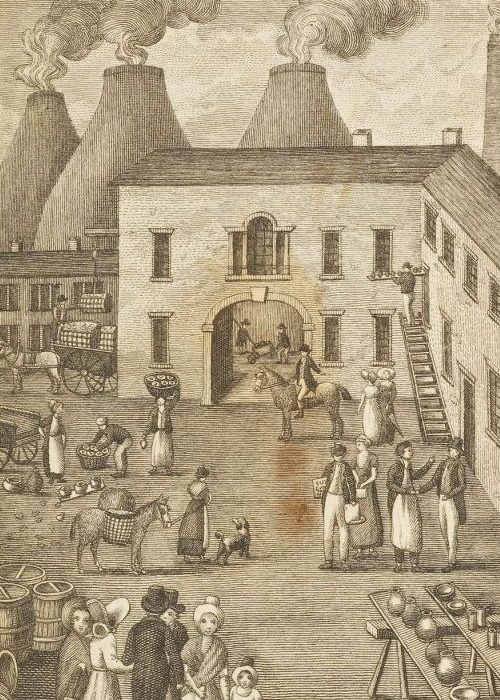
Longport in the 1790s

A Description of the Country From Thirty to Forty Miles Round Manchester, a book published in 1795, was compiled by Dr John Aikin. The book tells us about Newcastle-under-Lyme and North Staffordshire’s pottery towns and villages in the 1790s.

This edited extract from the book describes Longport in the 1790s.

Longport is situated in a valley between Burslem and Newcastle. There are some good buildings in it and several large pottery factories. Because it is in a valley, there are times when the smoke from bottle ovens and kilns hangs over Longport, making the air disagreeable, if not unwholesome.

The Trent & Mersey Canal passes through Longport, where there is a public canal wharf. Before the canal was constructed, Longport was called Longbridge Hays because there was a kind of bridge that ran parallel for a hundred yards with the Fowlea Brook. The bridge was dismantled when the canal was cut.

The number of buildings increased rapidly when the canal was completed, and the village’s name was changed from Longbridge Hays to Longport.
Burslem and Cobridge in the 1790s

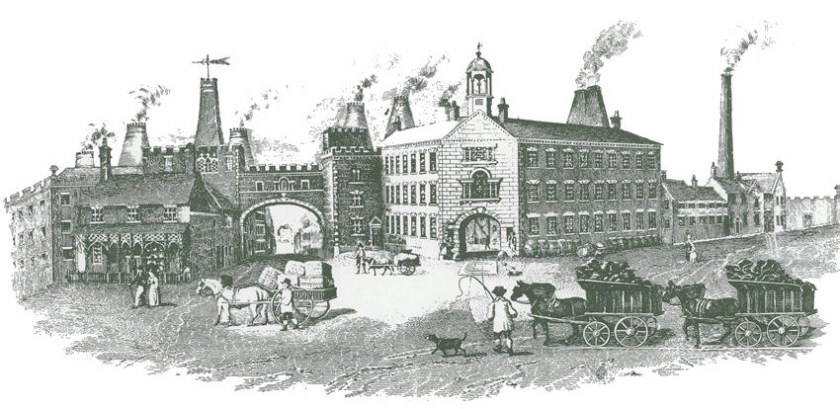
This image shows Wood & Caldwell’s Fountain Place Works in Burslem. In the 1790s the company made Staffordshire figures, earthenware and stoneware. Enoch Wood and James Caldwell were partners in the firm. The firm owned Bycars Colliery, where it mined coal to fire the factory’s bottle ovens and kilns.

A Description of the Country From Thirty to Forty Miles Round Manchester, a book published in 1795, was compiled by Dr John Aikin. The book tells us about Newcastle-under-Lyme and North Staffordshire’s pottery towns and villages in the 179os

This edited extract from the book describes Burslem and Cobridge as they were in the 1790s.

Burslem

Burslem is the home of North Staffordshire’s pottery industry. Earthenware has been made there for many centuries. Dr Plot, in his History of Staffordshire, written in 1686, said that the factories making pottery in Burslem were the largest in the district…

The town has two weekly markets. A large market is held on Monday, and a smaller one is held on Saturday. Four or five years ago, cattle markets were established. These markets are well attended by cattle dealers and butchers.

Burslem is a parish in its own right. The parish church, St John’s, has a good organ. The church has recently been enlarged and regenerated.

There are a large number of [Wesleyan] Methodists in the district. The Methodists have built a large chapel in Burslem and erected chapels in several pottery towns and villages. There are many other religious sects in the Potteries. Few areas have such a great diversity of sincerely held religious opinions.

Cobridge

Cobridge is an industrial village where earthenware is made. It is partly in Burslem Parish and partly in Stoke Parish.

Newfield and Smithfield in the 1790s

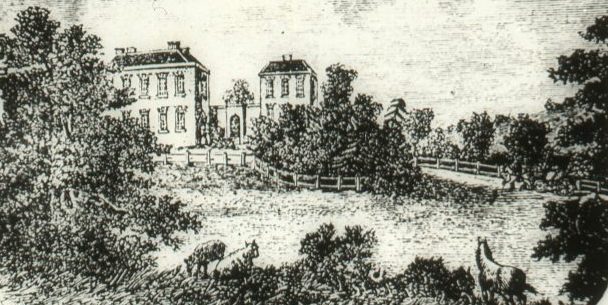
Smithfield Hall, which is shown above, was built in 1791 by Burslem pottery manufacturer, Theophilus Smith. In 1793, he built an industrial hamlet called Smithfield near the hall. Theophilus was declared bankrupt in 1800. He attempted to murder John Wainwright and was remanded to Stafford prison to await trial. When his wife and daughter visited him there, he murdered them and committed suicide. In 1801, the hall was bought by Jesse Breeze, who renamed it Greenfield Hall.

A Description of the Country From Thirty to Forty Miles Round Manchester, is a book published in 1795, compiled by Dr John Aikin. It describes Newcastle-under-Lyme and North Staffordshire’s pottery towns and villages as they were in the 1790s.

This edited extract from the book tells us what Newfield and Smithfield, two hamlets in the Township of Tunstall, were like in the 1790s.Newfield

Newfield is well situated for manufacturing purposes because there is plenty of coal nearby.

The hamlet belongs to Admiral Smith Child. He has a handsome estate there and lives at Newfield Hall. Smith Child owns Newfield Pottery. He is unlikely to allow more factories to be built in the hamlet in the foreseeable future.

Smithfield is the best place in the Potteries to manufacture earthenware. There are several strata of coal and clay, which are needed to make pottery. Smithfield belongs to Theophilus Smith. He owns a pottery and coal mines there. It is unlikely that there will be further industrial development in the hamlet.

Goldenhill in the 1790s

A Description of the Country From Thirty to Forty Miles Round Manchester, a book published in 1795, was compiled by Dr John Aikin. The book tells us about Newcastle-under-Lyme and North Staffordshire’s pottery towns and villages in the 1790s.

This edited extract from the book describes Goldenhill as it was in the 1790s.

One would imagine from its name that Goldenhill is a large, splendid place. But names can be deceptive. In fact, Goldenhill is the smallest village in the Potteries.

Nonetheless, the valuable coal mines, which gave the village its name, make ample amends for its deficiencies.

At the upper [North] end of the village is Green Lane, which commands an extensive view of the surrounding areas. On one side of the lane, the Cheshire Plain can be seen with the Welsh Hills in the distance. On the other side, there is the best view of the Potteries and the countryside beyond it.

The Potteries in the 1790s

A Description of the Country From Thirty to Forty Miles Round Manchester, a book published in 1795, was compiled by Dr John Aikin. The book tells us about Newcastle-under-Lyme and North Staffordshire’s pottery towns and villages in the 1790s.

This edited extract from the book describes the Potteries in the 1790s.

The Staffordshire Potteries commence about a mile from the Cheshire border at a village called Goldenhill.

From there it extends to Lane End [Longton], a distance of more than seven miles. Many of the towns and villages that form the Potteries are linked by houses and factories. The traveller is left with the impression that he is journeying through one town with different names. Manufacturing pottery is the primary business of this extensive and populous area. It is believed that the number of inhabitants or houses has increased threefold over the last twenty years. The towns and villages that make up the Potteries are likely to merge to create one town with one name. Many people who live nearby already call the area The Pottery.