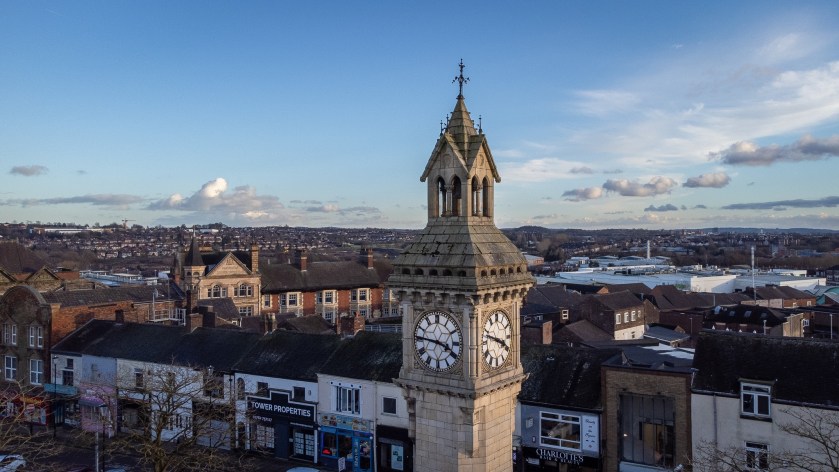
Who was Sir Smith Child? Why was a clock tower erected in Tunstall’s Tower Square to commemorate the financial help he gave to local charities? There are very few people living in Tunstall today who can answer these questions.
No one alive now can remember that, after he died in 1896, local children stood in front of the clock tower and sang in tune with the clock’s Cambridge Chimes, ‘Now Old Smith Child is dead and gone, Tunstall will miss a grand old man.’
Freemasons must wonder why there is a local Masonic Lodge named after him. Smith was not a Freemason. He was a quiet, unassuming man who used his vast wealth to help alleviate poverty and suffering.
Smith was born at Newfield Hall, Tunstall, in 1808.
Although he left Tunstall in 1841, Smith never forgot the town and always called its citizens his friends and neighbours. Smith retained close links with Tunstall and Goldenhill. He gave money to help build churches, support schools and create medical and welfare services.
Smith was a devout Christian. He worshipped at Christ Church while living in Tunstall and at St Nicholas’ Church, Fulford, when he lived at Stallington Hall.
Smith had a stroke that paralysed his left side. He was too ill to travel to Tunstall and lay the museum’s foundation stone.
The speech he had intended to make at the ceremony was read for him. In the speech, he said his philosophy of life was based on a firm belief in practical Christianity.
Smith had been influenced by St Paul’s teaching. He believed everyone was a member of Christ’s family, and it was their duty to use the gifts God gave them to help others. They were all part of one body – the body of Christ – no one could stand alone. People needed each other. He quoted from St Paul’s epistle to the Corinthians, ‘The eye cannot say to the hand, I have no need of thee; nor the head to the feet, I have no need of you.’
Smith hoped this Fundamental Truth would always prevail in Tunstall and that the museum would be dedicated in spirit to that Christian Grace of which St Paul said, ‘And now abideth Faith, Hope and Love, these three, but the greatest of these is Love.’
Smith’s health continued to deteriorate. He died at Stallington Hall on 27 March 1896 and was buried in St. Nicholas’ Churchyard, Fulford.
 North Staffordshire Heritage