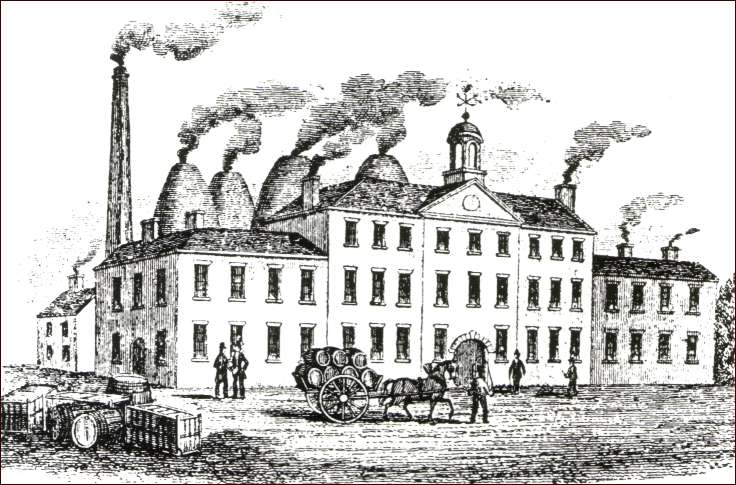
The sketch above shows William Adams’ Greengates Pottery in Tunstall. The factory built between 1779 and 1781 was one of the largest in the Potteries. It manufactured tableware, stoneware and jasper ornaments for the luxury market. William Chaffer, the author of ‘Marks and Monograms on Pottery and Porcelain’, said some of the jasper made at Greengates was ‘equal to, if not superior’ to that produced by Josiah Wedgwood at Etruria.
A Description of the Country From Thirty to Forty Miles Round Manchester, a book published in 1795, was compiled by Dr John Aikin. The book tells us about Newcastle-under-Lyme and North Staffordshire’s pottery towns and villages in the 1790s.
This edited extract from the book describes Tunstall as it was in the 1790s.
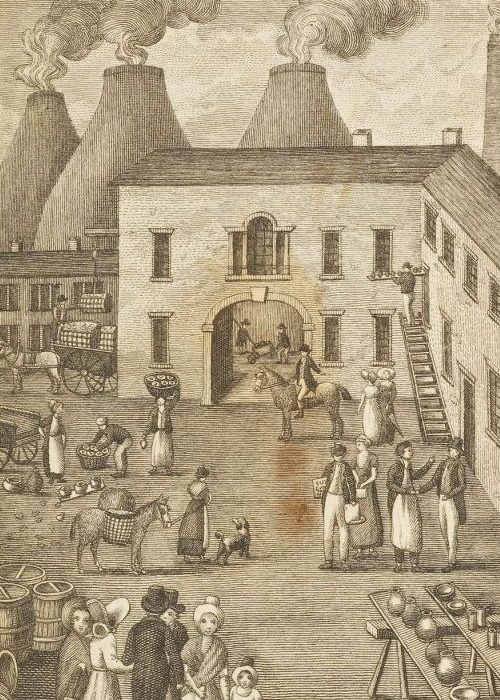
Tunstall is the pleasantest village in the Potteries. It stands on high ground, commanding extensive views of the surrounding countryside. Pottery manufacturers in the village produce good-quality ware and do considerable business. There was a church here, and human bones have been dug up. But such is the effect of time that no trace of either the church or the bones remains today. A small chapel has recently been built here. There is a considerable number of brick and tile works. They use local clay to make blue bricks, which look as well on the roofs of houses as moderate slate. Tunstall is four miles from Newcastle-under-Lyme and nine miles from Congleton. The turnpike road from Lawton to Newcastle-under-Lyme runs through Tunstall, where the turnpike road to Bosley in Cheshire begins [near the Wheatsheaf Inn].
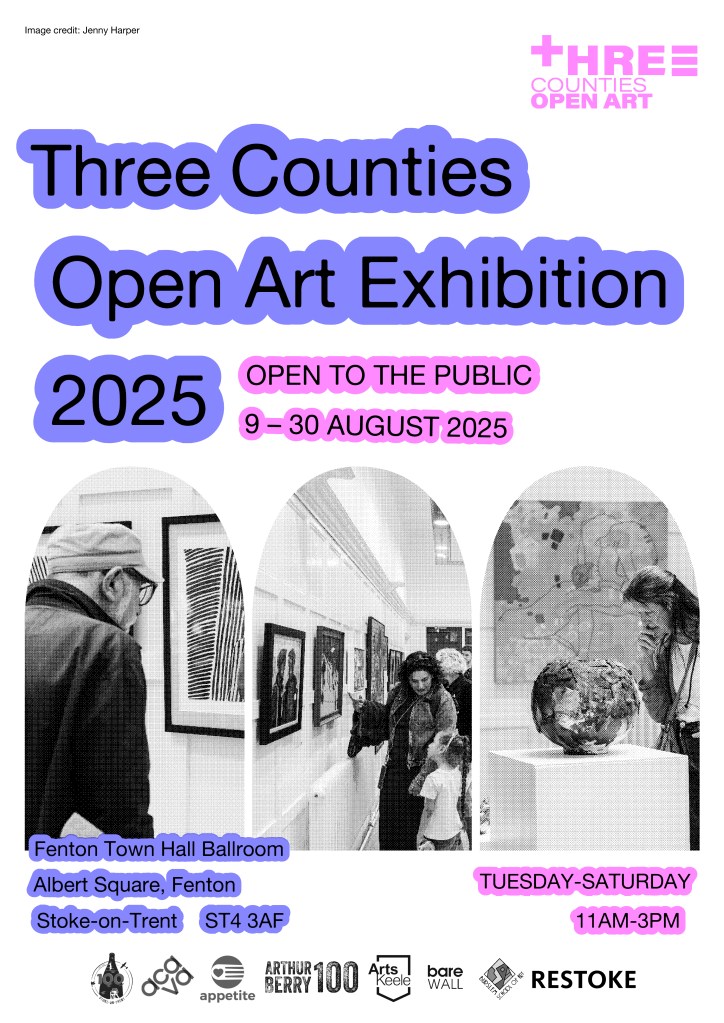
This year’s Three Counties Open Art Exhibition is being held in the ballroom at Fenton Town Hall. The exhibition runs from Saturday, August 9th, until Saturday, August 30th. It will be open on Tuesdays, Wednesdays, Thursdays, Fridays and Saturdays.
Artists from Staffordshire, Shropshire, and Cheshire are exhibiting their work, which includes paintings, drawings, sculptures, and moving images.
The cafe in the town hall will be open for refreshments and light bites.
A Description of the Country From Thirty to Forty Miles Round Manchester, a book published in 1795, was compiled by Dr John Aikin. The book tells us about Newcastle-under-Lyme and North Staffordshire’s pottery towns and villages in the 1790s.
This edited extract from the book describes Goldenhill as it was in the 1790s.
One would imagine from its name that Goldenhill is a large, splendid place. But names can be deceptive. In fact, Goldenhill is the smallest village in the Potteries.
Nonetheless, the valuable coal mines, which gave the village its name, make ample amends for its deficiencies.
At the upper [North] end of the village is Green Lane, which commands an extensive view of the surrounding areas. On one side of the lane, the Cheshire Plain can be seen with the Welsh Hills in the distance. On the other side, there is the best view of the Potteries and the countryside beyond it.
A Description of the Country From Thirty to Forty Miles Round Manchester, a book published in 1795, was compiled by Dr John Aikin. The book tells us about Newcastle-under-Lyme and North Staffordshire’s pottery towns and villages in the 1790s.
This edited extract from the book describes the Potteries in the 1790s.
The Staffordshire Potteries commence about a mile from the Cheshire border at a village called Goldenhill.
From there it extends to Lane End [Longton], a distance of more than seven miles. Many of the towns and villages that form the Potteries are linked by houses and factories. The traveller is left with the impression that he is journeying through one town with different names. Manufacturing pottery is the primary business of this extensive and populous area. It is believed that the number of inhabitants or houses has increased threefold over the last twenty years. The towns and villages that make up the Potteries arelikely to merge to create one town with one name. Many people who live nearby already call the area The Pottery.
A Halifax Bomber like the one that crashed on Grindon Moor.
The winter of 1946-47 was long and hard. There were heavy snowfalls and gale-force winds. Temperatures fell to below freezing, and icicles hung from the roofs of houses.
Mainline railway lines were kept open, but frozen points on branch lines prevented coal trains from leaving collieries. The National Coal Board did not thaw the points. They stockpiled coal at the pit head. This created a fuel shortage, and British industry was forced to introduce short-time working.
Between Sunday, February 2nd and Tuesday, February 4th, 1947 a blizzard lasting forty-eight hours swept across Staffordshire and Cheshire. More than ten inches of snow fell. Roads became impassable and motorists abandoned their vehicles.
Villages in the Staffordshire Moorlands were isolated by snowdrifts five or six feet deep. Over a hundred snowploughs and bulldozers fought to keep Staffordshire’s main roads open. German prisoners of war helped to clear the snow from roads leading into Burton-on-Trent. A working party from Stafford prison cleared snow blocking the road from Stafford to Stone.
In the Potteries, roads blocked by snowdrifts were reopened by Polish troops stationed at Keele. A bus fitted with a snowplough opened the road to Leek, but surrounding villages remained cut off.
Power stations producing electricity were running out of coal and output fell. Supplies of electricity were disrupted. Householders were asked not to use electricity between 9.00am and noon and between 2.00pm and 4.00pm. These savings were not enough to keep hospitals supplied with electricity. On February 7th, the government ordered companies to stop using electricity.
Industry throughout the country was hard hit. Factories were forced to close. At Stafford, English Electric dismissed its 5,000 employees. In the Potteries 44,000 men and women were made redundant.
At a meeting in Stoke, the National Political Union condemned the Labour government. It blamed the government for creating a fuel crisis. The crisis also caused widespread unemployment.
A few shopkeepers in Stafford continued to use electric spotlights to highlight displays in their shop windows. Lights and heating were turned off at the Guildhall where the Magistrates’ Court sat. It was so cold in the courtroom that Justices of the Peace wore their overcoats.
Many shops were lit by candlelight. Old gas mantles were used to light offices throughout the region. The Midland Bank at Crewe was lit by oil lamps and hurricane lamps were used to light Stoke town hall.
Blizzards prevented rescue teams from reaching Longnor, Butterton, Grindon and Ilam, isolated villages where 3,000 people were trapped.
The Royal Air Force was asked to help. At RAF Fairford in Gloucestershire, Halifax Bombers were loaded with food supplies for the villagers.
On February 12th, despite adverse weather conditions and low clouds, a bomber dropped thirteen canisters containing food near Longnor. Volunteers helped Police Sergeant Davenport carry the canisters to the village hall. They contained margarine, lard, sugar, cheese, bread and jam for the villagers and people living in neighbouring hamlets.
The next day, another Halifax, piloted by Squadron Leader McIntyre, took off from Fairford with food for Butterton. Weather conditions had deteriorated overnight. Visibility was poor. People on the ground, who were waiting for the food canisters to be dropped, heard the aircraft’s engines. They could not see the plane.
Squadron Leader McIntyre flew low hoping to find the dropping zone. The plane’s engines cut out. There was an explosion, and the Halifax crashed near Sheldon Farm on Grindon Moor. Eight men were on board. Only one survived the impact. He was unconscious when rescuers pulled him out of the cockpit and died shortly afterwards.
Among the dead was twenty-four-year-old Sergeant William Sherry from Clews Street, Burslem. Educated at Middleport School, he had been an army glider pilot before transferring to the Royal Air Force. William served with the 1st Airborne Division. He fought at Arnhem, where he was wounded and captured by the Germans.
Note: A Hard Winter (1946-1947) is one of a series of articles written by Betty Martin before her death. Other articles from the series will be posted from time to time.

 North Staffordshire Heritage