Historic Tunstall: Absalom Read Wood (1851-1922)

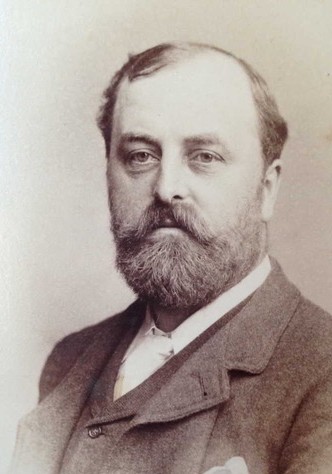
Absalom Reade Wood was one of North Staffordshire’s leading Architects. He created Tunstall’s unique Victorian Civic Centre.

When Absalom Reade Wood died in 1922, North Staffordshire lost one of its leading architects. During his long life, Absalom had created numerous churches and chapels, houses and factories, schools and civic buildings throughout the district.

He was born at Burslem in 1851, and attended the town’s Wesleyan Day School. When he left school, Absalom was articled to Shelton architect Robert Scrivener.

Absalom was a small man, with ‘a comfortable, neat figure and a short beard’ and a warm, friendly personality that gave him an optimistic outlook on life. He was a keen sportsman who enjoyed cycling, swimming, and playing cricket, tennis, and golf.

He became an architect during the early 1870s and established his own practice in Tunstall in 1874.

A year later, Absalom became the town’s part-time surveyor, a position he held until the creation of the County Borough of Stoke-on-Trent in 1910. Working closely with John Nash Peake and the town clerk, Arthur Llewellyn, he modernised Tunstall’s market hall. He created the town’s unique late Victorian Civic Centre containing his piece de resistance the town hall, which opened in 1875.

Other civic buildings Absalom designed included Kidsgrove’s town hall and Longton’s Sutherland Institute. Burslem School Board employed him to build Jackfield, Park Road and Longport Schools.

Absalom married Mary Holdcroft, the daughter of pottery manufacturer William Holdcroft. The couple had five children – two boys and three girls. The Wood family were Methodist. They worshipped at Hill Top Methodist Church in Burslem. In 1889, Absalom was employed to enlarge and modernise the church.

Absalom’s best-known building in Burslem is the Art School in Queen Street. Situated on land opposite the Wedgwood Institute, which was given by Thomas Hulme, the school cost £8,500. The school opened in 1907, and one of its most famous alumni was pottery designer Clarice Cliff.

Clarice was born in Meir Street, Tunstall, on 20 January 1899. Before going to Burslem Art School, she attended High Street School, Tunstall, Summerbank Road School, Tunstall and Tunstall Art School, which was housed in the Jubilee Buildings in Station Road (now The Boulevard). High Street and Summerbank Road Schools were designed by Absalom, as were the Jubilee Buildings.

Absalom died at his home Hillcrest, Woodland Avenue, Wolstanton on 21 December 1922.

Absalom Reade Wood (1851-1922) is one of a series of articles about North Staffordshire’s history written by Betty Martin before her death. Other articles from the series will be posted from time to time.

Friday NewsDesk

This has been a week of contrasts. We were delighted to learn that Longton is going to get a £2 million facelift. It will ease traffic congestion and attract more customers to the town’s shops and heritage market. Although disappointed, we were not surprised that production at Wedgwood’s Barlaston factory will cease from the end of September until January 5th 2026. The company’s accounts are due to be published in October. We wonder how economists will view them.

The Brownhills Murder (1797), the first post in our new series about Tunstall called Historic Tunstall, was posted this week.

Monday, September 15th, was Battle of Britain Day. Our post, North Staffordshire and the Battle of Britain, paid tribute to those whose courage in the face of overwhelming odds saved the world from Nazi domination and gave Britain its finest hour.

Although he is taking a Sabbatical to study Anglo-Saxon legal history, David will continue to edit our website.

We hope you have a relaxing and enjoyable weekend. Take care and stay safe.

Historic Tunstall: The Brownhills Murder (1797)

John Wood, whose father was a pottery manufacturer in Burslem, bought the Brownhills estate near Tunstall in 1782.

He built a pottery factory on the estate and erected Brownhills Hall. The hall was a red brick Georgian mansion, where John lived with his wife, Mary, and their children.

In 1796, Mary was taken ill, and John asked Burslem surgeon Thomas Oliver to treat her. During his visits to the hall, Thomas met and fell in love with their daughter Maria. His love was reciprocated, and the couple wanted to get married. Although Thomas had a successful practice, John refused to let him marry her.

He ordered Thomas to leave the hall and never darken its doors again.

Maria and Thomas started meeting near a mill in the Scotia Brook Valley. One evening, John found them there. He attacked Thomas, and the two men fought each other. After the fight, John called Thomas a poor beggar and ordered Maria to stop seeing him.

Maria obeyed her father and refused to see John again. John was devastated. He neglected his practice, took no interest in his personal appearance and started drinking heavily.

John’s wife, Mary, was taken seriously ill. John asked Thomas to treat her. He agreed, and she became his patient again. When Mary recovered, Maria and Thomas asked John to let them marry. He refused. Thomas became angry and told John that he would get even with him. After making the threat, Thomas left Brownhills Hall and walked home.

A few days afterwards, Thomas, armed with two loaded pistols, went to Brownhills Hall. When he arrived there, John was still in bed. Thomas went to the factory to wait for him in his office. When he came into the office, Thomas gave him the bill for treating Mary.

John gave the bill to Mr. Bathwell, one of his clerks and spoke to him. While he was speaking to Mr. Bathwell, Thomas pulled a pistol out of one of his pockets. He shot John. After firing the pistol, Thomas attempted to commit suicide by shooting himself. Before he could pull the trigger, Mr Bathwell knocked the gun out of his hand.

John looked at Thomas and said to him, “Oh, sir, you have killed me.” Thomas replied, “It is what I intended.” He made another attempt to kill himself. The attempt failed and he was arrested.

John died three days later. Thomas was charged with murder and remanded in custody to await trial at Staffordshire Assizes.

His trial took place on Friday, 25th August 1797. He pleaded not guilty by reason of insanity. Two leading physicians gave evidence to support his plea. Their evidence was rejected by the jury. He was found guilty and sentenced to death.

Until the beginning of the 20th century, a person found guilty by a jury at an Assize Court or Quarter Sessions could not appeal against conviction or sentence. Punishment was inflicted within days of the sentence being passed. Thomas was executed at 10.30am on Monday, 28th August, just three days after his trial.

After taking communion in the prison chapel, he walked calmly and bravely to the gallows. His body was taken to Stourbridge, where it was buried in the family grave.

The Brownhills Murder is one of a series of articles about North Staffordshire’s history written by Betty Martin before her death. Other articles from the series will be posted from time to time.