My story begins with a journey from Burslem in Staffordshire to Toxteth in Liverpool in November 1796.
To read the post, press the title A Herculaneum Potter (above).
My story begins with a journey from Burslem in Staffordshire to Toxteth in Liverpool in November 1796.
To read the post, press the title A Herculaneum Potter (above).
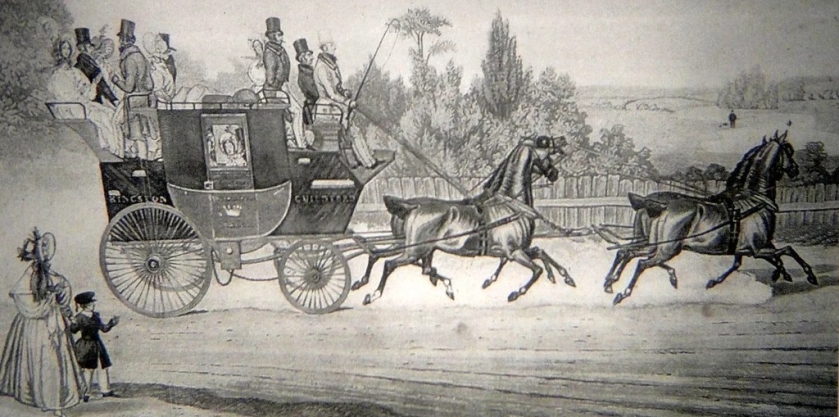
During the 1830s, two firms, the Red Rover Company and the Royal Express Company, ran mainline stagecoaches between London and Liverpool.
Between Warrington and the Potteries, the coaches were driven along the Old Lane (the A50) that linked London and the East Midlands with Merseyside and the Northwest. These coaches stopped at the Sneyd Arms in Tunstall to pick up passengers. When they left the Sneyd Arms, the coaches followed the Old Lane through the Potteries, stopping at coaching inns in Burslem, Hanley, Stoke, Fenton and Longton.
On leaving Longton, coaches owned by the Royal Express Company left the Old Lane and went to London via Stone, Rugeley, Lichfield, Birmingham and Warwick. Coaches owned by the Red Rover Company followed the Old Lane to Hockcliffe in Bedfordshire, where it joined the London to Holyhead Road (the A5).
Two Stoke-on-Trent firms, the Hark Forward Company and the Independent Potter Company, ran day return stagecoach services that stopped to pick up passengers at the Sneyd Arms.
The Hark Forward Company’s coach went to Birmingham via Stone, Stafford and Wolverhampton. The Independent Potter Company’s coach ran to Manchester, Congleton, Macclesfield and Stockport. These two coaches left the Potteries early in the morning and returned late at night.
Stagecoaches were pulled by teams of four or six horses and could travel at a speed of eight to ten miles an hour. Travelling by stagecoach was expensive, and tickets had to be booked in advance. Coaches carried first and second class passengers. First class passengers travelled in the coach, and second class passengers sat on wooden seats on the roof.
The cost of the journey depended on its length. First-class passengers were charged threepence per mile, and second-class passengers were charged one and a half pence per mile.
NSH.2023
 North Staffordshire Heritage