Miss Featherstone Was Lee’s Favourite Teacher
From London to Tunstall
My sister, Sylvia, and I moved to Tunstall when my parents left London in the mid-1950s. We moved from Bow, in the East End, where my father’s family lived. Shortly after the war, there was a housing shortage in London, and my parents were forced to live in a terraced house with my grandparents. My mother, who came from Tunstall, heard of a house for sale on Rathbone Street. My parents bought the property, and we moved to Tunstall.
St Mary’s Infants’ School
I was about five years old. My sister, Sylvia was three. We attended St Mary’s Infants’ School on Lascelles Street, which is the first school I can clearly remember. On our first day at St Mary’s, we stood in the playground holding each other’s hands. Sylvia and I were overwhelmed by what seemed to us to be a vast, unfamiliar building. Our strong Cockney accents made us stand out from the other children. They kept staring at us, and we became frightened.
Miss Featherstone
Our fears were quickly allayed by Miss Featherstone, the headmistress. Her warm, reassuring manner quickly put us at ease. Despite her stern appearance and black dress, Miss Featherstone was a remarkably kind and dedicated teacher. She seemed to run the school single-handed and always showed genuine care for every child there. I don’t think she married and had children, but she treated all her pupils as if they were her own children
Many years later, I passed Miss Featherstone on the High Street. She greeted me simply by name as she walked by. I was surprised that she remembered me. It was just a moment in time. A moment that made a lasting impression on me and spoke volumes about her remarkable memory.
An Afternoon Nap
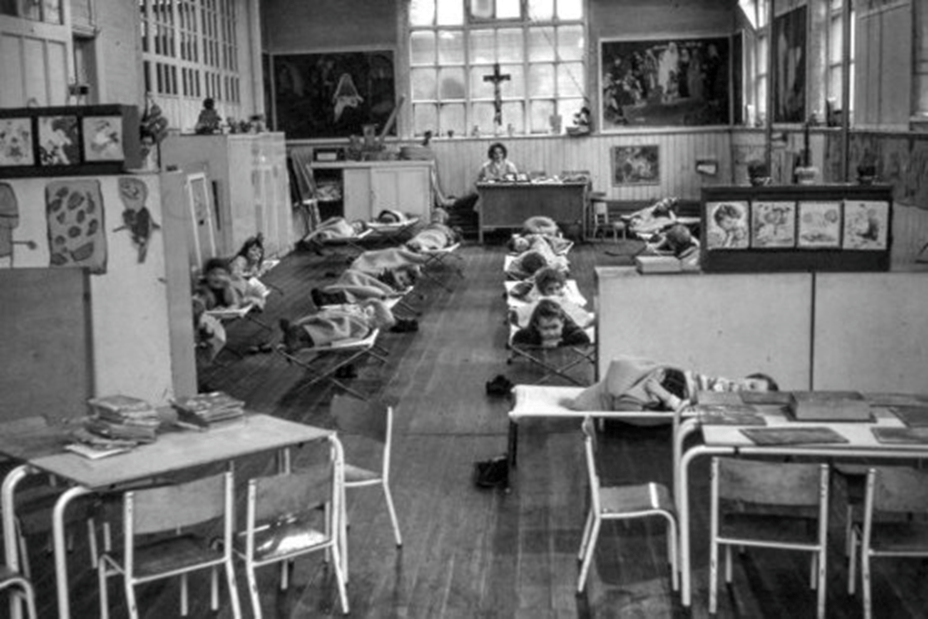
Another vivid memory of my first day at St Mary’s is that in the afternoon, the school hall was filled with small beds where we were expected to take an afternoon nap when play time ended. I found the idea of going to bed puzzling and unnecessary. I often wonder whether this was common practice in infant schools at the time.
Tell Us About Your School Days
We all remember that one teacher who made a lasting difference – the one who inspired us, encouraged us or simply made school a little brighter. Maybe they sparked your love of a subject, believed in you when you doubted yourself, or had a way of making lessons fun. We would love to hear your stories. Your memories can help celebrate the teachers who shaped our lives and remind us of the influence great teachers have on their students.
If, like us, you enjoyed reading Lee’s account of his first day at St Mary’s Infants’ School and his memories of Miss Featherstone, please visit https://northstaffordshireheritage.co.uk/2026/02/03/share-your-story-who-was-your-favourite-teacher/ and tell us about your favourite teacher.

 North Staffordshire Heritage