In 1876, Calver House and its grounds in Roundwell Street, Tunstall, were converted into a non-political and inter-denominational workingmen’s club.
The idea of using the house and its grounds to give Tunstall a workingmen’s club came from Sir Smith Child, who gave £100 towards the cost of conversion.
Inside the clubhouse, there were rooms for conversation, smoking, and playing games, including bagatelle, draughts, and chess. It contained reading rooms where members could read books and newspapers, a lecture theatre and a bar that sold alcoholic drinks.
The management committee intended to open a lending library, enabling members to borrow books and planned to create a recreation ground and build a gymnasium.
Membership of the club costs 2d per week, 6d a month or 1s 3d a quarter.
Smith opened the club on 14 July 1876. The opening ceremony was preceded by a parade led by the Tunstall Volunteer Band from the town hall along High Street to Calver House. During the ceremony, Smith said he was always happy to support any project that benefited Tunstall and its citizens. He believed the club could become the second home for many young working men who had only a bedroom in the house they lived in, that they could call their own.
Absalom Reade Wood was one of North Staffordshire’s leading Architects. He created Tunstall’s unique Victorian Civic Centre.
When Absalom Reade Wood died in 1922, North Staffordshire lost one of its leading architects. During his long life, Absalom had created numerous churches and chapels, houses and factories, schools and civic buildings throughout the district.
He was born at Burslem in 1851, and attended the town’s Wesleyan Day School. When he left school, Absalom was articled to Shelton architect Robert Scrivener.
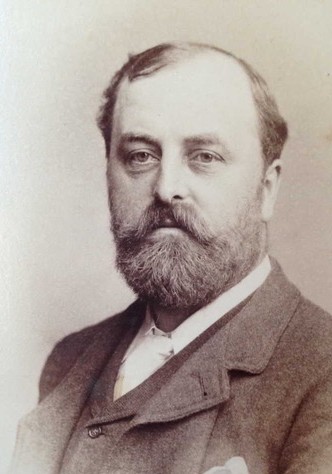
Absalom was a small man, with ‘a comfortable, neat figure and a short beard’ and a warm, friendly personality that gave him an optimistic outlook on life. He was a keen sportsman who enjoyed cycling, swimming, and playing cricket, tennis, and golf.
He became an architect during the early 1870s and established his own practice in Tunstall in 1874.
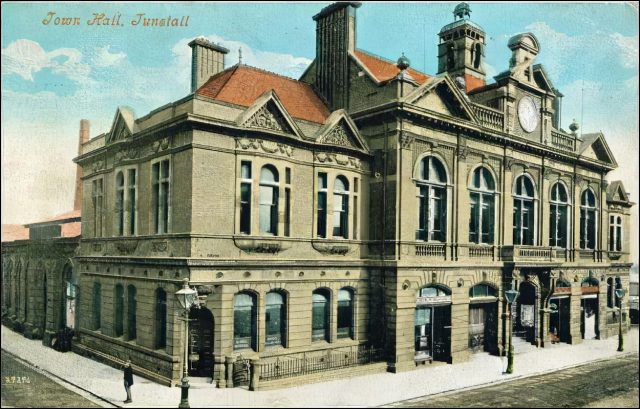
A year later, Absalom became the town’s part-time surveyor, a position he held until the creation of the County Borough of Stoke-on-Trent in 1910. Working closely with John Nash Peake and the town clerk, Arthur Llewellyn, he modernised Tunstall’s market hall. He created the town’s unique late Victorian Civic Centre containing his piece de resistance the town hall, which opened in 1875.
Other civic buildings Absalom designed included Kidsgrove’s town hall and Longton’s Sutherland Institute. Burslem School Board employed him to build Jackfield, Park Road and Longport Schools.
Absalom married Mary Holdcroft, the daughter of pottery manufacturer William Holdcroft. The couple had five children – two boys and three girls. The Wood family were Methodist. They worshipped at Hill Top Methodist Church in Burslem. In 1889, Absalom was employed to enlarge and modernise the church.
Absalom’s best-known building in Burslem is the Art School in Queen Street. Situated on land opposite the Wedgwood Institute, which was given by Thomas Hulme, the school cost £8,500. The school opened in 1907, and one of its most famous alumni was pottery designer Clarice Cliff.
Clarice was born in Meir Street, Tunstall, on 20 January 1899. Before going to Burslem Art School, she attended High Street School, Tunstall, Summerbank Road School, Tunstall and Tunstall Art School, which was housed in the Jubilee Buildings in Station Road (now The Boulevard). High Street and Summerbank Road Schools were designed by Absalom, as were the Jubilee Buildings.
Absalom died at his home Hillcrest, Woodland Avenue, Wolstanton on 21 December 1922.
Absalom Reade Wood (1851-1922) is one of a series of articles about North Staffordshire’s history written by Betty Martin before her death. Other articles from the series will be posted from time to time.
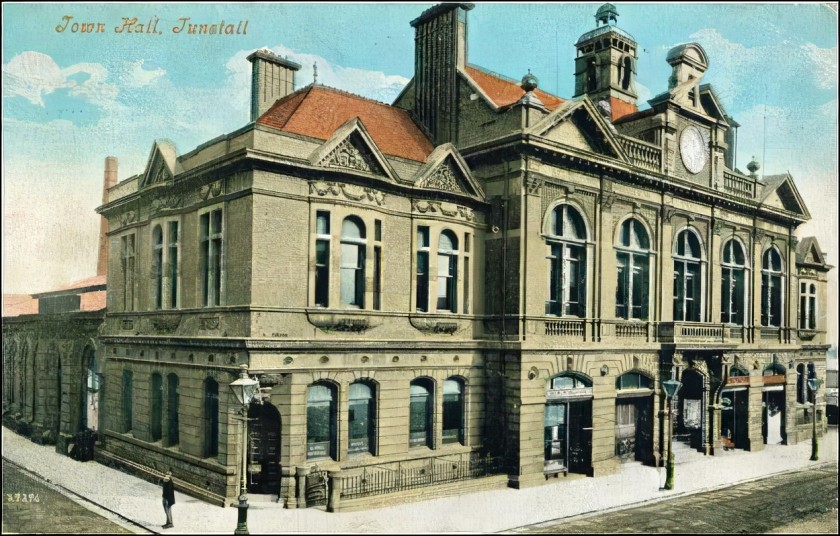
Tunstall Town Hall is part of Tunstall’s unique late Victorian Civic Centre. It was designed by Absalom Reade Wood and opened by John Nash Peake on 29 October 1885.
John Nash Peake, after whom Nash Peake Street is named, was one of Tunstall’s most flamboyant characters. Born in Tunstall on 13 April 1837, he was the son of Thomas Peake.
Thomas owned Tunstall Tileries, in Watergate Street. He was the town’s Chief Bailiff (Chief Constable) and Chairman of the Board of Health from 1858 to 1861.
John, whose Christian names were John and Nash, was educated at the North London Collegiate School. At school, he showed considerable artistic ability. When he left school, John became a student at the Royal Academy, where he studied under Millais, one of England’s leading artists.
One of John’s paintings, Alpine Monks Restoring a Traveller, was exhibited at Burlington House when he was 18 years old. A year later, he showed another painting, The Last Hours of the Condemned, which portrayed a soldier awaiting execution.
Although he could have stayed in London and become a professional artist, John returned to Tunstall in the 1850s. He joined his father’s company, which made bricks, tiles, water pipes and ornamental garden pottery. John managed the firm after Thomas’s death in 1881. Under his management, the works doubled in size. It became one of the largest tileries in the world. There were 35 ovens producing more than 250,000 tiles a week.
John had a strong personality. He was a man with a keen intellect and a commanding presence, who was eloquent, versatile and persevering.
A devout Christian, John was an evangelist and a member of the Church of England. He opposed the Oxford Movement’s attack on the Reformation and its plan to make the Pope head of the Church of England.
His views on the activities of the Oxford Movement were shared by Sir Smith Child and Tunstall’s leading Methodists.
John spoke out against the movement’s growing influence and the introduction of Roman Catholic dogma and rites into Potteries’ churches. The Wesleyan Methodists invited him to lay one of King Street Methodist Church’s* four foundation stones.
The stones were laid on 20 October 1873. During the ceremony, John said he was sure that the Wesleyan Methodist Church would defend the Protestant faith. He was grieved to see the Church of England abandoning its traditions and embracing the doctrines of Roman Catholicism. John advised the Wesleyans to adhere to their faith and not allow anyone to interfere with it. He told them that the doctrines being introduced into the established church would destroy the Reformation.
John was a member of the Liberal Party. In 1869, he became a member of Tunstall’s Board of Health. His energy and determination led to the creation of the town’s Victorian civic centre. This centre included a new town hall and a public library as well as a school of art and science, a museum, a fire station, public baths, a drill hall and a recreation ground.
Despite his busy commercial and political life, John retained his interest in art. He painted portraits of Queen Victoria, Lord Roberts, and his father (Thomas Peake). He also painted Sir Smith Child and civic leaders, including Alfred Meakin, George Wilks, Henry Smallman, and Thomas Booth. These portraits hung in the town hall. A self-portrait which he painted was hung in the museum. Other examples of his work displayed there included Bosley Reservoir and Cloud End, The Fishing Fleet at Tenby, Menai Suspension Bridge, The Isle of Arran and The Matterhorn.
He designed the Free Library sign that hangs outside the Jubilee Building and Victoria Park’s main gates, which were erected in memory of his father.
On 15 October 1903, John gave Tunstall a mahogany cabinet with drawers to store the town’s records. One of his portraits of Queen Victoria is incorporated into the cabinet. The cabinet remains in the council chamber of the former town hall. Its doors open to reveal a list of the main events in the town’s history. There are also photographs of the chief bailiffs (Chief Constables), clerks, and surveyors from 1855 to 1909.
A bronze portrait bust of John was unveiled in the council chamber. He was given an illuminated address to thank him for his services to the town.
John, who was 66 years old, said: “I know well that day by day, I come nearer to a time when I shall be forever absent from the council chamber and the streets. Think, then, what it means to me this surprising tribute of yours that I shall not be forgotten: that I shall be with you, dwelling among my own people in imperishable bronze.”
He died three years later on 29 April 1905. The bronze bust disappeared many years ago. So far, all attempts to trace it have failed.
*King Street is now Madison Street.The church was demolished in the 1970s.
Note: John Nash Peake (1837-1905) is one of a series of articles Betty Martin wrote before she died in 2023. More articles from this series will be posted periodically.
The filmstrip ‘The Township of Tunstall’, last seen in the 1990s, was shown again last Saturday in Tunstall Town Hall.
Made by Highgate School in 1960, the filmstrip depicts life in the town during the 19th century and features images of historic buildings that have been demolished. Members of the audience were introduced to Anglo-Saxon Tunstall and told about the lives of Sir Smith Child and John Nash Peake.
Did you go to the discos held in Tunstall town hall during the 1970s and 80s?
These discos were designed for young people; only light refreshments and soft drinks were sold. When they started in 1974, discos were held on Saturday nights. The discos were popular with teenagers. By 1977, they were being held on Monday and Friday nights.
David Martin and Lee Wanger are writing a book about Tunstall Town Hall and Market. They would like to know more about these discos. If you went to the discos, share your memories with David and Lee. You can email David at davidmartin227@outlook.com
 North Staffordshire Heritage