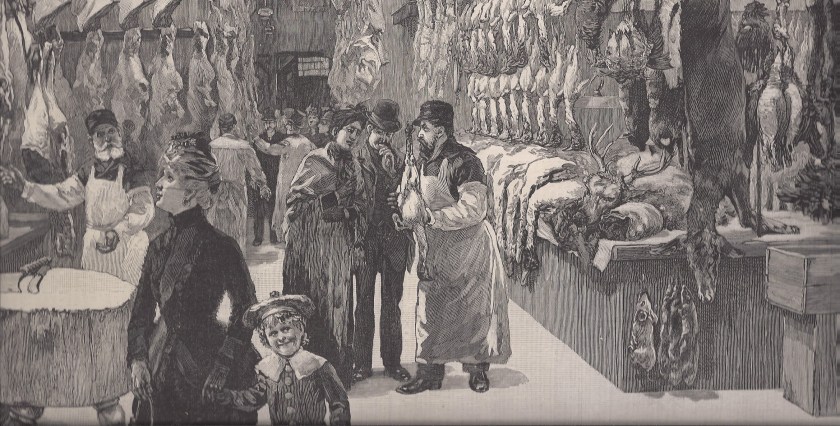
Tunstall Market in the 1850s

A 19th Century Meat Market

In his book, Old Times in the Potteries, published in 1906, William Scarratt describes the scene in Tunstall‘s Market Square. These scenes occur on Saturday nights during the 1850s.

Pottery workers worked a six-day week and were paid their wages at five o’clock on Saturday afternoon.

Saturday night was the busiest time in the market.

A score or two of butchers had stalls in the market square. Their tent-like stalls were lit by naphtha lamps. They were chopping up meat and haggling over prices with customers. These fat and smiling butchers seemed content. I do not think they liked covered markets. They were used to trading in the open air.

In the lower part of the square, in front of the town hall, were the hucksters and the poultry dealers. Stalls sold green groceries, fruit, and vegetables. A higgler from Cheshire was nicknamed ‘Cabbage’. His cry ‘Cabbage and cou’d (cold) lard’ was so loud that it was heard by customers at other stalls.

Between the higglers and the High Street were the fishmongers.

On Saturdays and Mondays, a quack doctor had a stall outside the Sneyd Arms. He sold patent medicines and displayed extracted teeth, charts and physic bottles on his stall. A real doctor who frequented the Sneyd Arms enjoyed teasing the quack. He sent notes to him asking difficult medical questions. These questions puzzled the quack, who couldn’t answer them.

Edited by The History Factory (2025)
 

The Chatterley Valley in the 1850s

William Scarratt’s book Old Times in the Potteries, published in 1906, describes the Chatterley Valley in the 1850s. 

Ironworks sprang up rapidly in North Staffordshire during the 1850s. I recall a workingman who was a forgeman. He predicted that all the land in the valley would be covered by industrial buildings of one kind or another. I have often thought of that visionary’s foresight when I look at the industries there today. 

It was a pretty valley. The Fowlea Brook, surrounded by meadows, ran through it. Willow trees called Osiers grew on its banks. Osiers were small willows with long, flexible shoots used to make baskets. They were grown commercially in damp, marshy fields near the brook.  

A shepherd looked after a flock of sheep in a field by the railway line. People in the valley heard the leading sheep’s bell tinkling. 

Men working on the night shift in local industries would leave work briefly to smoke their pipes. They would go into the valley to catch a breath of spring. Sometimes, they lingered there for a few minutes in the long twilight of a summer’s evening. 

Edited by The History Factory (2025) 
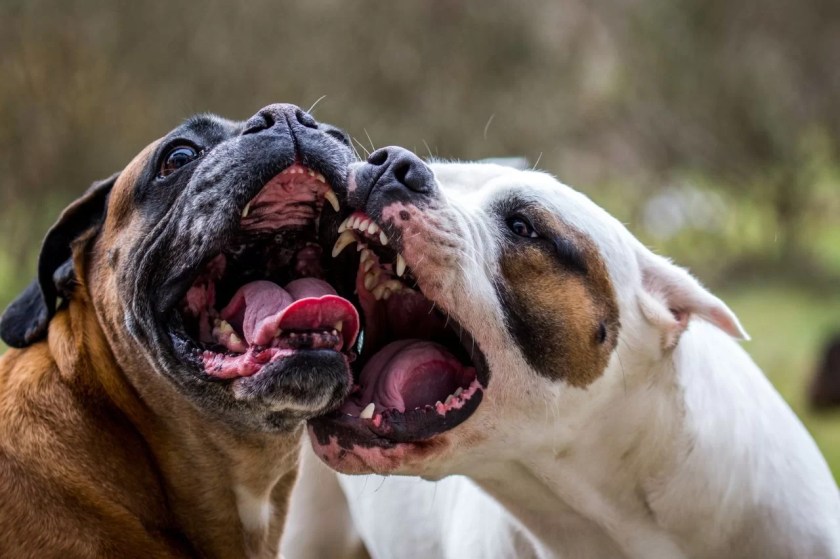
Dog Fighting in Tunstall

Fighting dogs were aggressive. When they fought, there was no stopping them.

In his book Old Times in the Potteries, published in 1906, William Scarratt shares his memories of a dog fight.

Although dog fighting declined in the 1840s and 50s, there were still dog fights in Tunstall.

Bull terriers, or fighting dogs, had large yellow and white patches. They also had brindle and white patches on their bodies, over their eyes and on their ears. Their coats were course, and their tails were thick.

Fighting dogs were aggressive, although they were quiet and affectionate at home. They had to be forced to fight, and when they fought, there was no stopping them.

I saw a dog fight when I was a schoolboy. It was between two dogs and took place at dinnertime. One dog was a white bullterrier that weighed 24 lbs. The other was a cross-breed that weighed 28 lbs.

The struggle continued for several rounds until both dogs were exhausted. When the next round started, the dogs had to crawl to each other before starting to fight again.

At the end of each round, the dogs were picked up and taken out of the arena. The hairs caught in their mouths were removed before the next round.

The fight lasted a long time. The dogs continued to fight. To end the contest, their owners reached a compromise. They agreed that the dog entering the arena first would be the winner when the next round started.

The dogs fought for about an hour. When it ended, both dogs were too weak to walk. The men picked them up and carried them to the Grapes Inn. They took the dogs to an outhouse and weighed them.

Edited by North Staffordshire Heritage 2024

William Scarratt’s Schooldays

William Scarratt remembers his schooldays in Tunstall.

In his book Old Times in the Potteries, published in 1906, William Scarratt recalls his schooldays in Tunstall

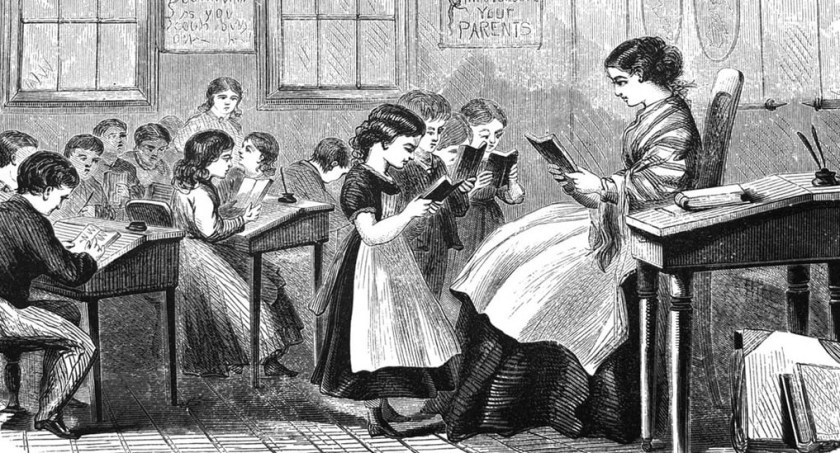
A 19th Century Classroom

There were three schools for primary education in Tunstall. There was one Church of England school (Christ Church National School), two Methodist Church schools and a few dame schools. 

In the 1840s, Mr Lambert was the headteacher of the Church of England school I attended. The school was surrounded by fields. I was one of the ‘little ones’ when I saw my first barring out day. 

The headteacher came to school at the usual time. He found he was locked out of the building. The older boys had locked him out. There was great excitement inside the school. The big boys opened the windows.

They held the keys out of a window on the end of a long pole, which was held so high that he could not reach them.

The headteacher and his staff had been barred out.

Good-natured bantering occurred between the boys and the head until he agreed to give them a holiday.  

Ho! The triumph of the victors. The big boys said they were going to keep the doors locked all afternoon if he had refused to give them a holiday.  

We had an all-around education that was not restricted to the three Rs. When the school day started, a hymn was sung. My heart filled with joy when we sang, ‘Awake my soul and with the sun’.  

After singing the hymn, we learned the creed before lessons began. It was a pleasant school. Sometimes, the curate would take us to an adjacent field for games. I saw my first cricket match played there.  

Pupils attended school on Saturday mornings. On Wednesday afternoons, there were recitations at one Methodist school. On Wednesday mornings, pupils who went to Christ Church National School were taken to a service in the church.

Edited by The History Factory (2024)  


Furlong Road in the 1850s

Scarratt’s Tunstall

Furlong Road ran from High Street, Tunstall, to Greenfield, an industrial village near Pitts Hill. The road was narrow and overhung with laburnum and other trees.

In his book Old Times in the Potteries (published in 1906), William Scarratt describes the road in the 1850s.

In 1854, Furlong Road was like a country lane. The oak and other trees surrounded Greengates House, which Mr William Adams built in the 18th century. These trees were quite leafy. Rooks built their nests in them, and wild ducks sported on the pool in front of the house. At the back of the house were large trees where rooks cawed noisily in the spring. Little birds built nests in the hedgerows below the church – I have found them there. Nobody today would believe that harriers or beagles were kept at this house. But that is a fact. The owner of the house was fond of sport. I met them on the road to school in Newchapel. One of my school fellows, the owner’s son, has followed them, so he said. The road ran from High Street to Greenfield. It was narrow and overhung in some places with laburnum and other trees.

Edited by The History Factory (2024)