Despite his superficial charismatic charm, William Frederick Horry, the landlord of Burslem’s George Hotel, was a cold-blooded, ruthless killer.
Born on November 17th, 1843, in Boston, Lincolnshire, he was the son of William Horry, senior, a successful brewer.
When he left school, young William became a trainee manager at Parker’s Brewery in Zion Street, Burslem. He lived at the George Hotel in Nile Street, where he fell in love with Jane Wright, the hotel’s barmaid.
Jane left the George Hotel and went to work at the Sneyd Arms Hotel in Tunstall. William realised he could not live without her. He asked her to marry him. She consented, and William’s father gave them £800 to buy the George Hotel. The couple married in 1867 and had three children.
William who was a heavy drinker convinced himself that Jane was flirting with male customers. At night, he walked the streets looking for prostitutes or drinking with criminals in back street beer houses.
William’s father and Jane’s brother Thomas, a solicitors clerk, came to Burslem to find out why the marriage had failed. William told them Jane had committed adultery with three of the town’s leading citizens. When the two men investigated the allegation, they discovered that William had lied to them.
William and Jane separated in March 1871. She took the children and went to live with his father in Boston. William sold the George Hotel and went to Nottingham.
He visited Boston and asked Jane to take him back. She refused, and William started divorce proceedings, claiming she had committed adultery with five men.
While waiting for the case to be heard, William bought expensive clothes and often visited the Potteries. Early in January 1872, he stayed for a week visiting brothels in Hanley and drinking with friends in Burslem.
On Saturday, January 13, William returned to Nottingham, where he bought a revolver and a hundred cartridges.
William left Nottingham and went to Boston, where he visited his father’s home where Jane was living. She invited him into the house. He followed her along the passage leading to the breakfast room. As she entered the room, William pulled out the gun and shot her in the back. The bullet passed through her left rib and penetrated her lung. Jane died a few minutes later. William was detained by members of his family, who called the police. He was arrested and charged with murder.
William’s friends in Burslem launched a public appeal to pay for his defence.
He was tried at Lincoln Assizes on March 13 and pleaded “Not Guilty”. His trial lasted three hours. The jury took 15 minutes to convict him.
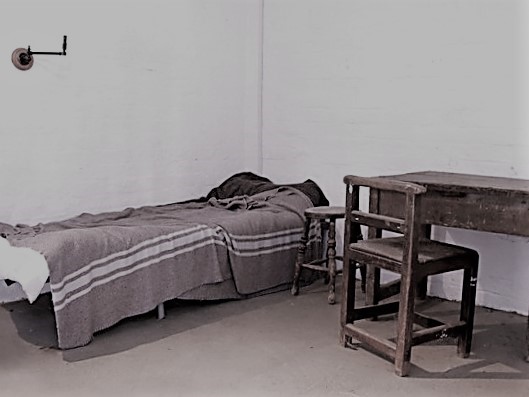
William stood in the dock and watched Mr Justice Quain don the Black Cap before sentencing him to death. He was taken to Lincoln Castle Prison and hanged on Easter Monday, April 1st, 1872.
Post: Copyright © Betty Martin and David Martin, 2023
Photograph: © Copyright Dave Hitchborne, licensed for reuse under this Creative Commons Licence.


 North Staffordshire Heritage