David’s School Days in Tunstall

The two people from different backgrounds who had the greatest influence on my life were Miss Wood, the headmistress, and Mr Williams, the caretaker.
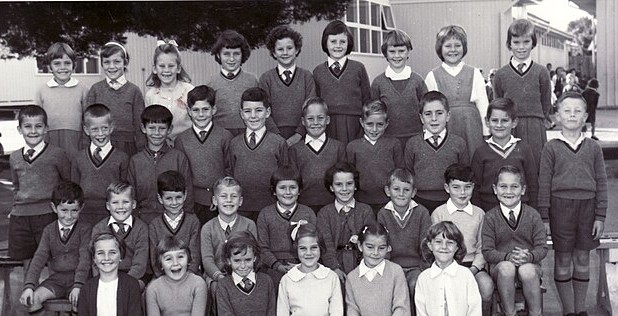
David Martin, North Staffordshire Heritage’s chief executive, remembers his school days in Tunstall, Stoke-on-Trent.

During the 1950s, I went to Central County Mixed School in Tunstall.

Mr Williams was the caretaker, and Miss Wood was the headteacher.

The school’s cellars, where Mr Williams had a table and chair, fascinated me. They were dark and dismal, with cobwebs hanging from the ceilings. I visited the cellars most dinner times. While I was sitting on a pile of coke drinking Tizer and eating potato crisps, Mr Williams told me about Medieval Tunstall and its courthouse in the market square. He vividly described the markets and fairs held there when the court was sitting.

Mr Williams showed me two large rooms, each housing a small Robin Hood boiler. He said these rooms had been the condemned cells beneath the courthouse, where men and women were held before being hanged in the square on market days. I sat enthralled as he told me about the cases heard by the court, and I decided to become a barrister.

My visits to the cellar ended when Miss Wood saw me walking across the playground covered in soot.

Despite giving the impression that she was a strict disciplinarian, Miss Wood was a person who loved and cared for children.

To keep me out of mischief, Miss Wood persuaded me to help her in the library after dinner. She shared her passion for history and classical literature with me. One afternoon, she took me to a second-hand book stall in Tunstall Market. I liked the stall and visited it on Saturday mornings to buy two or three books. The stall’s owner always gave me a discount, and I quickly acquired a collection of children’s classics and history books.

Miss Wood was an inspiring teacher whose passion for literature fired my imagination. Under her watchful eye, historical figures and characters from novels jumped off the pages and came to life in my mind’s eye. Her passion was infectious. I began to share her love of Shakespeare, Milton, Dickens and Hardy. My visits to the cellars were soon forgotten. I was now walking with Heathcliff on the moors surrounding Wuthering Heights, jousting with King Arthur and the knights of the Round Table, travelling around the world with Phileas Fogg and sailing to Treasure Island with Jim Hawkins and Long John Silver.

Most of my free time at home was spent reading. I lost interest in sports and rarely watched television. Looking back, it seems strange that two people from different backgrounds, whom I met at school, had such a significant influence on my life.
Tunstall Was a Prosperous Town

In the 1830s, Tunstall was a prosperous industrial and market town.

There were 17 firms manufacturing pottery. Twelve made earthenware. Three produced earthenware and china. Two manufactured china figures and Egyptian blackware.

The Trent & Mersey Canal ran through the Chatterley Valley. In the valley, there were two brick and tile works. There was a factory making chemicals at Clayhills and a coal wharf on the banks of the canal. Coal and ironstone were mined at Newfield and Clanway.

The east side of Liverpool Road (High Street) from the Highgate Inn to the Old Wheatsheaf Inn had been developed. There were shops on Liverpool Road and in Market Place (Tower Square) where a market was held on Saturdays.

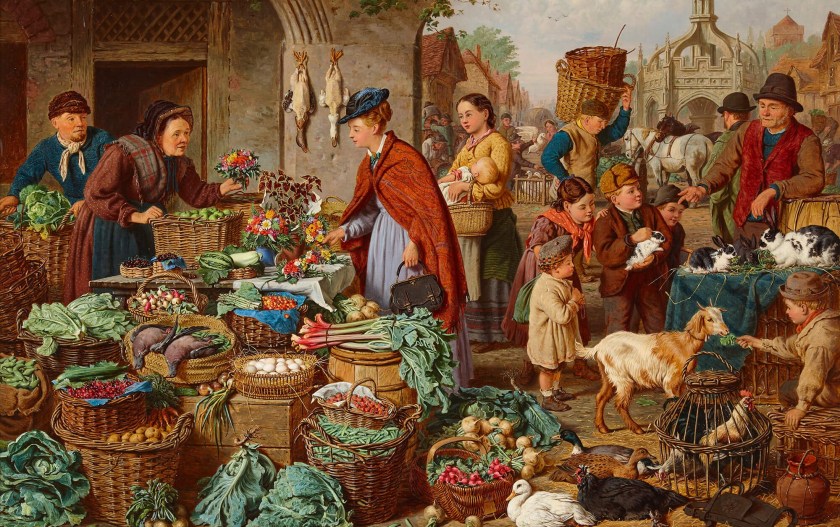
A typical 19th-century market where green grocers displayed fruit and vegetables in wicker baskets.

The market opened early in the morning and closed late at night. It was a bustling market with stalls selling a wide range of goods, including household items, furniture, shoes, and clothing. Green grocers sold fruit and vegetables. Farmers’ wives had stalls in the Market Hall, where they sold eggs, butter and cheese. Between the Market Hall and Liverpool Road were stalls selling meat, fish and poultry.

Saturday was the busiest day of the week for shopkeepers and innkeepers. The market attracted customers from Butt Lane, Kidsgrove, Mow Cop, Harriseahead, Packmoor, Biddulph, Chell and Goldenhill.

Copyright David Martin 2023

NSH2023/Revised2025

William Frederick Horry (1843-1872)

William Frederick Horry, born in 1843, was a charismatic yet ruthless killer who owned Burslem’s George Hotel. After a tumultuous marriage, he shot his estranged wife, Jane. Convicted of murder, he was sentenced to death and hanged on April 1, 1872, at Lincoln Castle Prison.

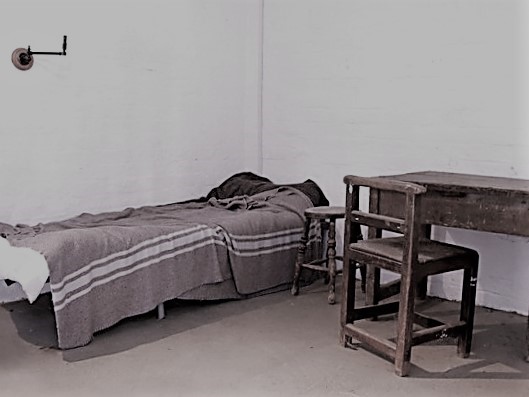
The condemned cell at Lincoln Castle Prison where William Horry spent his last days.

Despite his superficial charismatic charm, William Frederick Horry, the landlord of Burslem’s George Hotel, was a cold-blooded, ruthless killer.

Born on November 17th, 1843, in Boston, Lincolnshire, he was the son of William Horry, senior, a successful brewer.

When he left school, young William became a trainee manager at Parker’s Brewery in Zion Street, Burslem. He lived at the George Hotel in Nile Street, where he fell in love with Jane Wright, the hotel’s barmaid.

Jane left the George Hotel and went to work at the Sneyd Arms Hotel in Tunstall. William realised he could not live without her. He asked her to marry him. She consented, and William’s father gave them £800 to buy the George Hotel. The couple married in 1867 and had three children.

William who was a heavy drinker convinced himself that Jane was flirting with male customers. At night, he walked the streets looking for prostitutes or drinking with criminals in back street beer houses.

William’s father and Jane’s brother Thomas, a solicitors clerk, came to Burslem to find out why the marriage had failed. William told them Jane had committed adultery with three of the town’s leading citizens. When the two men investigated the allegation, they discovered that William had lied to them.

William and Jane separated in March 1871. She took the children and went to live with his father in Boston. William sold the George Hotel and went to Nottingham.

He visited Boston and asked Jane to take him back. She refused, and William started divorce proceedings, claiming she had committed adultery with five men.

While waiting for the case to be heard, William bought expensive clothes and often visited the Potteries. Early in January 1872, he stayed for a week visiting brothels in Hanley and drinking with friends in Burslem.

On Saturday, January 13, William returned to Nottingham, where he bought a revolver and a hundred cartridges.

William left Nottingham and went to Boston, where he visited his father’s home where Jane was living. She invited him into the house. He followed her along the passage leading to the breakfast room. As she entered the room, William pulled out the gun and shot her in the back. The bullet passed through her left rib and penetrated her lung. Jane died a few minutes later. William was detained by members of his family, who called the police. He was arrested and charged with murder.

William’s friends in Burslem launched a public appeal to pay for his defence.

He was tried at Lincoln Assizes on March 13 and pleaded “Not Guilty”. His trial lasted three hours. The jury took 15 minutes to convict him.

William stood in the dock and watched Mr Justice Quain don the Black Cap before sentencing him to death. He was taken to Lincoln Castle Prison and hanged on Easter Monday, April 1st, 1872.

Post: Copyright © Betty Martin and David Martin, 2023

Photograph: © Copyright Dave Hitchborne, licensed for reuse under this Creative Commons Licence.