Tunstall in the 1790s

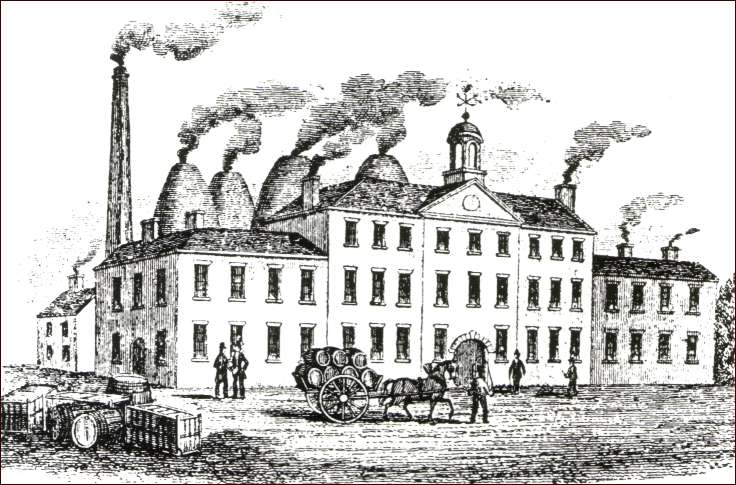
The sketch above shows William Adams’ Greengates Pottery in Tunstall. The factory built between 1779 and 1781 was one of the largest in the Potteries. It manufactured tableware, stoneware and jasper ornaments for the luxury market. William Chaffer, the author of ‘Marks and Monograms on Pottery and Porcelain’, said some of the jasper made at Greengates was ‘equal to, if not superior’ to that produced by Josiah Wedgwood at Etruria.

A Description of the Country From Thirty to Forty Miles Round Manchester, a book published in 1795, was compiled by Dr John Aikin. The book tells us about Newcastle-under-Lyme and North Staffordshire’s pottery towns and villages in the 1790s.

This edited extract from the book describes Tunstall as it was in the 1790s.

Tunstall is the pleasantest village in the Potteries. It stands on high ground, commanding extensive views of the surrounding countryside. Pottery manufacturers in the village produce good-quality ware and do considerable business. There was a church here, and human bones have been dug up. But such is the effect of time that no trace of either the church or the bones remains today. A small chapel has recently been built here. There is a considerable number of brick and tile works. They use local clay to make blue bricks, which look as well on the roofs of houses as moderate slate. Tunstall is four miles from Newcastle-under-Lyme and nine miles from Congleton. The turnpike road from Lawton to Newcastle-under-Lyme runs through Tunstall, where the turnpike road to Bosley in Cheshire begins [near the Wheatsheaf Inn].

Friday NewsDesk

Friday NewsDesk is a new regular weekly post that will tell you about North Staffordshire Heritage’s activities.

Worldwide interest has been shown in Chatterley Whitfield’s future. The creation of a circular heritage tourist trail linking Burslem, Ford Green Hall, Chatterley Whitfield and Biddulph Grange with Mow Cop and Kidsgrove.

North Staffordshire Heritage is continuing to research Mercia and its legal system. This is a long-term project, which is expected to last for eight or nine months.

Our new series of posts about the Township of Tunstall starts in September, and we will give you more details at the end of August.

We hope you all have a relaxing and enjoyable weekend. Take care and stay safe. We’ll see you again on Tuesday.

Image of Biddulph Grange Creative Commons Attribution-Share Alike 4.0 International license. Photograph by Mike Peel (www.mikepeel.net)

It’s Friday again…

Another working week is almost over. It will soon be time to close the office for the weekend.

North Staffordshire Heritage welcomed the news that the Heritage at Risk Fund has given £1.5 million to help save Bethesda Church and Burslem’s Indoor Market.

We are still concerned about the future of the former colliery at Chatterley Whitfield.

If Chatterley Whitfield had been on the South Wales Coalfield, it would have been made a World Heritage Site many years ago.

It is not too late to save Chatterley Whitfield and make it an international tourist attraction. Regenerating the site and breathing new life into its derelict buildings would revitalise Tunstall, Burslem, Biddulph and Kidsgrove.

With imagination and initiative, Chatterley Whitfield can be the starting point of a North Staffordshire Tourist Trail. A circular trail linking Middleport Pottery, Burslem’s Historic Town Centre, Ford Green Hall and Biddulph Grange with Mow Cop, the Trent & Mersey Canal and the Harecastle Tunnels at Kidsgrove.

We hope you have an enjoyable weekend. Take care and keep safe. See you again on Monday.

Another Busy Week is Nearly Over

Another busy week is coming to an end.

During the week, we began learning how to use our new portable photocopier. This will allow us to visit people at home to copy their treasured photographs from bygone days.

A new series of posts tracing Tunstall’s history and architectural heritage will start in the autumn. The series is based on images in the film strip The Township of Tunstall, made by Highgate School in 1960. Posts in the series will trace the history of Tunstall from Anglo-Saxon times to the 21st century. These posts will introduce you to Tunstall’s heritage buildings. They will tell you about its unique Victorian Civic Centre, which includes the former Town Hall, Tower Square, Market Hall, the Jubilee Buildings, Tunstall Pool, the Drill Hall and the Memorial Gardens.

Have a relaxing and enjoyable weekend. Take care, and we’ll see you again on Monday.

Newfield and Smithfield in the 1790s

Smithfield Hall, which is shown above, was built in 1791 by Burslem pottery manufacturer, Theophilus Smith. In 1793, he built an industrial hamlet called Smithfield near the hall. Theophilus was declared bankrupt in 1800. He attempted to murder John Wainwright and was remanded to Stafford prison to await trial. When his wife and daughter visited him there, he murdered them and committed suicide. In 1801, the hall was bought by Jesse Breeze, who renamed it Greenfield Hall.

A Description of the Country From Thirty to Forty Miles Round Manchester, is a book published in 1795, compiled by Dr John Aikin. It describes Newcastle-under-Lyme and North Staffordshire’s pottery towns and villages as they were in the 1790s.

This edited extract from the book tells us what Newfield and Smithfield, two hamlets in the Township of Tunstall, were like in the 1790s.Newfield

Newfield is well situated for manufacturing purposes because there is plenty of coal nearby.

The hamlet belongs to Admiral Smith Child. He has a handsome estate there and lives at Newfield Hall. Smith Child owns Newfield Pottery. He is unlikely to allow more factories to be built in the hamlet in the foreseeable future.

Smithfield is the best place in the Potteries to manufacture earthenware. There are several strata of coal and clay, which are needed to make pottery. Smithfield belongs to Theophilus Smith. He owns a pottery and coal mines there. It is unlikely that there will be further industrial development in the hamlet.

An aerial view of Stallington Hall Hospital

In the 19th century, Stallington Hall was the home of Sir Smith Child. He was born at Newfield Hall in Tunstall. During his long life, Smith Child gave financial support to the North Staffordshire Infirmary and charities in Tunstall. He became North Staffordshire’s most generous philanthropist. The clock tower in Tunstall’s Tower Square was erected to guarantee that his generosity would not be forgotten. Smith Child died at Stallington Hall on 27 March 1896. He was buried in Fulford churchyard.

Child’s Tea Set made in Tunstall by Plex Street Pottery

This delightful child’s tea service was made in the 1950s at the Staffordshire Tea Set Company’s Plex Street Pottery in Tunstall. We discovered this factory while researching the history of education in the Potteries.

High Street Tunstall (c.1900)

This postcard shows Tunstall High Street at the end of the 19th century. Notice the tram line and the tram in the middle of the road. In the distance, you can see Lawton’s Tile Works at the Haymarket, where Roundwell Street joins High Street.

John Nash Peake (1837-1905)

Tunstall Town Hall is part of Tunstall’s unique late Victorian Civic Centre. It was designed by Absalom Reade Wood and opened by John Nash Peake on 29 October 1885.

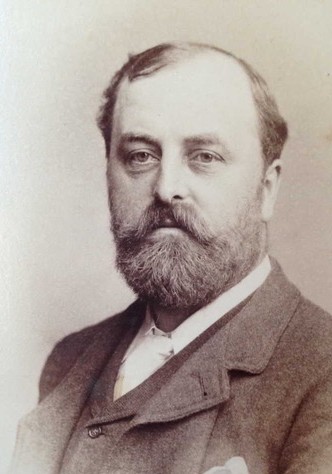
John Nash Peake, after whom Nash Peake Street is named, was one of Tunstall’s most flamboyant characters. Born in Tunstall on 13 April 1837, he was the son of Thomas Peake.

Thomas owned Tunstall Tileries, in Watergate Street. He was the town’s Chief Bailiff (Chief Constable) and Chairman of the Board of Health from 1858 to 1861.

John, whose Christian names were John and Nash, was educated at the North London Collegiate School. At school, he showed considerable artistic ability. When he left school, John became a student at the Royal Academy, where he studied under Millais, one of England’s leading artists.

One of John’s paintings, Alpine Monks Restoring a Traveller, was exhibited at Burlington House when he was 18 years old. A year later, he showed another painting, The Last Hours of the Condemned, which portrayed a soldier awaiting execution.

Although he could have stayed in London and become a professional artist, John returned to Tunstall in the 1850s. He joined his father’s company, which made bricks, tiles, water pipes and ornamental garden pottery. John managed the firm after Thomas’s death in 1881. Under his management, the works doubled in size. It became one of the largest tileries in the world. There were 35 ovens producing more than 250,000 tiles a week.

John had a strong personality. He was a man with a keen intellect and a commanding presence, who was eloquent, versatile and persevering.

A devout Christian, John was an evangelist and a member of the Church of England. He opposed the Oxford Movement’s attack on the Reformation and its plan to make the Pope head of the Church of England.

His views on the activities of the Oxford Movement were shared by Sir Smith Child and Tunstall’s leading Methodists.

John spoke out against the movement’s growing influence and the introduction of Roman Catholic dogma and rites into Potteries’ churches. The Wesleyan Methodists invited him to lay one of King Street Methodist Church’s* four foundation stones.

The stones were laid on 20 October 1873. During the ceremony, John said he was sure that the Wesleyan Methodist Church would defend the Protestant faith. He was grieved to see the Church of England abandoning its traditions and embracing the doctrines of Roman Catholicism. John advised the Wesleyans to adhere to their faith and not allow anyone to interfere with it. He told them that the doctrines being introduced into the established church would destroy the Reformation.

John was a member of the Liberal Party. In 1869, he became a member of Tunstall’s Board of Health. His energy and determination led to the creation of the town’s Victorian civic centre. This centre included a new town hall and a public library as well as a school of art and science, a museum, a fire station, public baths, a drill hall and a recreation ground.

Despite his busy commercial and political life, John retained his interest in art. He painted portraits of Queen Victoria, Lord Roberts, and his father (Thomas Peake). He also painted Sir Smith Child and civic leaders, including Alfred Meakin, George Wilks, Henry Smallman, and Thomas Booth. These portraits hung in the town hall. A self-portrait which he painted was hung in the museum. Other examples of his work displayed there included Bosley Reservoir and Cloud End, The Fishing Fleet at Tenby, Menai Suspension Bridge, The Isle of Arran and The Matterhorn.

He designed the Free Library sign that hangs outside the Jubilee Building and Victoria Park’s main gates, which were erected in memory of his father.

On 15 October 1903, John gave Tunstall a mahogany cabinet with drawers to store the town’s records. One of his portraits of Queen Victoria is incorporated into the cabinet. The cabinet remains in the council chamber of the former town hall. Its doors open to reveal a list of the main events in the town’s history. There are also photographs of the chief bailiffs (Chief Constables), clerks, and surveyors from 1855 to 1909.

A bronze portrait bust of John was unveiled in the council chamber. He was given an illuminated address to thank him for his services to the town.

John, who was 66 years old, said: “I know well that day by day, I come nearer to a time when I shall be forever absent from the council chamber and the streets. Think, then, what it means to me this surprising tribute of yours that I shall not be forgotten: that I shall be with you, dwelling among my own people in imperishable bronze.”

He died three years later on 29 April 1905. The bronze bust disappeared many years ago. So far, all attempts to trace it have failed.

*King Street is now Madison Street. The church was demolished in the 1970s.

Note: John Nash Peake (1837-1905) is one of a series of articles Betty Martin wrote before she died in 2023. More articles from this series will be posted periodically.

Another week

Another week is coming to an end. We have been busy preparing a series of posts about Tunstall’s heritage. The posts will tell you about the people who created the town we know today. They will introduce you to the town’s historic buildings. You will learn the history of its churches and chapels. Readers of these posts will discover Tunstall’s unique Victorian civic centre. Other posts will tell you about stagecoaches and coaching inns. They will cover working conditions in factories and mines, as well as local government and the administration of justice.

It’s time to close the office. Enjoy your weekend. We’ll be back on Monday. See you then.