Longport in the 1790s

A Description of the Country From Thirty to Forty Miles Round Manchester, a book published in 1795, was compiled by Dr John Aikin. The book tells us about Newcastle-under-Lyme and North Staffordshire’s pottery towns and villages in the 1790s.

This edited extract from the book describes Longport in the 1790s.

Longport is situated in a valley between Burslem and Newcastle. There are some good buildings in it and several large pottery factories. Because it is in a valley, there are times when the smoke from bottle ovens and kilns hangs over Longport, making the air disagreeable, if not unwholesome.

The Trent & Mersey Canal passes through Longport, where there is a public canal wharf. Before the canal was constructed, Longport was called Longbridge Hays because there was a kind of bridge that ran parallel for a hundred yards with the Fowlea Brook. The bridge was dismantled when the canal was cut.

The number of buildings increased rapidly when the canal was completed, and the village’s name was changed from Longbridge Hays to Longport.

Friday NewsDesk

During the week, we have learned how to use a new scanner that can scan books without damaging them.

We have completed the first stage of our research into the growth of further and higher education in the Potteries. The research program examined vocational training from the early 19th to the end of the 20th century. It traced the history of Staffordshire Polytechnic and Stoke-on-Trent College.

During the project’s second stage, we will look at university and further education since the end of the 20th century.

Have a relaxing and enjoyable weekend. Stay safe and we’ll see you again on Monday.

      High Energy Costs Could Kill the Pottery Industry

      High energy costs are threatening the Pottery industry’s future.

      Local firms are paying £875 million a year for the energy they use. An analysis by Nottingham Trent University indicates that Britain’s ceramic industry spends 70% of its turnover on energy and 14% on government and regulatory levies.

      Energy costs for the pottery industry in America and China have not risen since 2020.

      The analysis examined a company based in Stoke-on-Trent with 49 employees and a turnover of approximately £630,000. This year, the firm will be paying £443,000 for the energy it uses.

      Pottery worker Sharon Yates said to delegates attending the Labour Party Conference: “I am a proud pottery worker – just like my dad before me. The most highly skilled potters make ceramics in my town and we export the round the globe. But the industry we rely on is dying.

      Tell us what you think. Do you agree with Sharon? Is the pottery industry dying, or can it survive the high cost of energy? If the industry is on its last legs, what does the future hold for Stoke-on-Trent? Have your say and tell us what you think.

      Burslem and Cobridge in the 1790s

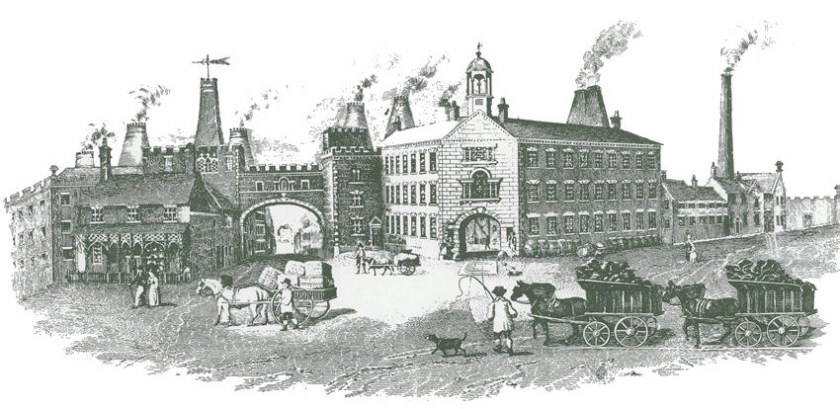
      This image shows Wood & Caldwell’s Fountain Place Works in Burslem. In the 1790s the company made Staffordshire figures, earthenware and stoneware. Enoch Wood and James Caldwell were partners in the firm. The firm owned Bycars Colliery, where it mined coal to fire the factory’s bottle ovens and kilns.

      A Description of the Country From Thirty to Forty Miles Round Manchester, a book published in 1795, was compiled by Dr John Aikin. The book tells us about Newcastle-under-Lyme and North Staffordshire’s pottery towns and villages in the 179os

      This edited extract from the book describes Burslem and Cobridge as they were in the 1790s.

      Burslem

      Burslem is the home of North Staffordshire’s pottery industry. Earthenware has been made there for many centuries. Dr Plot, in his History of Staffordshire, written in 1686, said that the factories making pottery in Burslem were the largest in the district…

      The town has two weekly markets. A large market is held on Monday, and a smaller one is held on Saturday. Four or five years ago, cattle markets were established. These markets are well attended by cattle dealers and butchers.

      Burslem is a parish in its own right. The parish church, St John’s, has a good organ. The church has recently been enlarged and regenerated.

      There are a large number of [Wesleyan] Methodists in the district. The Methodists have built a large chapel in Burslem and erected chapels in several pottery towns and villages. There are many other religious sects in the Potteries. Few areas have such a great diversity of sincerely held religious opinions.

      Cobridge

      Cobridge is an industrial village where earthenware is made. It is partly in Burslem Parish and partly in Stoke Parish.

      Memory Lane: Longton in the 1960s

      This video takes you on a nostalgic journey down Memory Lane to Longton in the 1960s. You will be taken back to a time of tight-knit communities, bustling high streets and industrial activity in a pottery town in Stoke-on-Trent.

      During your trip down Memory Lane you will see a stunning collection of rare photographs that bring Longton’s past to life.

      When you have seen the video, please use our Comments Section below to share your memories of Longton with us. Tell us about the schools you attended and your first job. Let us know what you did in your spare time and tell us about your interests and hobbies.

      North Staffordshire and the Battle of Britain

      Monday, 15th September, was Battle of Britain Day.

      It’s the day we pay tribute to the courage of the pilots who, fighting against overwhelming odds, won the battle. We also remember members of the armed forces killed in action and the civilians who died when enemy bombs fell on British towns and cities.

      The role North Staffordshire played in the battle must not be underestimated. RAF pilots were trained at Meir. Firefighters from the Potteries were sent to help their colleagues in Coventry when it was bombed.

      Two of the world’s leading aircraft designers, John Lloyd and Reginald Mitchell, grew up in the Potteries. Both men were educated at Hanley High School and served their engineering apprenticeships with local firms.

      John Lloyd designed the Whitley, a heavy bomber. During the Battle of Britain the Whitley bombed and destroyed strategic targets in Germany and Italy.

      The Spitfire, designed by Reginald Mitchell, became a living legend. It was the aircraft that gave Britain its Finest Hour and saved the world from Nazi domination.

      Went the day well?
      We died and never knew.
      But, well or ill,
      Freedom, we died for you.

      Barry Winter, a popular lecturer from the Potteries

      My cousin, Barry Winter, died recently. He was the loveliest person you could hope to meet. He was born in Stoke-on-Trent, the only child of my dad’s older brother, Clifford, and his wife, Fay, market traders in the Tunstall and Hanley markets.

      Josiah Wedgwood (1769-1843): From Pottery to Politics

      Josiah Wedgwood (1769-1843) was the second son and namesake of the famous potter and inventor, Josiah Wedgwood (1730-95). He followed his father as head of the family’s pottery manufacturing firm, based at Etruria near Stoke-on-Trent. Although he was the second son and had lived as a country gentleman in Dorset before his father’s death, taking little interest in the business, its management fell to him because of his older brother’s ‘chronic incompetence’ and his younger brother’s death.

      Stoke-on-Trent’s Remaining Bottle Ovens

      About half of Stoke-on-Trent’s remaining bottle ovens are featured in this short video.

      A bottle oven or bottle kiln was a type of kiln used in the ceramic industry. For many years, Stoke-on-Trent’s bottle ovens and kilns symbolised our industrial heritage.

      Some were built in the late 18th century. Many were built in the 19th century and a few in the 20th. They remind us that Stoke-on-Trent was once the centre of the world’s pottery industry.

      Only 47 bottle ovens are left. They are all listed buildings. Longton has more than any town in the Potteries. Stoke-on-Trent’s remaining bottle ovens will help to make North Staffordshire’s Industrial Landscape a World Heritage Site.

      Visit Stoke-on-Trent during its Centenary Year

      A 19th-century kitchen in a typical working-class terraced house in the Potteries.

      We strolled through the ‘Street of Life in Stoke’ [at the Potteries Museum and Art Gallery] where we envisaged living in the past and gazed in wonderment at the old chemist’s shop with its small wooden drawers filled with pills and potions. Also on display was an antiquated fish and chip shop range, a cosy potter’s cottage and the interior of a village pub.