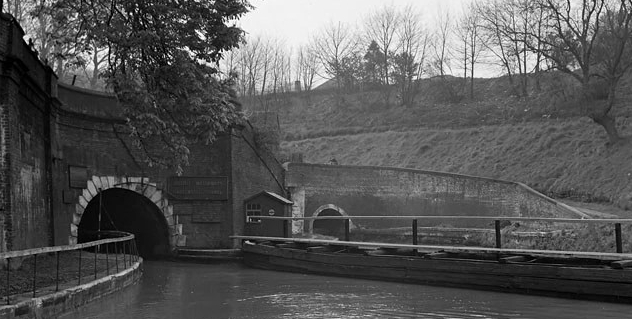
The Harecastle Tunnels on the Trent & Mersey Canal at Kidsgrove
There are no historical reasons to prevent North Staffordshire’s Industrial Landscape from becoming a World Heritage Site.
In the 18th century, North Staffordshire helped to make England “the workshop of the world.” Local entrepreneurs, like Wedgwood and Adams, transformed a group of small towns into an industrial area of international importance.
James Brindley’s Trent & Mersey Canal “kick-started” the Industrial Revolution, which made Britain “the Workshop of the World. The canal and railway tunnels between Kidsgrove and Chatterley are significant feats of civil engineering. They merit World Heritage Site status in their own right.
The Primitive Methodist Church was founded in North Staffordshire by Hugh Bourne and William Clowes. It gave the Potteries its unique culture and a way of life that Arnold Bennett vividly portrayed in his novels.
Burslem’s “old town hall” is one of the finest examples of Victorian civic architecture. The Wedgwood Institute’s terracotta facade is an inspiring tribute to the men, women and children who worked in local industries.
The former colliery at Chatterley Whitfield should have been made a World Heritage Site many years ago.
Making North Staffordshire’s Industrial Landscape a World Heritage Site would encourage economic regeneration and create new employment opportunities.
Tunstall is one of the oldest towns in the Potteries. Its Old English name suggests it dates from the late 5th or 6th century.
The Anglo-Saxons called a town or village surrounded by a ditch and a stockade a “Tun”, and a “Stall” was a place inside the stockade where cattle were kept.
Anglo-Saxon Tunstall was built at the crossroads where a road from the Staffordshire Moorlands to Chester crossed the main highway linking London and the East Midlands with the North West and Scotland. Part of the highway’s route through Tunstall can be traced by following Oldcourt Street, America Street, Hawes Street and Summerbank Road to its junction with High Street.
The road from the Staffordshire Moorlands to Chester may have been a drove road.
Old drove roads are not easy to trace. In places, they were a quarter of a mile wide. We believe the road from the Staffordshire Moorlands entered Tunstall near the Wheatsheaf Inn and passed through the village on a track called Green Street, which is now Roundwell Street.
All physical traces of Anglo-Saxon Tunstall have disappeared. Two old field names, God’s Croft and Church Field, tell us there was a church in the village. Another old field name, Cross Croft, suggests that a marketplace may have existed.
A song for the Potters, The Staffordshire Potters, A lay for their children so tender and young, Who treading the jiggers, Toiling as slaves, Suffer, with them, much oppression and wrong.
Chorus: Who treading etc.
At six in the morning, Ere daybreak is dawning, Mere infants in Petticoats stand at the wheel, Privations enduring, While barely securing, The means of procuring the requisite meal.
Chorus: Privations etc.
And when evening shadows, Flit over the meadows, And songsters are snug and asleep in their nest, Still heavily laden, The meek little maiden, Has much to endure ere retiring to rest.
Chorus: Still heavily etc.
Their poor little brothers, In common with others, Their equal in stature, who toil through the day, Not one duty shunning, Are either 'mould running', Or working like slaves in the wedging of clay.
Chorus: Not one duty etc.
A whip for the fathers, A rod for the mothers, So early for labour, who drag them from school, Thus changing their nature, While stunting their stature, And dwarfing their energies, body and soul.
Chorus: Thus changing etc.
The eye of the nation, Winks not at oppression, Philanthropists soon to their rescue will come, While public opinion, The sword of the million, Will smite all the minions of slavery dumb.
Chorus: While public etc.
Ye stalwart and strong ones, Oh pity the young ones, By parents consigned to the doom of the slave! Let it be your mission, To change their condition, By rescuing them from a premature grave,
Chorus: Let it be etc.
All ye that are healthy, All ye that are wealthy, And willing to help them with heart and with hand, Come on like a river, And banish for ever, The remnant of slavery, far from the land.
Some jasper made at Adams’ Greengates Pottery in Tunstall was equal to, if not superior to, jasper made by Wedgwood at Etruria.
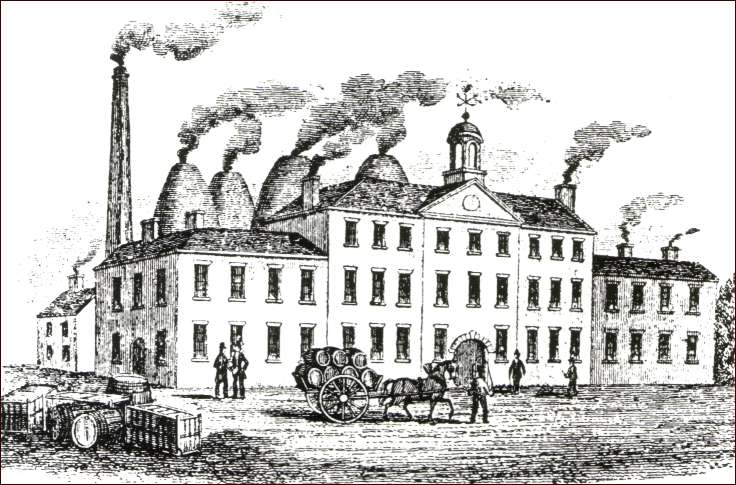
William Adams’ Greengates Pottery in Tunstall.
During the 18th century, the Industrial Revolution changed the face of Britain, making it the ‘workshop of the world’.
Earthenware factories were built in Tunstall, a township that included Sandyford, Newfield and Furlong. At the end of the 18th century, there were seven factories making pottery. Small coal and ironstone mines were scattered throughout the district. Blue bricks and tiles were made in the Chatterley Valley.
As early as 1735, William Simpson was making earthenware in the township. By 1750, Enoch Booth had a factory near a field called Stony Croft. The factory made cream coloured ware glazed with a mixture of lead ore and ground flint.
In 1763, Admiral Smith Child built Newfield Pottery, where he produced earthenware. By the 1780s, two brothers, Samuel and Thomas Cartlich, were making pottery and mining coal at Sandyford. There were brick kilns, coal mines, a flint mill and a crate maker’s workshop at Furlong.
During the 1740s, George Booth and his son Thomas leased a pottery factory. on an estate called Will Flats, next to Furlong Lane. In 1779, Burslem pottery manufacturer William Adams rented the factory and part of the estate.
On 1 March 1784, William purchased the factory and the land he had been renting. He changed the estate’s name from Will Flats to Greengates and demolished the old factory.
William built Greengates Pottery (shown above), where he made high-quality stoneware and jasper ornaments for the luxury market. He employed Swiss modeller Joseph Mongolot. Joseph helped him create models for moulds to produce the bas-reliefs for jasper and stoneware.
Pottery produced by William was sold to wealthy customers. Some purchased ware from his showrooms in Fleet Street, London. Others visited the Greengates factory’s showrooms where they bought tea sets, dinner services, jasper, and stoneware ornaments.
In his book, Marks and Monograms on Pottery and Porcelain, William Chaffer mentioned the quality of Adams’ jasper. He said some of it was “equal to, if not superior to” jasper made at Etruria by Wedgwood.
A Halifax Bomber like the one that crashed on Grindon Moor.
The winter of 1946-47 was long and hard. There were heavy snowfalls and gale-force winds. Temperatures fell to below freezing, and icicles hung from the roofs of houses.
Mainline railway lines were kept open, but frozen points on branch lines prevented coal trains from leaving collieries. The National Coal Board did not thaw the points. They stockpiled coal at the pit head. This created a fuel shortage, and British industry was forced to introduce short-time working.
Between Sunday, February 2nd and Tuesday, February 4th, 1947 a blizzard lasting forty-eight hours swept across Staffordshire and Cheshire. More than ten inches of snow fell. Roads became impassable and motorists abandoned their vehicles.
Villages in the Staffordshire Moorlands were isolated by snowdrifts five or six feet deep. Over a hundred snowploughs and bulldozers fought to keep Staffordshire’s main roads open. German prisoners of war helped to clear the snow from roads leading into Burton-on-Trent. A working party from Stafford prison cleared snow blocking the road from Stafford to Stone.
In the Potteries, roads blocked by snowdrifts were reopened by Polish troops stationed at Keele. A bus fitted with a snowplough opened the road to Leek, but surrounding villages remained cut off.
Power stations producing electricity were running out of coal and output fell. Supplies of electricity were disrupted. Householders were asked not to use electricity between 9.00am and noon and between 2.00pm and 4.00pm. These savings were not enough to keep hospitals supplied with electricity. On February 7th, the government ordered companies to stop using electricity.
Industry throughout the country was hard hit. Factories were forced to close. At Stafford, English Electric dismissed its 5,000 employees. In the Potteries 44,000 men and women were made redundant.
At a meeting in Stoke, the National Political Union condemned the Labour government. It blamed the government for creating a fuel crisis. The crisis also caused widespread unemployment.
A few shopkeepers in Stafford continued to use electric spotlights to highlight displays in their shop windows. Lights and heating were turned off at the Guildhall where the Magistrates’ Court sat. It was so cold in the courtroom that Justices of the Peace wore their overcoats.
Many shops were lit by candlelight. Old gas mantles were used to light offices throughout the region. The Midland Bank at Crewe was lit by oil lamps and hurricane lamps were used to light Stoke town hall.
Blizzards prevented rescue teams from reaching Longnor, Butterton, Grindon and Ilam, isolated villages where 3,000 people were trapped.
The Royal Air Force was asked to help. At RAF Fairford in Gloucestershire, Halifax Bombers were loaded with food supplies for the villagers.
On February 12th, despite adverse weather conditions and low clouds, a bomber dropped thirteen canisters containing food near Longnor. Volunteers helped Police Sergeant Davenport carry the canisters to the village hall. They contained margarine, lard, sugar, cheese, bread and jam for the villagers and people living in neighbouring hamlets.
The next day, another Halifax, piloted by Squadron Leader McIntyre, took off from Fairford with food for Butterton. Weather conditions had deteriorated overnight. Visibility was poor. People on the ground, who were waiting for the food canisters to be dropped, heard the aircraft’s engines. They could not see the plane.
Squadron Leader McIntyre flew low hoping to find the dropping zone. The plane’s engines cut out. There was an explosion, and the Halifax crashed near Sheldon Farm on Grindon Moor. Eight men were on board. Only one survived the impact. He was unconscious when rescuers pulled him out of the cockpit and died shortly afterwards.
Among the dead was twenty-four-year-old Sergeant William Sherry from Clews Street, Burslem. Educated at Middleport School, he had been an army glider pilot before transferring to the Royal Air Force. William served with the 1st Airborne Division. He fought at Arnhem, where he was wounded and captured by the Germans.
Note: A Hard Winter (1946-1947) is one of a series of articles written by Betty Martin before her death. Other articles from the series will be posted from time to time.
When they left the Sneyd Arms in Tunstall, stagecoaches going to London followed the Old Lane through the Potteries, stopping at coaching inns in Burslem, Hanley, Stoke, Fenton and Longton.
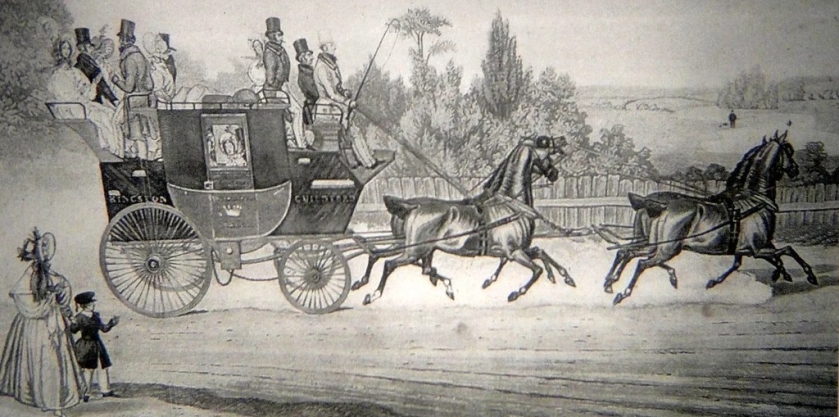
A Red Rover Stagecoach
During the 1830s, two firms, the Red Rover Company and the Royal Express Company, ran mainline stagecoaches between London and Liverpool.
Between Warrington and the Potteries, the coaches were driven along the Old Lane (the A50) that linked London and the East Midlands with Merseyside and the Northwest. These coaches stopped at the Sneyd Arms in Tunstall to pick up passengers. When they left the Sneyd Arms, the coaches followed the Old Lane through the Potteries, stopping at coaching inns in Burslem, Hanley, Stoke, Fenton and Longton.
On leaving Longton, coaches owned by the Royal Express Company left the Old Lane and went to London via Stone, Rugeley, Lichfield, Birmingham and Warwick. Coaches owned by the Red Rover Company followed the Old Lane to Hockcliffe in Bedfordshire, where it joined the London to Holyhead Road (the A5).
Two Stoke-on-Trent firms, the Hark Forward Company and the Independent Potter Company, ran day return stagecoach services that stopped to pick up passengers at the Sneyd Arms.
The Hark Forward Company’s coach went to Birmingham via Stone, Stafford and Wolverhampton. The Independent Potter Company’s coach ran to Manchester, Congleton, Macclesfield and Stockport. These two coaches left the Potteries early in the morning and returned late at night.
Stagecoaches were pulled by teams of four or six horses and could travel at a speed of eight to ten miles an hour. Travelling by stagecoach was expensive, and tickets had to be booked in advance. Coaches carried first and second class passengers. First class passengers travelled in the coach, and second class passengers sat on wooden seats on the roof.
The cost of the journey depended on its length. First-class passengers were charged threepence per mile, and second-class passengers were charged one and a half pence per mile.
Between 1842 and 1870, law and order in Hanley was maintained by Staffordshire’s county police force.
Although Hanley and Shelton, the two largest townships in the Potteries, amalgamated in 1857 to form the Borough of Hanley, the borough did not obtain its own police force until 1870.
Stanford Alexander was appointed chief constable. He had 35 police officers to maintain law and order in a town that had a population of 41,000. His officers worked three overlapping shifts, two 12-hour shifts during the day and one nine-hour shift at night. Despite the long hours worked, pay was low. Constables earned 21 shillings a week. Sergeants were paid 25 shillings, and inspectors received 30 shillings.
When Alexander retired in 1875, Herbert Windle was made chief constable. Windle improved pay and working conditions for his officers. He persuaded the town’s Watch Committee to give them a library and a recreation room, with a billiard table, where they could relax when they came off duty.
By the late 1870s, Hanley had become the Potteries’ commercial and cultural centre. Trains and trams brought people from neighbouring towns to its shops and markets, music halls and theatres.
On Saturday nights, Henley’s criminal fraternity made its way to the town centre. Children begged outside shops or stole from market stalls. Drunken brawls broke out in public houses. Gangs roamed the streets looking for a fight. Prostitutes accosted men in Piccadilly. Pickpockets mingled with the crowds in Fountain Square, and robbers lurked in dark alleys waiting to pounce on their victims.
Robbery and theft were indictable offences. They had to be tried in Stafford before the Assize Court or at Quarter Sessions.
Police officers and witnesses were forced to travel to Stafford. They had to wait outside the courtrooms in the Shire Hall until called to give evidence. Unwilling to make the journey, many victims of crime refused to prosecute offenders.
Law and order in Hanley were breaking down. The borough council requested Queen Victoria to grant the town its own Quarter Sessions. She granted the request. The borough’s Quarter Sessions held its first sitting on January 19, 1881. There were eight defendants, three of whom were illiterate.
Note: Law Enforcement in Hanley is one of a series of articles written by Betty Martin before her death. Other articles from the series will be posted from time to time.
William Frederick Horry, born in 1843, was a charismatic yet ruthless killer who owned Burslem’s George Hotel. After a tumultuous marriage, he shot his estranged wife, Jane. Convicted of murder, he was sentenced to death and hanged on April 1, 1872, at Lincoln Castle Prison.
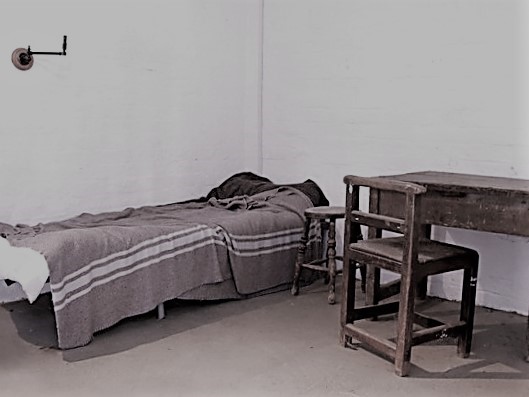
The condemned cell at Lincoln Castle Prison where William Horry spent his last days.
Despite his superficial charismatic charm, William Frederick Horry, the landlord of Burslem’s George Hotel, was a cold-blooded, ruthless killer.
Born on November 17th, 1843, in Boston, Lincolnshire, he was the son of William Horry, senior, a successful brewer.
When he left school, young William became a trainee manager at Parker’s Brewery in Zion Street, Burslem. He lived at the George Hotel in Nile Street, where he fell in love with Jane Wright, the hotel’s barmaid.
Jane left the George Hotel and went to work at the Sneyd Arms Hotel in Tunstall. William realised he could not live without her. He asked her to marry him. She consented, and William’s father gave them £800 to buy the George Hotel. The couple married in 1867 and had three children.
William who was a heavy drinker convinced himself that Jane was flirting with male customers. At night, he walked the streets looking for prostitutes or drinking with criminals in back street beer houses.
William’s father and Jane’s brother Thomas, a solicitors clerk, came to Burslem to find out why the marriage had failed. William told them Jane had committed adultery with three of the town’s leading citizens. When the two men investigated the allegation, they discovered that William had lied to them.
William and Jane separated in March 1871. She took the children and went to live with his father in Boston. William sold the George Hotel and went to Nottingham.
He visited Boston and asked Jane to take him back. She refused, and William started divorce proceedings, claiming she had committed adultery with five men.
While waiting for the case to be heard, William bought expensive clothes and often visited the Potteries. Early in January 1872, he stayed for a week visiting brothels in Hanley and drinking with friends in Burslem.
On Saturday, January 13, William returned to Nottingham, where he bought a revolver and a hundred cartridges.
William left Nottingham and went to Boston, where he visited his father’s home where Jane was living. She invited him into the house. He followed her along the passage leading to the breakfast room. As she entered the room, William pulled out the gun and shot her in the back. The bullet passed through her left rib and penetrated her lung. Jane died a few minutes later. William was detained by members of his family, who called the police. He was arrested and charged with murder.
William’s friends in Burslem launched a public appeal to pay for his defence.
He was tried at Lincoln Assizes on March 13 and pleaded “Not Guilty”. His trial lasted three hours. The jury took 15 minutes to convict him.
William stood in the dock and watched Mr Justice Quain don the Black Cap before sentencing him to death. He was taken to Lincoln Castle Prison and hanged on Easter Monday, April 1st, 1872.
There was no M.P. for the town until 1832. The whole of the Potteries was formed into a constituency. It sent two members to Parliament. This early recognition showed that the six municipalities shared common interests. It marked the beginning of nearly eighty years of debate over unifying local government in the district.
To read the whole post, click on “Staffordshire Archives and Heritage” below.
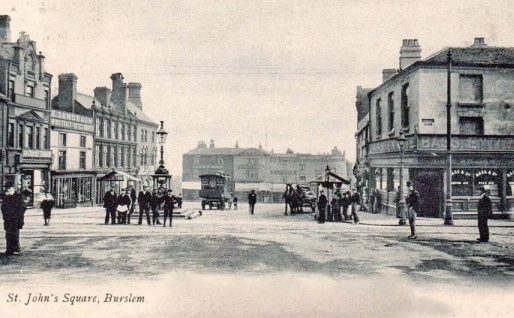
Burslem is situated in the north-west of the City of Stoke-on-Trent, one of the six towns which form the City.
When it was recorded in the Domesday Book in 1086, Burslem was called Barcardeslim (Burgweard’s Lyme). It was not a large village consisting of just four households and one plough team. The other resource mentioned is two acres of alder wood. Its value was 10 shillings.
Through the medieval period, Burslem was not a centre of any importance. It was part of the parish of Stoke on Trent and was subject to the Tunstall manor court. A survey in 1563 reported 30 households for the area served by the chapel of St John. The village was agricultural and did not have good communications. However the occupants of the poor farms had beneath their feet mineral resources, which over the next two centuries produced steady growth turning Burslem into…
There was something for everyone at Woolworths, a chain store found on High Streets in England and Wales.
Affectionately known as “Woolies”, Woolworths stocked a wide range of goods. These included toys and games, sweets and chocolate, and record players.
They also sold portable radios, car accessories, household paint, stamps, stationery, electric fires and fan heaters. The larger stores sold garden furniture and plants. If you and your family shopped at Hanley Woolworths, tell us about the shop and the things it sold. Email, northstaffordshireheritage@outlook.com
To learn about Hanley Woolworths, click “Woolies Buildings-Then and Now” at the top of the extract.
In 1915, World War One did not stop Woolworth expanding and they opened their 55th store on Upper Market Square in Hanley, Stoke-on-Trent. As with many war-time stores, it had a similar design to Kingston-upon-Thames (Store 43), with an open pediment and a Venetian window.
In the 1970s the store was modernised along with the conversion to self-service. A typical frontage design was to have long narrow brick sections alternating with aluminium panels. As for the entrance, the display windows were moved to the sides and a panel of doors installed across the centre.





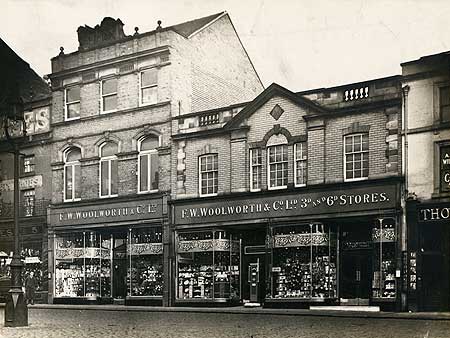 Hanley Woolworths 1920s
 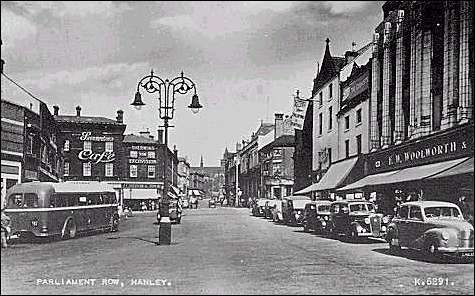 Hanley Woolworths 1950s
 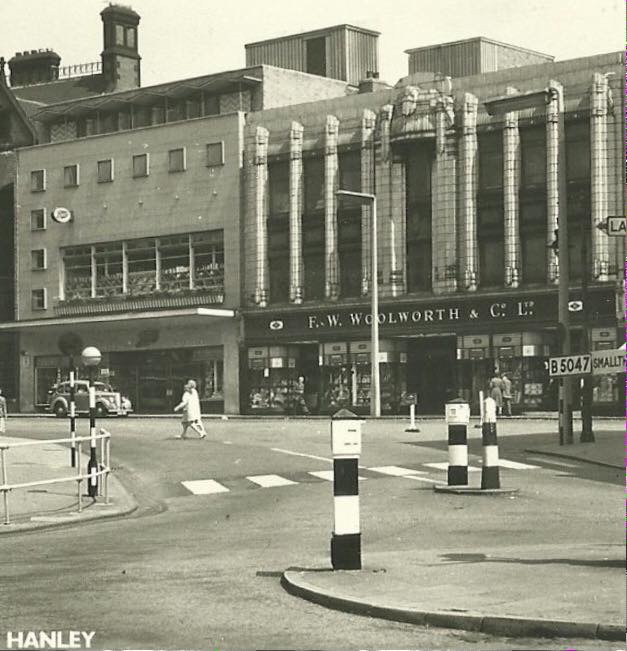 Hanley Woolworths 1950s
  Hanley Woolworths 1958
 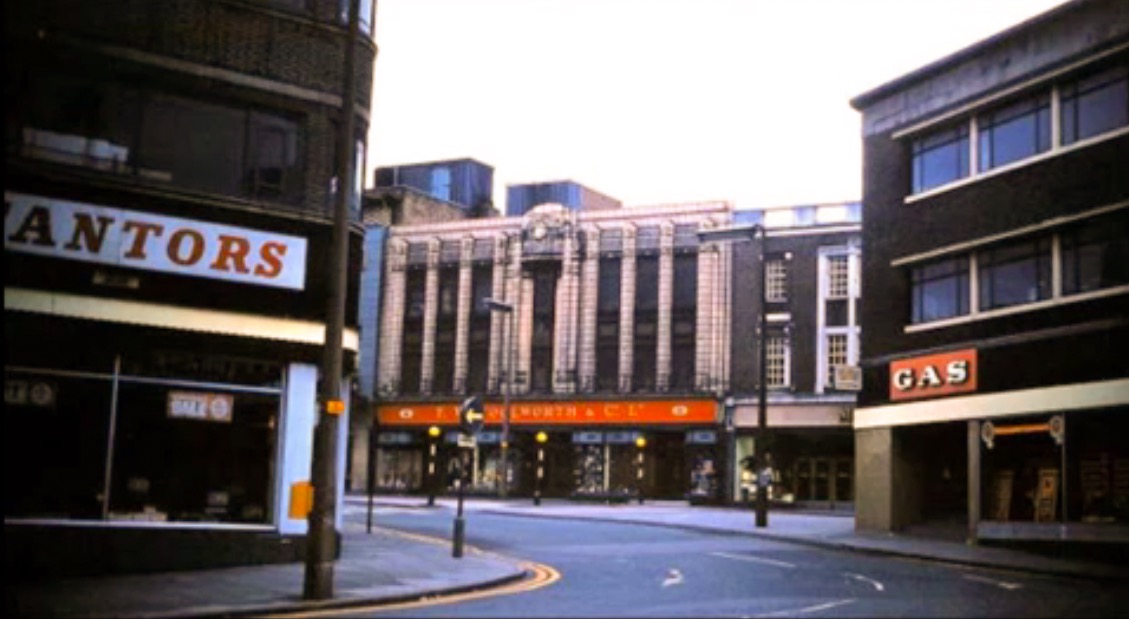 Hanley Woolworths 1960s
  North Staffordshire Heritage