The Great Wind brought destruction and death to the Mersey Estuary.
Between Sunday, January 6th and Thursday, January 10th, 1839, a hurricane known as ‘the great wind’ swept across the British Isles leaving a trail of death and destruction.
Small boats and ocean-going sailing vessels were blown onto sandbanks in the Mersey Estuary. Many were broken up by high waves before steam tugs could reach them. Passengers and crews were forced to take to the lifeboats. Most were rescued, but over 100 men, women and children were drowned.
As it swept across Cheshire, the hurricane destroyed farmhouses and uprooted trees. Particles of salt were blown along village streets. Buildings, hedgerows and fields were covered with a layer of white salt, giving the impression that there had been a heavy frost.
When the hurricane hit North Staffordshire, gale-force winds caused extensive damage.
A 130-foot-high chimney at Apedale was blown down. Streets in Newcastle-under-Lyme were blocked by falling masonry, and windmills in the Potteries lost their sails.
The galleries in Christ Church, Tunstall, were destroyed when pinnacles on the church tower were blown down and fell through the roof. At Chell, the wind blew the roof off the new workhouse that was being built for the Wolstanton and Burslem Union.
Note: The Great Wind is one of a series of articles written by Betty Martin before her death. Other articles from the series will be posted from time to time.
Between 1842 and 1870, law and order in Hanley was maintained by Staffordshire’s county police force.
Although Hanley and Shelton, the two largest townships in the Potteries, amalgamated in 1857 to form the Borough of Hanley, the borough did not obtain its own police force until 1870.
Stanford Alexander was appointed chief constable. He had 35 police officers to maintain law and order in a town that had a population of 41,000. His officers worked three overlapping shifts, two 12-hour shifts during the day and one nine-hour shift at night. Despite the long hours worked, pay was low. Constables earned 21 shillings a week. Sergeants were paid 25 shillings, and inspectors received 30 shillings.
When Alexander retired in 1875, Herbert Windle was made chief constable. Windle improved pay and working conditions for his officers. He persuaded the town’s Watch Committee to give them a library and a recreation room, with a billiard table, where they could relax when they came off duty.
By the late 1870s, Hanley had become the Potteries’ commercial and cultural centre. Trains and trams brought people from neighbouring towns to its shops and markets, music halls and theatres.
On Saturday nights, Henley’s criminal fraternity made its way to the town centre. Children begged outside shops or stole from market stalls. Drunken brawls broke out in public houses. Gangs roamed the streets looking for a fight. Prostitutes accosted men in Piccadilly. Pickpockets mingled with the crowds in Fountain Square, and robbers lurked in dark alleys waiting to pounce on their victims.
Robbery and theft were indictable offences. They had to be tried in Stafford before the Assize Court or at Quarter Sessions.
Police officers and witnesses were forced to travel to Stafford. They had to wait outside the courtrooms in the Shire Hall until called to give evidence. Unwilling to make the journey, many victims of crime refused to prosecute offenders.
Law and order in Hanley were breaking down. The borough council requested Queen Victoria to grant the town its own Quarter Sessions. She granted the request. The borough’s Quarter Sessions held its first sitting on January 19, 1881. There were eight defendants, three of whom were illiterate.
Note: Law Enforcement in Hanley is one of a series of articles written by Betty Martin before her death. Other articles from the series will be posted from time to time.
William Frederick Horry, born in 1843, was a charismatic yet ruthless killer who owned Burslem’s George Hotel. After a tumultuous marriage, he shot his estranged wife, Jane. Convicted of murder, he was sentenced to death and hanged on April 1, 1872, at Lincoln Castle Prison.
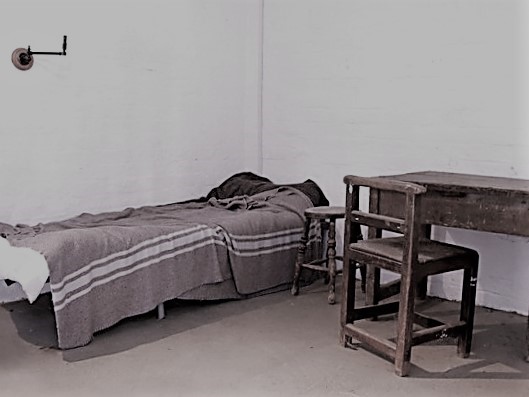
The condemned cell at Lincoln Castle Prison where William Horry spent his last days.
Despite his superficial charismatic charm, William Frederick Horry, the landlord of Burslem’s George Hotel, was a cold-blooded, ruthless killer.
Born on November 17th, 1843, in Boston, Lincolnshire, he was the son of William Horry, senior, a successful brewer.
When he left school, young William became a trainee manager at Parker’s Brewery in Zion Street, Burslem. He lived at the George Hotel in Nile Street, where he fell in love with Jane Wright, the hotel’s barmaid.
Jane left the George Hotel and went to work at the Sneyd Arms Hotel in Tunstall. William realised he could not live without her. He asked her to marry him. She consented, and William’s father gave them £800 to buy the George Hotel. The couple married in 1867 and had three children.
William who was a heavy drinker convinced himself that Jane was flirting with male customers. At night, he walked the streets looking for prostitutes or drinking with criminals in back street beer houses.
William’s father and Jane’s brother Thomas, a solicitors clerk, came to Burslem to find out why the marriage had failed. William told them Jane had committed adultery with three of the town’s leading citizens. When the two men investigated the allegation, they discovered that William had lied to them.
William and Jane separated in March 1871. She took the children and went to live with his father in Boston. William sold the George Hotel and went to Nottingham.
He visited Boston and asked Jane to take him back. She refused, and William started divorce proceedings, claiming she had committed adultery with five men.
While waiting for the case to be heard, William bought expensive clothes and often visited the Potteries. Early in January 1872, he stayed for a week visiting brothels in Hanley and drinking with friends in Burslem.
On Saturday, January 13, William returned to Nottingham, where he bought a revolver and a hundred cartridges.
William left Nottingham and went to Boston, where he visited his father’s home where Jane was living. She invited him into the house. He followed her along the passage leading to the breakfast room. As she entered the room, William pulled out the gun and shot her in the back. The bullet passed through her left rib and penetrated her lung. Jane died a few minutes later. William was detained by members of his family, who called the police. He was arrested and charged with murder.
William’s friends in Burslem launched a public appeal to pay for his defence.
He was tried at Lincoln Assizes on March 13 and pleaded “Not Guilty”. His trial lasted three hours. The jury took 15 minutes to convict him.
William stood in the dock and watched Mr Justice Quain don the Black Cap before sentencing him to death. He was taken to Lincoln Castle Prison and hanged on Easter Monday, April 1st, 1872.


 North Staffordshire Heritage