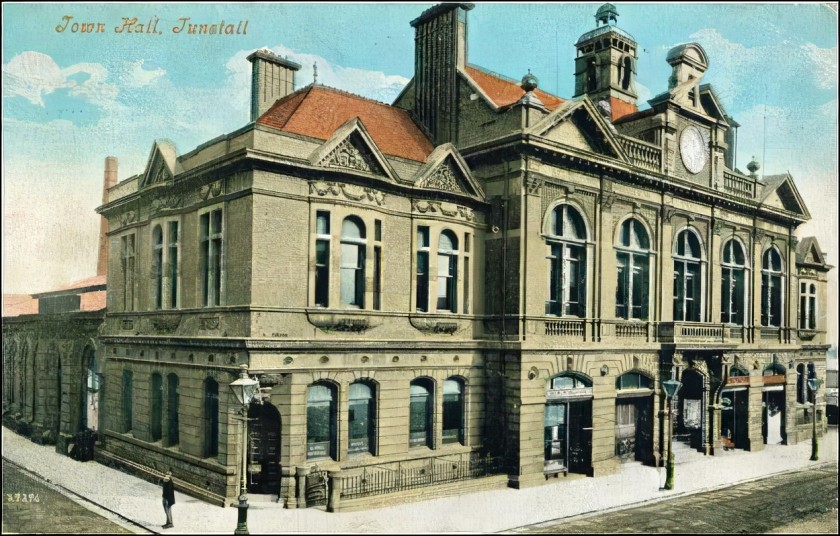
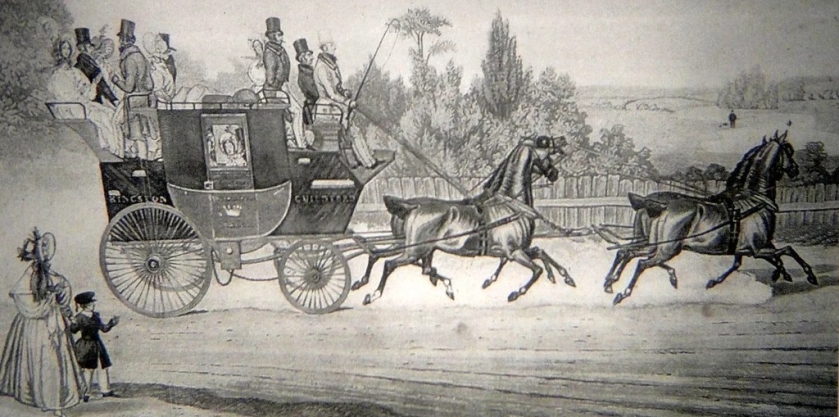
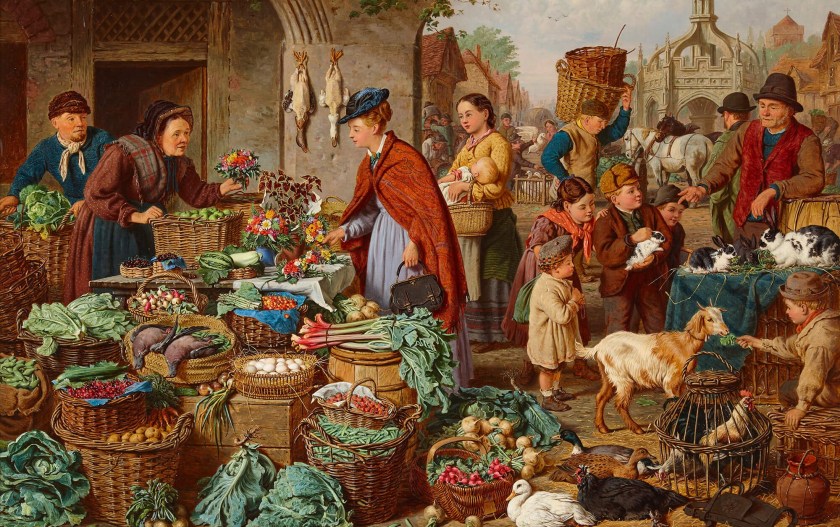
In his Romance of Staffordshire (Published in the 1870s), Henry Wedgwood describes the Swan Inn, a coaching inn where stagecoaches to London, Birmingham, Manchester and Liverpool stopped to pick up passengers.He writes:
It is wonderful how soon public buildings pass from memory. How completely the “Old Swan Inn”, Hanley, is now buried in the past and, along with the memory of those who met to socialise under its roof.
The old inn was a large building with strange-looking wings and gable ends, with square-built chimneys and gothic windows, some of them exceedingly small and mullioned by heavy stonework. There were iron palisades at the front of the inn and an extensive bowling green at the rear. The front entrance was covered by a flat canopy supported by stone pillars.
Inside there were queer, old, little rooms with chimney nooks and ancient screens that told of bygone days. There was one large room used by local clubs and for civic celebrations where speeches were made about the state of the pottery industry.
One of the rooms at the rear of the inn had a large bay window that overlooked the bowling green. In this room, the magistrates held petty sessions to try summary offences. They sent those suspected of committing indictable offences for trial at Quarter Sessions or the Assize Courts, which sat in the Shire Hall at Stafford.
Hanley’s bullring, where bulls were baited on Sundays, was near the Cock Inn at Far Green. Henry Wedgwood, in his Romance of Staffordshire, says the bullring was a place where ” some poor animal was attacked by dogs” and tortured by men. He writes:
Bull baiting was organised by men who frequented the Cock Inn, a small tavern with a thatched roof.
Writing about bull baiting, Wedgwood asks his readers to picture an infuriated bull made fast to a stake or a ring driven into the ground. The bullring was surrounded by hundreds of people – both men and women. Standing in front of the crowd were men restraining snarling dogs struggling to break free and attack the bull.
Spectators were betting on which dog would bring the bull to its knees. There were excited shrieks from its supporters when the dog they had bet on was sent into the ring. They cheered if the dog’s teeth tore flesh from the bull’s nose or another part of its body.
During the winter months, when bull baiting took place in the late afternoon or early evening, the ring was lit by torches made from long pieces of pit rope resoaked in pitch.
According to Wedgwood, the crowd surrounding the bullring was a drunken rabble that included colliers whose faces were as black as midnight and potters wearing leather aprons and breaches.
When the bull collapsed with exhaustion, its tormentors, egged on by the spectators, attempted to force it to get up by prodding it with sharp spikes or pouring hot tar onto the most tender parts of its body.
Between 1842 and 1870, law and order in Hanley was maintained by Staffordshire’s county police force.
Although Hanley and Shelton, the two largest townships in the Potteries, amalgamated in 1857 to form the Borough of Hanley, the borough did not obtain its own police force until 1870.
Stanford Alexander was appointed chief constable. He had 35 police officers to maintain law and order in a town that had a population of 41,000. His officers worked three overlapping shifts, two 12-hour shifts during the day and one nine-hour shift at night. Despite the long hours worked, pay was low. Constables earned 21 shillings a week. Sergeants were paid 25 shillings, and inspectors received 30 shillings.
When Alexander retired in 1875, Herbert Windle was made chief constable. Windle improved pay and working conditions for his officers. He persuaded the town’s Watch Committee to give them a library and a recreation room, with a billiard table, where they could relax when they came off duty.
By the late 1870s, Hanley had become the Potteries’ commercial and cultural centre. Trains and trams brought people from neighbouring towns to its shops and markets, music halls and theatres.
On Saturday nights, Henley’s criminal fraternity made its way to the town centre. Children begged outside shops or stole from market stalls. Drunken brawls broke out in public houses. Gangs roamed the streets looking for a fight. Prostitutes accosted men in Piccadilly. Pickpockets mingled with the crowds in Fountain Square, and robbers lurked in dark alleys waiting to pounce on their victims.
Robbery and theft were indictable offences. They had to be tried in Stafford before the Assize Court or at Quarter Sessions.
Police officers and witnesses were forced to travel to Stafford. They had to wait outside the courtrooms in the Shire Hall until called to give evidence. Unwilling to make the journey, many victims of crime refused to prosecute offenders.
Law and order in Hanley were breaking down. The borough council requested Queen Victoria to grant the town its own Quarter Sessions. She granted the request. The borough’s Quarter Sessions held its first sitting on January 19, 1881. There were eight defendants, three of whom were illiterate.
Note: Law Enforcement in Hanley is one of a series of articles written by Betty Martin before her death. Other articles from the series will be posted from time to time.
During the 18th century, Hanley and Shelton became the most important towns in the Potteries.
Between 1762 and 1801, their populations increased from 2,000 to 7,940. Hanley’s first church, St. John’s, was erected in 1738 and enlarged in the 1760s. Stage coaches called at the Swan Inn. Horse-drawn wagons carried pottery to the Weaver Navigation at Winsford and returned carrying ball clay and household goods.
A covered market, designed by architect James Trubshaw, was built on Town Road in 1776.
The Trent and Mersey and the Caldon Canals stimulated economic expansion. Entrepreneurs opened factories, collieries and ironworks. Families from the surrounding countryside flocked to Hanley and Shelton looking for work. New houses were built to accommodate them.
In 1791, a trust was formed to manage the market and build a town hall. The trustees leased land in Market Square, where they erected a town hall. Markets were held on Wednesdays and Saturdays. A fortnightly cattle market was established at the beginning of the 19th century. In 1813, Parliament gave the trustees the power to regenerate Market Square. They demolished the town hall, replacing it with a poultry market. A lockup was also built where those arrested were held before being brought to court.
In 1895, the first known women’s association football team, the British Ladies Football Club, was formed in London. Nettie Honeyball was the team’s captain, and Lady Florence Dixie (a Scottish aristocrat, writer and feminist) was the club’s patron.
Our photograph shows a ladies’ football team in the 1950s.
During the 19th century, there were numerous springs, called wells, on the slopes of Mow Cop from which local people obtained their water supply.
In his book “Mow Cop and its Slopes” published in 1907, W. J. Harper describes the Corda Well – a spring that never ran dry.
Not far from Mow Cop is a little well, about 2ft in diameter, which was never known to be dry. The water always bubbles up in summer or winter, seedtime or harvest.
About 30 years ago, there was a drought. The cows were moaning in the fields, and the sheep were bleating in the mountain meadows for want of water. This little well, all the while, supplied the inhabitants with water for many miles around. At three o’clock in the morning, people came for water bringing buckets, tubs and various utensils to carry the precious liquid. Although a small well, its water supply was never exhausted but flowed on and continues to flow.
William Frederick Horry, born in 1843, was a charismatic yet ruthless killer who owned Burslem’s George Hotel. After a tumultuous marriage, he shot his estranged wife, Jane. Convicted of murder, he was sentenced to death and hanged on April 1, 1872, at Lincoln Castle Prison.
The condemned cell at Lincoln Castle Prison where William Horry spent his last days.
Despite his superficial charismatic charm, William Frederick Horry, the landlord of Burslem’s George Hotel, was a cold-blooded, ruthless killer.
Born on November 17th, 1843, in Boston, Lincolnshire, he was the son of William Horry, senior, a successful brewer.
When he left school, young William became a trainee manager at Parker’s Brewery in Zion Street, Burslem. He lived at the George Hotel in Nile Street, where he fell in love with Jane Wright, the hotel’s barmaid.
Jane left the George Hotel and went to work at the Sneyd Arms Hotel in Tunstall. William realised he could not live without her. He asked her to marry him. She consented, and William’s father gave them £800 to buy the George Hotel. The couple married in 1867 and had three children.
William who was a heavy drinker convinced himself that Jane was flirting with male customers. At night, he walked the streets looking for prostitutes or drinking with criminals in back street beer houses.
William’s father and Jane’s brother Thomas, a solicitors clerk, came to Burslem to find out why the marriage had failed. William told them Jane had committed adultery with three of the town’s leading citizens. When the two men investigated the allegation, they discovered that William had lied to them.
William and Jane separated in March 1871. She took the children and went to live with his father in Boston. William sold the George Hotel and went to Nottingham.
He visited Boston and asked Jane to take him back. She refused, and William started divorce proceedings, claiming she had committed adultery with five men.
While waiting for the case to be heard, William bought expensive clothes and often visited the Potteries. Early in January 1872, he stayed for a week visiting brothels in Hanley and drinking with friends in Burslem.
On Saturday, January 13, William returned to Nottingham, where he bought a revolver and a hundred cartridges.
William left Nottingham and went to Boston, where he visited his father’s home where Jane was living. She invited him into the house. He followed her along the passage leading to the breakfast room. As she entered the room, William pulled out the gun and shot her in the back. The bullet passed through her left rib and penetrated her lung. Jane died a few minutes later. William was detained by members of his family, who called the police. He was arrested and charged with murder.
William’s friends in Burslem launched a public appeal to pay for his defence.
He was tried at Lincoln Assizes on March 13 and pleaded “Not Guilty”. His trial lasted three hours. The jury took 15 minutes to convict him.
William stood in the dock and watched Mr Justice Quain don the Black Cap before sentencing him to death. He was taken to Lincoln Castle Prison and hanged on Easter Monday, April 1st, 1872.
In the 1950s and 60s, self-service stores replaced local shops in town centres throughout North Staffordshire and South Cheshire.
If your family used self-service stores, please share your memories of shopping there with our readers. Tell them how self-service stores differed from High Street and corner shops.
To read the full post, click on “How England’s First Self-Service Store Heralded the Birth of the Modern Supermarket” below the photograph.
There was no M.P. for the town until 1832. The whole of the Potteries was formed into a constituency. It sent two members to Parliament. This early recognition showed that the six municipalities shared common interests. It marked the beginning of nearly eighty years of debate over unifying local government in the district.
To read the whole post, click on “Staffordshire Archives and Heritage” below.
Burslem is situated in the north-west of the City of Stoke-on-Trent, one of the six towns which form the City.
When it was recorded in the Domesday Book in 1086, Burslem was called Barcardeslim (Burgweard’s Lyme). It was not a large village consisting of just four households and one plough team. The other resource mentioned is two acres of alder wood. Its value was 10 shillings.
Through the medieval period, Burslem was not a centre of any importance. It was part of the parish of Stoke on Trent and was subject to the Tunstall manor court. A survey in 1563 reported 30 households for the area served by the chapel of St John. The village was agricultural and did not have good communications. However the occupants of the poor farms had beneath their feet mineral resources, which over the next two centuries produced steady growth turning Burslem into…
Until they closed in 2009, Woolworth’s stores dominated the High Street in many towns and cities.
Affectionately known as “Woolies”, they sold a wide range of goods. These included children’s toys, ladies’ clothes, chocolate, tins of paint, and cutlery. Prices were reasonable and Woolworth’s attracted customers from all walks of life. Did you and your family shop at a Woolworth’s’ store in North Staffordshire or South Cheshire? Please share your memories of shopping there with us.