Goldenhill in the 1790s

A Description of the Country From Thirty to Forty Miles Round Manchester, a book published in 1795, was compiled by Dr John Aikin. The book tells us about Newcastle-under-Lyme and North Staffordshire’s pottery towns and villages in the 1790s.

This edited extract from the book describes Goldenhill as it was in the 1790s.

One would imagine from its name that Goldenhill is a large, splendid place. But names can be deceptive. In fact, Goldenhill is the smallest village in the Potteries.

Nonetheless, the valuable coal mines, which gave the village its name, make ample amends for its deficiencies.

At the upper [North] end of the village is Green Lane, which commands an extensive view of the surrounding areas. On one side of the lane, the Cheshire Plain can be seen with the Welsh Hills in the distance. On the other side, there is the best view of the Potteries and the countryside beyond it.

Arthur’s Memories of Victorian Tunstall

These shops in High Street, Tunstall, built in 1898, were designed by Absalom Reade Wood. Many local historians believe that Absalom was North Staffordshire’s leading architect.

In 1935, Arthur Cotton shared his memories of late Victorian Tunstall with a Sentinel reporter.

Arthur, who was born at Goldenhill in 1857, became an estate agent with an office in Market Square (Tower Square). He and his wife, Gavina, lived in Tunstall. They had six children – four boys and two girls. The family were Methodists. They worshiped at the Wesleyan Methodist Church in Wesley Place (Wesley Street).

Arthur took a keen interest in local politics and joined the Liberal Party. He became a Staffordshire County Councillor and an Urban District Councillor in Tunstall.

From 1905 to 1907, he was chairperson of the Urban District Council.

Arthur opposed the scheme to amalgamate the six towns and create the County Borough of Stoke-on-Trent. He believed it would undermine local democracy by transferring power from councillors to senior local government officials.

A man with a retentive memory, Arthur was a local historian. He told the Sentinel what Tunstall was like during the latter part of the 19th century, saying:

During the past 70 years or so, the district has changed beyond all recognition. The Tunstall of my boyhood days was an industrial town of small pottery factories. Many of them have long since disappeared, giving way to an industrial era that demands fewer factories, but bigger ones.

Many small collieries were scattered throughout the district. There were collieries at Goldenhill, Clanway, Newfield, Greenfield, Scotia and on the slopes leading up to High Lane… All these have ceased to exist because of flooding.

There were hardly any public buildings in the town. The old town hall stood in the centre of Market Square [Tower Square].

Much of the land now occupied by streets, houses, and factories was open country. The public library was built in Phoenix Park, which local people called Cope’s Running Ground. The Memorial Gardens were laid out in the park.

(Edited by the History Factory 30.05.2025)

The Potteries in the 1790s

A Description of the Country From Thirty to Forty Miles Round Manchester, a book published in 1795, was compiled by Dr John Aikin. The book tells us about Newcastle-under-Lyme and North Staffordshire’s pottery towns and villages in the 1790s.

This edited extract from the book describes the Potteries in the 1790s.

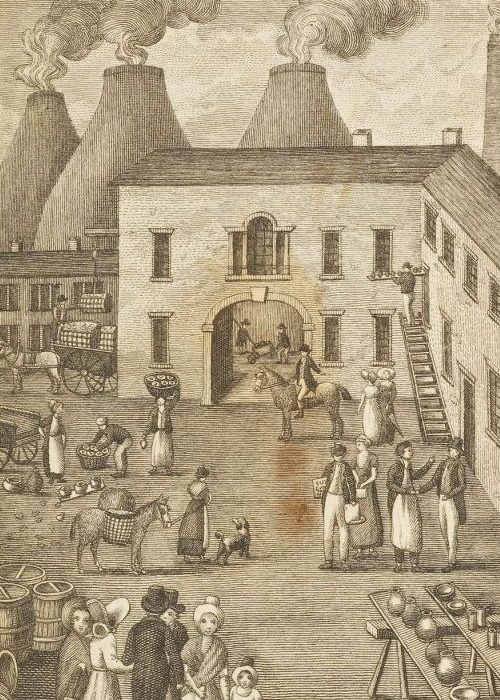
The Staffordshire Potteries commence about a mile from the Cheshire border at a village called Goldenhill.

From there it extends to Lane End [Longton], a distance of more than seven miles. Many of the towns and villages that form the Potteries are linked by houses and factories. The traveller is left with the impression that he is journeying through one town with different names. Manufacturing pottery is the primary business of this extensive and populous area. It is believed that the number of inhabitants or houses has increased threefold over the last twenty years. The towns and villages that make up the Potteries are likely to merge to create one town with one name. Many people who live nearby already call the area The Pottery.

A Polluted Stream at Birchenwood

Showing a stream polluted by water from old coal and iron stone mines and fly tipping next to the route followed by the North Staffordshire Railway's 'loop line' at Birchenwood nr. Kidsgrove (1994).

This image was taken at Birchenwood near Kidsgrove in 1994. It shows a polluted stream. The stream ran next to the route followed by the North Staffordshire Railway Company’s ‘loop line’. The line closed in the 1960s. It ran from Etruria to Kidsgrove. There were stations at Hanley, Waterloo Road, Cobridge, Burslem, Tunstall, Pitts Hill and Goldenhill.

Daimler buses ran from Mow Cop to Tunstall

After the First World War, former soldiers and sailors set up small bus companies and ran bus services from towns and villages on the North Staffordshire Coalfield to Tunstall.
A forty-horsepower Daimler Bus

In 1914, the Potteries Electric Traction Company started running bus services from Biddulph and Mow Cop to Tunstall, using forty-horsepower Daimler Buses.

During the First World War (1914-1918), the government requisitioned the buses and services were suspended. The buses were sent to France, where they were used to take troops to the front line. When the war ended, the buses were returned to the company, and the services resumed.

After the First World War, former soldiers and sailors formed bus companies. The companies ran services to Tunstall that competed with those run by the Potteries Motor Traction Company.

Rowbotham’s was a bus company with a garage in Sands Road, Harriseahead. The firm ran a service from The Bank, a hamlet in South Cheshire, to Tunstall. Its buses ran through Mount Pleasant, Dales Green, The Rookery, Whitehill, Newchapel Packmoor, Chell and Pitts Hill.

The Potteries Electric Traction Company operated another service from The Bank to Tunstall. Its route ran through Mount Pleasant, Dales Green, The Rookery, Whitehill, Kidsgrove, Goldenhill and Sandyford.

Stanier’s was a bus company based in Newchapel. It ran a service from Mow Cop to Tunstall via Harriseahead, Newchapel, Packmoor, Chell and Pitts Hill.

St. John’s Church, Goldenhill

After watching this video, we are asking ourselves whether Stoke-on-Trent City Council cares about our city’s heritage or realises the role heritage buildings can play in revitalising the declining economy of a post-industrial area?

Tunstall Was a Prosperous Town

In the 1830s, Tunstall was a prosperous industrial and market town.

There were 17 firms manufacturing pottery. Twelve made earthenware. Three produced earthenware and china. Two manufactured china figures and Egyptian blackware.

The Trent & Mersey Canal ran through the Chatterley Valley. In the valley, there were two brick and tile works. There was a factory making chemicals at Clayhills and a coal wharf on the banks of the canal. Coal and ironstone were mined at Newfield and Clanway.

The east side of Liverpool Road (High Street) from the Highgate Inn to the Old Wheatsheaf Inn had been developed. There were shops on Liverpool Road and in Market Place (Tower Square) where a market was held on Saturdays.

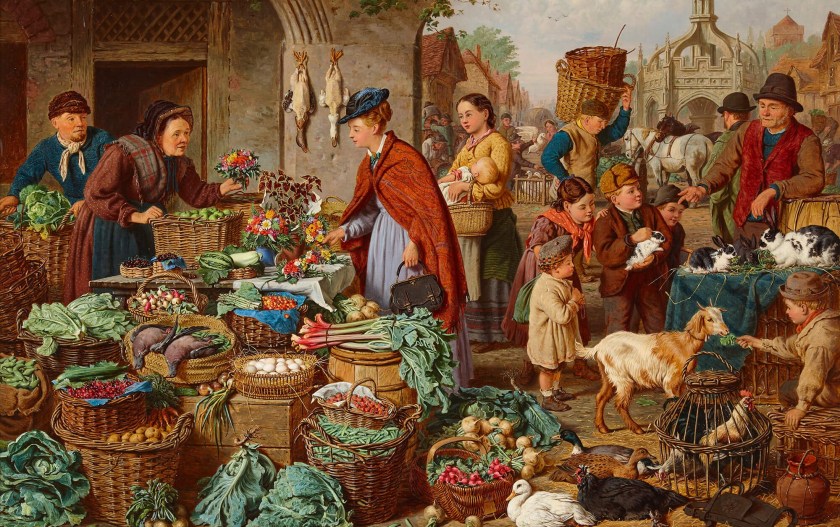
A typical 19th-century market where green grocers displayed fruit and vegetables in wicker baskets.

The market opened early in the morning and closed late at night. It was a bustling market with stalls selling a wide range of goods, including household items, furniture, shoes, and clothing. Green grocers sold fruit and vegetables. Farmers’ wives had stalls in the Market Hall, where they sold eggs, butter and cheese. Between the Market Hall and Liverpool Road were stalls selling meat, fish and poultry.

Saturday was the busiest day of the week for shopkeepers and innkeepers. The market attracted customers from Butt Lane, Kidsgrove, Mow Cop, Harriseahead, Packmoor, Biddulph, Chell and Goldenhill.

Copyright David Martin 2023

NSH2023/Revised2025