| There is widespread public support in Tunstall for Stoke-on-Trent City Council’s proposed multi-million-pound scheme to change the character of the town centre. A public consultation was held recently. Seventy-six per cent of the people who took part in it believe the changes proposed for High Street, Tower Square, Butterfield Place and The Boulevard will benefit the town and make it more attractive. The proposed changes are designed to improve accessibility, attractiveness and sustainability, while celebrating Tunstall’s distinct heritage. The two most popular proposals were those for Tower Square and Butterfield Place. Plans for Tower Square include planting new trees, laying new paving and providing new seating. The existing parking spaces will be removed, and new parking facilities will be created behind the clock tower. There will be room for an outdoor market in Butterfield Place and a green space where children can play. Many people want to see the High Street improved. Proposals for High Street include widening the pavements around the town hall and reducing traffic speed to 20mph to make the area safer and more attractive. Councillor Gordon-McCusker, cabinet member for transport, infrastructure and regeneration at Stoke-on-Trent City Council, said the proposals were part of a package of measures aimed at improving the town centre. The improvements will cost £4.6 million. The council hopes to start work on the project early next year. |
Tag: High Street
Furlong Road in the 1850s
Scarratt’s Tunstall
Furlong Road ran from High Street, Tunstall, to Greenfield, an industrial village near Pitts Hill. The road was narrow and overhung with laburnum and other trees.
In his book Old Times in the Potteries (published in 1906), William Scarratt describes the road in the 1850s.
In 1854, Furlong Road was like a country lane. The oak and other trees surrounded Greengates House, which Mr William Adams built in the 18th century. These trees were quite leafy. Rooks built their nests in them, and wild ducks sported on the pool in front of the house. At the back of the house were large trees where rooks cawed noisily in the spring. Little birds built nests in the hedgerows below the church – I have found them there. Nobody today would believe that harriers or beagles were kept at this house. But that is a fact. The owner of the house was fond of sport. I met them on the road to school in Newchapel. One of my school fellows, the owner’s son, has followed them, so he said. The road ran from High Street to Greenfield. It was narrow and overhung in some places with laburnum and other trees.
Edited by The History Factory (2024)
Tunstall Was a Prosperous Town
In the 1830s, Tunstall was a prosperous industrial and market town.
There were 17 firms manufacturing pottery. Twelve made earthenware. Three produced earthenware and china. Two manufactured china figures and Egyptian blackware.
The Trent & Mersey Canal ran through the Chatterley Valley. In the valley, there were two brick and tile works. There was a factory making chemicals at Clayhills and a coal wharf on the banks of the canal. Coal and ironstone were mined at Newfield and Clanway.
The east side of Liverpool Road (High Street) from the Highgate Inn to the Old Wheatsheaf Inn had been developed. There were shops on Liverpool Road and in Market Place (Tower Square) where a market was held on Saturdays.
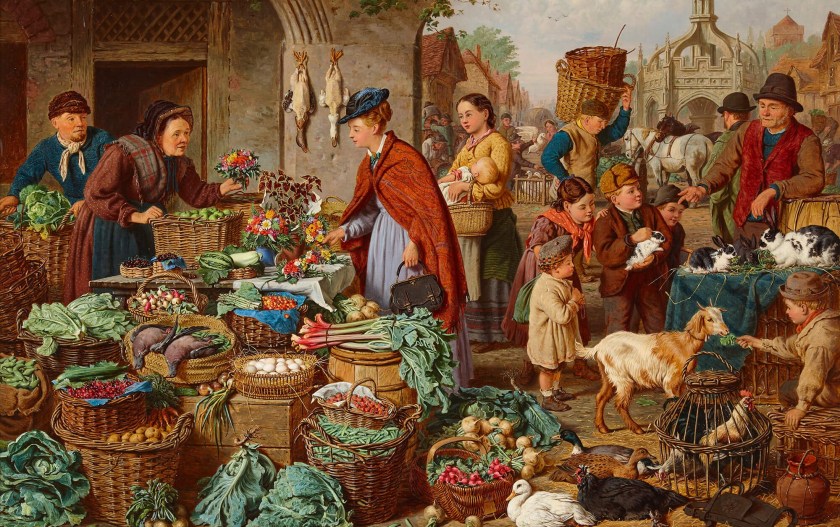
The market opened early in the morning and closed late at night. It was a bustling market with stalls selling a wide range of goods, including household items, furniture, shoes, and clothing. Green grocers sold fruit and vegetables. Farmers’ wives had stalls in the Market Hall, where they sold eggs, butter and cheese. Between the Market Hall and Liverpool Road were stalls selling meat, fish and poultry.
Saturday was the busiest day of the week for shopkeepers and innkeepers. The market attracted customers from Butt Lane, Kidsgrove, Mow Cop, Harriseahead, Packmoor, Biddulph, Chell and Goldenhill.
Copyright David Martin 2023
NSH2023/Revised2025
Memory Lane – Woolworth’s Stores
Until they closed in 2009, Woolworth’s stores dominated the High Street in many towns and cities.
Affectionately known as “Woolies”, they sold a wide range of goods. These included children’s toys, ladies’ clothes, chocolate, tins of paint, and cutlery. Prices were reasonable and Woolworth’s attracted customers from all walks of life. Did you and your family shop at a Woolworth’s’ store in North Staffordshire or South Cheshire? Please share your memories of shopping there with us.
Email us at northstaffordshireheritage@outlook.com
To read the whole post, click on “8 Classic Features To Help You Recognise an Old Woolworth’s Store.” You will find it below the photograph.
High Street Shopping (1880-1980)
These photographs depict shops, shopkeepers, and shoppers from each decade, from the 1880s to the 1980s.
They illustrate a century of changing shopping habits and shop architecture.
To see these images, click on “100 Years of High Street Shopping from 1880 to 1980” below the photograph.
 North Staffordshire Heritage