| There is widespread public support in Tunstall for Stoke-on-Trent City Council’s proposed multi-million-pound scheme to change the character of the town centre. A public consultation was held recently. Seventy-six per cent of the people who took part in it believe the changes proposed for High Street, Tower Square, Butterfield Place and The Boulevard will benefit the town and make it more attractive. The proposed changes are designed to improve accessibility, attractiveness and sustainability, while celebrating Tunstall’s distinct heritage. The two most popular proposals were those for Tower Square and Butterfield Place. Plans for Tower Square include planting new trees, laying new paving and providing new seating. The existing parking spaces will be removed, and new parking facilities will be created behind the clock tower. There will be room for an outdoor market in Butterfield Place and a green space where children can play. Many people want to see the High Street improved. Proposals for High Street include widening the pavements around the town hall and reducing traffic speed to 20mph to make the area safer and more attractive. Councillor Gordon-McCusker, cabinet member for transport, infrastructure and regeneration at Stoke-on-Trent City Council, said the proposals were part of a package of measures aimed at improving the town centre. The improvements will cost £4.6 million. The council hopes to start work on the project early next year. |
Tag: Tower Square
It’s Friday Again
It’s Friday again. How quickly time flies.
We have had a busy week planning a series of talks and posts about Tunstall’s history. Our plans include talks about Tower Square, the Jubilee Buildings and the Memorial Gardens.
Have a good weekend. Relax and keep safe. We’ll see you again on Monday.
Arthur’s Memories of Victorian Tunstall

In 1935, Arthur Cotton shared his memories of late Victorian Tunstall with a Sentinel reporter.
Arthur, who was born at Goldenhill in 1857, became an estate agent with an office in Market Square (Tower Square). He and his wife, Gavina, lived in Tunstall. They had six children – four boys and two girls. The family were Methodists. They worshiped at the Wesleyan Methodist Church in Wesley Place (Wesley Street).
Arthur took a keen interest in local politics and joined the Liberal Party. He became a Staffordshire County Councillor and an Urban District Councillor in Tunstall.
From 1905 to 1907, he was chairperson of the Urban District Council.
Arthur opposed the scheme to amalgamate the six towns and create the County Borough of Stoke-on-Trent. He believed it would undermine local democracy by transferring power from councillors to senior local government officials.
A man with a retentive memory, Arthur was a local historian. He told the Sentinel what Tunstall was like during the latter part of the 19th century, saying:
During the past 70 years or so, the district has changed beyond all recognition. The Tunstall of my boyhood days was an industrial town of small pottery factories. Many of them have long since disappeared, giving way to an industrial era that demands fewer factories, but bigger ones.
Many small collieries were scattered throughout the district. There were collieries at Goldenhill, Clanway, Newfield, Greenfield, Scotia and on the slopes leading up to High Lane… All these have ceased to exist because of flooding.
There were hardly any public buildings in the town. The old town hall stood in the centre of Market Square [Tower Square].
Much of the land now occupied by streets, houses, and factories was open country. The public library was built in Phoenix Park, which local people called Cope’s Running Ground. The Memorial Gardens were laid out in the park.
(Edited by the History Factory 30.05.2025)
John Henry Clive’s Outlook on Life
John Henry Clive, an astute entrepreneur, founded the company that created Tunstall‘s Market Place (Tower Square) and built the first Market Hall. He believed time was money and too precious to waste.
In 1830, John wrote The Linear System of Short Hand, a practical textbook for students. One of the exercises in the book is called a Letter Against Waste of Time, in which he gives his philosophy of life.
LETTER AGAINST WASTE OF TIME
Converse often with yourself, and neither lavish your time, nor suffer others to rob you of it. Many of our hours are stolen from us, and others pass insensibly away; but of both these losses, the most shameful is that which happens through our own neglect. If we take the trouble to observe, we shall find, that one considerable part of our life is spent in doing evil, and the other in doing nothing, or in doing what we should not do. We do not seem to know the value of time, nor how precious a day is; nor do we consider, that every moment brings us nearer our end. Reflect upon this, I entreat you, and keep a strict account of time. Procrastination is the most dangerous thing in life. Nothing is properly ours but the instant we breathe in, and all the rest is nothing; it is the only good we possess, but then it is fleeting, and the first-comer robs us of it. Men are so weak, that they think they oblige by giving trifles, and yet reckon that time as nothing, for which the most grateful person in the world can never make amends. Let us, therefore, consider time as the most valuable of all things; and every moment spent without some improvement in virtue, or some advancement in goodness, as the greatest sublunary loss.
Tunstall’s First Market
John Henry Clive founded an unincorporated company that gave Tunstall a market hall and a Market Place (Tower Square).
He was born at Bath on 29 March 1781. After his father’s death, John and his mother, Sarah, came to live in Longton.
On 28 May 1793, Sarah married earthenware manufacturer Charles Simpson at St. Giles’ Church, Newcastle-under-Lyme.
John served an apprenticeship in the pottery industry. He married Lydia Cash on 30 September 1805 at St. Bartholomew’s Church, Norton-in-the Moors.
Shortly after John’s wedding, his stepfather, Charles Simpson, started making pottery at a factory in Sandyford.
Sarah and Charles left Longton and moved to Tunstall, where they lived at Newfield Hall. John and Lydia came to live with them. John managed the Newfield Estate for its owner, Admiral Smith Child, and went into partnership with him. They formed a company, Child & Clive. The firm mined coal and ironstone at Clanway Colliery and made earthenware at Newfield Pottery.
John was an astute entrepreneur. He realised Tunstall was a growing industrial town. A town that needed shops, a market square and a civic building containing a covered market and a courtroom, where Justices of the Peace could hold Petty Sessions (Magistrates’ Courts) and try minor criminal cases.
John formed a company to finance the project and sold its shares to local businesspeople. The company leased a plot of land, on a field called Stony Croft, for 500 years at an annual rent of £5 from Walter Sneyd, the Lord of the Manor, who lived at Keele Hall. Shares in the company cost £25 each. John bought one share. Walter bought eight, and Ralph Hall, the company’s treasurer, bought two.
Between 1816 and 1817, the company created Market Place, a market square surrounded by shops and erected a civic building. The building had two names until it became known as the Town Hall in the 1840s. The company called it the Courthouse, and the Sneyd family called it the Market Hall. In the late 1830s, Market Place’s name was changed to Market Square.
NSH-2o24(F)
Tunstall Was a Prosperous Town
In the 1830s, Tunstall was a prosperous industrial and market town.
There were 17 firms manufacturing pottery. Twelve made earthenware. Three produced earthenware and china. Two manufactured china figures and Egyptian blackware.
The Trent & Mersey Canal ran through the Chatterley Valley. In the valley, there were two brick and tile works. There was a factory making chemicals at Clayhills and a coal wharf on the banks of the canal. Coal and ironstone were mined at Newfield and Clanway.
The east side of Liverpool Road (High Street) from the Highgate Inn to the Old Wheatsheaf Inn had been developed. There were shops on Liverpool Road and in Market Place (Tower Square) where a market was held on Saturdays.
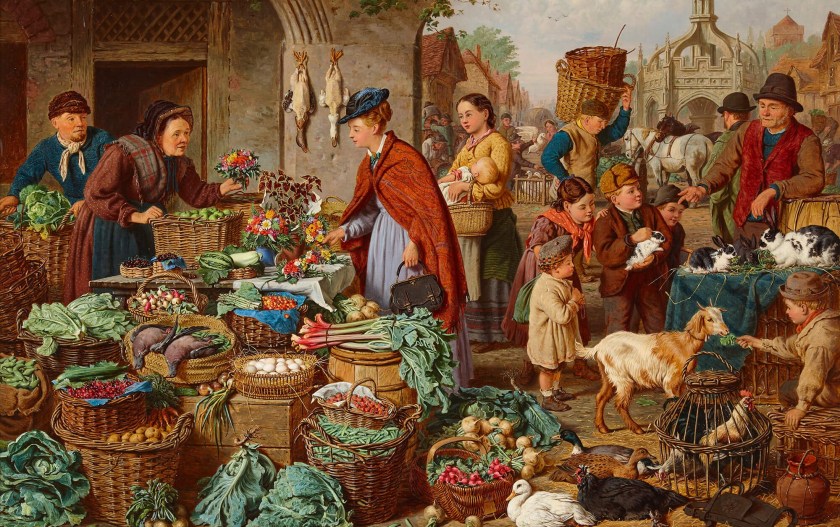
The market opened early in the morning and closed late at night. It was a bustling market with stalls selling a wide range of goods, including household items, furniture, shoes, and clothing. Green grocers sold fruit and vegetables. Farmers’ wives had stalls in the Market Hall, where they sold eggs, butter and cheese. Between the Market Hall and Liverpool Road were stalls selling meat, fish and poultry.
Saturday was the busiest day of the week for shopkeepers and innkeepers. The market attracted customers from Butt Lane, Kidsgrove, Mow Cop, Harriseahead, Packmoor, Biddulph, Chell and Goldenhill.
Copyright David Martin 2023
NSH2023/Revised2025
 North Staffordshire Heritage